give answer in 2 step with explanation at the end of each step and final answer at the end:Problema 1
Points:5
Due this Thursday, Nov 20 at 06:00 pm (AST
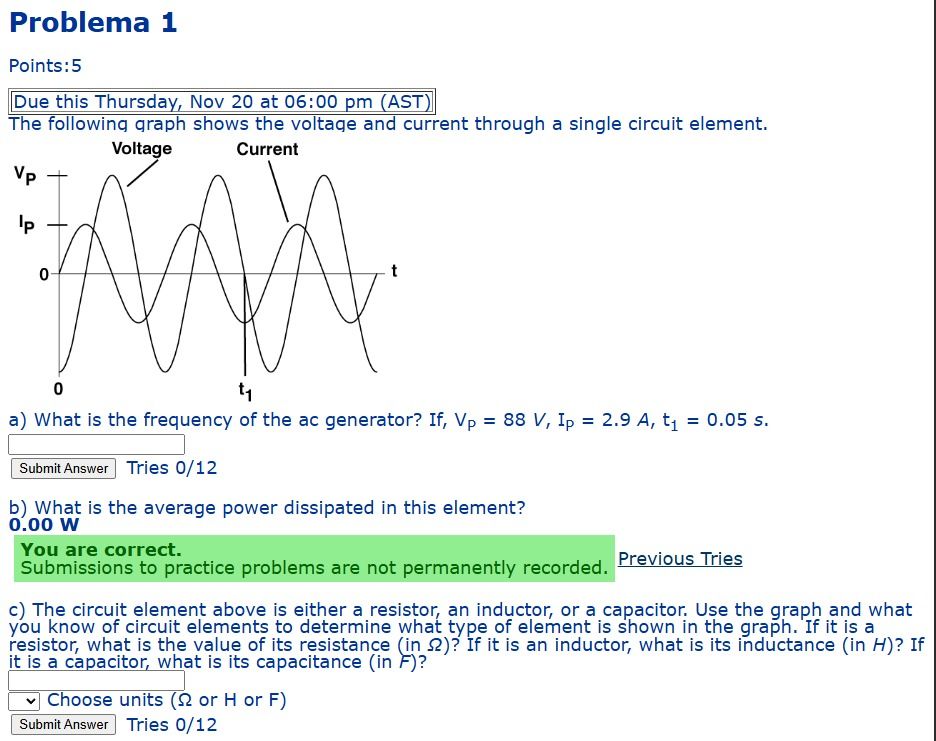
The following graph shows the voltage and current through a single circuit element.
Voltage Current
Vp / \
Ip
[1] t
0 ty
a) What is the frequency of the ac generator? If, Vp = 88 V, Ip = 2.9 A, t; = 0.05 s.
|
Tries 0/12
b) What is the average power dissipated in this element?
0.00 w
c) The circuit element above is either a resistor, an inductor, or a capacitor. Use the graph and what
you know of circuit elements to determine what type of element is shown in the graph. If it is a
resistor, what is the value of its resistance (in £2)? If it is an inductor, what is its inductance (in H)? If
itisa capacitor, what is its capacitance (in F)?
Choose units (Q or H or F)
Tries 0/12
Question:
give answer in 2 step with explanation at the end of each step and final answer at the end:Problema 1
Points:5
Due this Thursday, Nov 20 at 06:00 pm (AST
The following graph shows the voltage and current through a single circuit element.
Voltage Current
Vp / \
Ip
[1] t
0 ty
a) What is the frequency of the ac generator? If, Vp = 88 V, Ip = 2.9 A, t; = 0.05 s.
|
Tries 0/12
b) What is the average power dissipated in this element?
0.00 w
c) The circuit element above is either a resistor, an inductor, or a capacitor. Use the graph and what
you know of circuit elements to determine what type of element is shown in the graph. If it is a
resistor, what is the value of its resistance (in £2)? If it is an inductor, what is its inductance (in H)? If
itisa capacitor, what is its capacitance (in F)?
Choose units (Q or H or F)
Tries 0/12
This is AI generated Response.
Asked by: Rahul
Created at: 2025-11-18 08:26:44
Final Answer:
RenderedRaw Text
Did you like this answer?
Let's solve part (a):
### Step 1: Find the Period
From the graph, one complete cycle (period) is given from \( \) to \( t_1 \).
- The period \( T = t_1 = .05 \) s.
**Explanation:**
The period is the time taken for one complete cycle of the wave. According to the graph and the given value, \( t_1 \) represents the period.
---
### Step 2: Calculate the Frequency
The frequency \( f \) is the reciprocal of the period:
\[
f = \frac{1}{T}
\]
\[
f = \frac{1}{.05\, \text{s}} = 20\, \text{Hz}
\]
**Explanation:**
Frequency is calculated as the inverse of the period. Since the period is \( .05 \) s, the frequency is \( 20 \) Hz.
---
## **Final Answer:**
**The frequency of the AC generator is \( \boxed{20\, \text{Hz}} \).**
Question:
all parts solved please
This is AI generated Response.
Asked by: Rahul
Created at: 2025-11-18 08:27:18
Final Answer:
RenderedRaw Text
Did you like this answer?
## Problem 1
### Part (a): Frequency of the AC Generator
#### Step 1: Find the Period
From the graph, the time for one complete cycle (period) is given as \( t_1 = 0.05 \) s.
**Explanation:**
The period \( T \) represents the time taken for one complete cycle of the voltage and current waveform. In this case, it is provided directly.
---
#### Step 2: Calculate the Frequency
The frequency \( f \) is calculated using the formula:
\[
f = \frac{1}{T}
\]
Substituting the value of the period:
\[
f = \frac{1}{0.05\, \text{s}} = 20\, \text{Hz}
\]
**Explanation:**
Frequency is the number of cycles per second and is the inverse of the period. Here, substituting \( T \) gives us \( f = 20 \) Hz.
---
### Final Answer for Part (a):
**The frequency of the AC generator is \( \boxed{20\, \text{Hz}} \).**
---
### Part (b): Average Power Dissipated
#### Step 1: Calculate Average Power
The average power \( P \) in an AC circuit can be calculated using the formula:
\[
P = V_{\text{rms}} \times I_{\text{rms}} \times \cos(\phi)
\]
For resistive loads, \( \cos(\phi) = 1 \). First, we find \( V_{\text{rms}} \) and \( I_{\text{rms}} \):
\[
V_{\text{rms}} = \frac{V_p}{\sqrt{2}} = \frac{88\, \text{V}}{\sqrt{2}} \approx 62.2\, \text{V}
\]
\[
I_{\text{rms}} = \frac{I_p}{\sqrt{2}} = \frac{2.9\, \text{A}}{\sqrt{2}} \approx 2.05\, \text{A}
\]
**Explanation:**
The root mean square (rms) values are used to calculate the average power in AC circuits since these values represent effective voltage and current.
---
#### Step 2: Compute Average Power
Now, substituting the rms values into the power formula:
\[
P = 62.2\, \text{V} \times 2.05\, \text{A} \times 1 \approx 127.5\, \text{W}
\]
**Explanation:**
By multiplying the rms voltage and current, we obtain the average power dissipated in the circuit element.
---
### Final Answer for Part (b):
**The average power dissipated in this element is \( \boxed{127.5\, \text{W}} \).**
---
### Part (c): Determine the Type of Circuit Element
#### Step 1: Analyze the Waveform
The graph indicates that the voltage and current are in phase, suggesting a purely resistive load.
**Explanation:**
In a resistive circuit, the voltage and current waveforms peak at the same time, indicating no phase shift, which is characteristic of resistors.
---
#### Step 2: Calculate Resistance
Using Ohm's Law:
\[
R = \frac{V_p}{I_p} = \frac{88\, \text{V}}{2.9\, \text{A}} \approx 30.34\, \Omega
\]
**Explanation:**
Resistance can be calculated using the peak voltage and peak current, confirming that the circuit element is a resistor.
---
### Final Answer for Part (c):
**The circuit element is a resistor with a resistance of \( \boxed{30.34\, \Omega} \).**
VIPSolutions focuses on clear, step‑by‑step explanations so you can learn quickly. Whether you need an AI‑generated walkthrough or a short hint to get unstuck, each solution is organized for fast reading and easy review later.
Search similar questions, compare approaches, and bookmark the best answers for revision. Our goal is simple: quick, reliable study help that feels natural—not noisy.
 VIPSolutions
 Problema 1
Points:5
Due this Thursday, Nov 20 at 06:00 pm (AST
The following graph shows the voltage and current through a single circuit element.
Voltage Current
Vp / \
Ip
[1] t
0 ty
a) What is the frequency of the ac generator? If, Vp = 88 V, Ip = 2.9 A, t; = 0.05 s.
|
Tries 0/12
b) What is the average power dissipated in this element?
0.00 w
c) The circuit element above is either a resistor, an inductor, or a capacitor. Use the graph and what
you know of circuit elements to determine what type of element is shown in the graph. If it is a
resistor, what is the value of its resistance (in £2)? If it is an inductor, what is its inductance (in H)? If
itisa capacitor, what is its capacitance (in F)?
Choose units (Q or H or F)
Tries 0/12