give answer in 2 step with explanation at the end of each step and final answer at the end:of the itcm in terms of the original price x. you got is %
off
P(x) = (0.70)(0.85) (x)
=0.595¢
Ib A rain drop hirting a lake makes a circular ripple. If the
ralias, in inches, pows as a function of time in minutes
according to r(t) = 25 Via find the arca of the ripple as
a fanction of time. Find the arca of the ripple at = 2.
A= po
Al) = m25V 12)?
= 71%625(1 2)
=6257(t 2)
1 A(t) = 62571(t 2)
Artaet=2
A(2) = 6257(2,2)
= 625714
= 25007
1.250077 square inches or 7854 in 5
2. The radius r, inches, of a spherical bulloon is
Ty
rclaned the tholanc, V, by r(V) = —. Airis pumped
1 Arr
into the balloon, so the volume affer ¢ scoonds is given
by: V(t) = 10 20¢
sot, = 31020)
3 4m
"os 4m
b. Find the cxact time 2” hen the radius raches 10
inches.
r(v(1)) =10
10= ¥ 3(10 201)
7 4
1000 = 3(10 201)
4
40007t = 30 60¢
60r 40077 - 30
Question:
give answer in 2 step with explanation at the end of each step and final answer at the end:of the itcm in terms of the original price x. you got is %
off
P(x) = (0.70)(0.85) (x)
=0.595¢
Ib A rain drop hirting a lake makes a circular ripple. If the
ralias, in inches, pows as a function of time in minutes
according to r(t) = 25 Via find the arca of the ripple as
a fanction of time. Find the arca of the ripple at = 2.
A= po
Al) = m25V 12)?
= 71%625(1 2)
=6257(t 2)
1 A(t) = 62571(t 2)
Artaet=2
A(2) = 6257(2,2)
= 625714
= 25007
1.250077 square inches or 7854 in 5
2. The radius r, inches, of a spherical bulloon is
Ty
rclaned the tholanc, V, by r(V) = —. Airis pumped
1 Arr
into the balloon, so the volume affer ¢ scoonds is given
by: V(t) = 10 20¢
sot, = 31020)
3 4m
"os 4m
b. Find the cxact time 2” hen the radius raches 10
inches.
r(v(1)) =10
10= ¥ 3(10 201)
7 4
1000 = 3(10 201)
4
40007t = 30 60¢
60r 40077 - 30
This is AI generated Response.
Asked by: Rahul
Created at: 2025-12-11 02:59:46
Final Answer:
RenderedRaw Text
Did you like this answer?
Let's break down the last problem (the balloon radius) into **two steps**:
---
## **Step 1: Set up the equation for the radius**
Given:
- \( r(V) = \sqrt[3]{\frac{V}{4\pi}} \)
- \( V(t) = 10 \cdot 20t = 200t \)
So,
\[
r(V(t)) = \sqrt[3]{\frac{200t}{4\pi}}
\]
We want the radius to reach 10 inches:
\[
10 = \sqrt[3]{\frac{200t}{4\pi}}
\]
**Explanation:**
Here, we substituted the volume function into the radius formula and set it equal to 10 to find when the radius reaches 10 inches.
---
## **Step 2: Solve for \( t \)**
Cube both sides to remove the cube root:
\[
10^3 = \frac{200t}{4\pi}
\]
\[
100 = \frac{200t}{4\pi}
\]
Multiply both sides by \( 4\pi \):
\[
100 \times 4\pi = 200t
\]
\[
400\pi = 200t
\]
Divide both sides by 200:
\[
t = \frac{400\pi}{200}
\]
\[
t = 20\pi
\]
**Explanation:**
We solved for \( t \) by algebraic manipulation: cubing both sides and isolating \( t \).
---
## **Final Answer**
**The exact time when the radius reaches 10 inches is:**
\[
\boxed{20\pi}
\]
(seconds)
Question:
All parts solved please
This is AI generated Response.
Asked by: Rahul
Created at: 2025-12-11 03:00:25
Final Answer:
RenderedRaw Text
Did you like this answer?
Let's solve the entire problem step by step.
---
## **Part 1: Finding the Discounted Price**
### **Step 1: Set up the equation for price after discounts**
Given:
- Original price: \( x \)
- Discounts: 30% and 15%
The discounted price \( P(x) \) can be calculated as:
\[
P(x) = (1 - 0.30)(1 - 0.15)x
\]
This simplifies to:
\[
P(x) = (0.70)(0.85)x
\]
**Explanation:**
Here, we first convert the percentage discounts into decimal form (30% is 0.30 and 15% is 0.15) and calculate the remaining price after applying both discounts.
---
### **Step 2: Calculate the final price**
Calculating the final price:
\[
P(x) = 0.70 \times 0.85 \times x = 0.595x
\]
**Explanation:**
We multiplied the factors to find that the final price after both discounts is 59.5% of the original price.
---
## **Final Answer for Part 1**
The final price after applying the discounts is:
\[
\boxed{0.595x}
\]
---
## **Part 2: Area of the Ripple as a Function of Time**
### **Step 1: Set up the equation for the area of the ripple**
Given:
- Radius as a function of time: \( r(t) = 25\sqrt{t} \)
- Area formula: \( A = \pi r^2 \)
Substituting \( r(t) \):
\[
A(t) = \pi (25\sqrt{t})^2 = \pi \cdot 625t = 625\pi t
\]
**Explanation:**
We used the area formula and substituted the radius function to express the area as a function of time.
---
### **Step 2: Calculate the area at \( t = 2 \)**
Plugging \( t = 2 \) into the area function:
\[
A(2) = 625\pi \cdot 2 = 1250\pi
\]
**Explanation:**
We evaluated the area function at \( t = 2 \) to find the area of the ripple at that specific time.
---
## **Final Answer for Part 2**
The area of the ripple at \( t = 2 \) is:
\[
\boxed{1250\pi} \text{ square inches}
\]
---
## **Part 3: Finding Time for Balloon Radius to Reach 10 Inches**
### **Step 1: Set up the equation for the radius**
Given:
- Volume function: \( V(t) = 200t \)
- Radius formula: \( r(V) = \sqrt[3]{\frac{V}{4\pi}} \)
Substituting the volume into the radius formula:
\[
r(V(t)) = \sqrt[3]{\frac{200t}{4\pi}}
\]
Setting the radius to 10:
\[
10 = \sqrt[3]{\frac{200t}{4\pi}}
\]
**Explanation:**
We expressed the radius in terms of time and set it equal to 10 inches.
---
### **Step 2: Solve for \( t \)**
Cubing both sides:
\[
10^3 = \frac{200t}{4\pi} \implies 1000 = \frac{200t}{4\pi}
\]
Multiply both sides by \( 4\pi \):
\[
1000 \cdot 4\pi = 200t \implies 4000\pi = 200t
\]
Divide both sides by 200:
\[
t = \frac{4000\pi}{200} = 20\pi
\]
**Explanation:**
We manipulated the equation algebraically to isolate \( t \).
---
## **Final Answer for Part 3**
The exact time when the radius reaches 10 inches is:
\[
\boxed{20\pi} \text{ seconds}
\]
VIPSolutions focuses on clear, step‑by‑step explanations so you can learn quickly. Whether you need an AI‑generated walkthrough or a short hint to get unstuck, each solution is organized for fast reading and easy review later.
Search similar questions, compare approaches, and bookmark the best answers for revision. Our goal is simple: quick, reliable study help that feels natural—not noisy.
 VIPSolutions
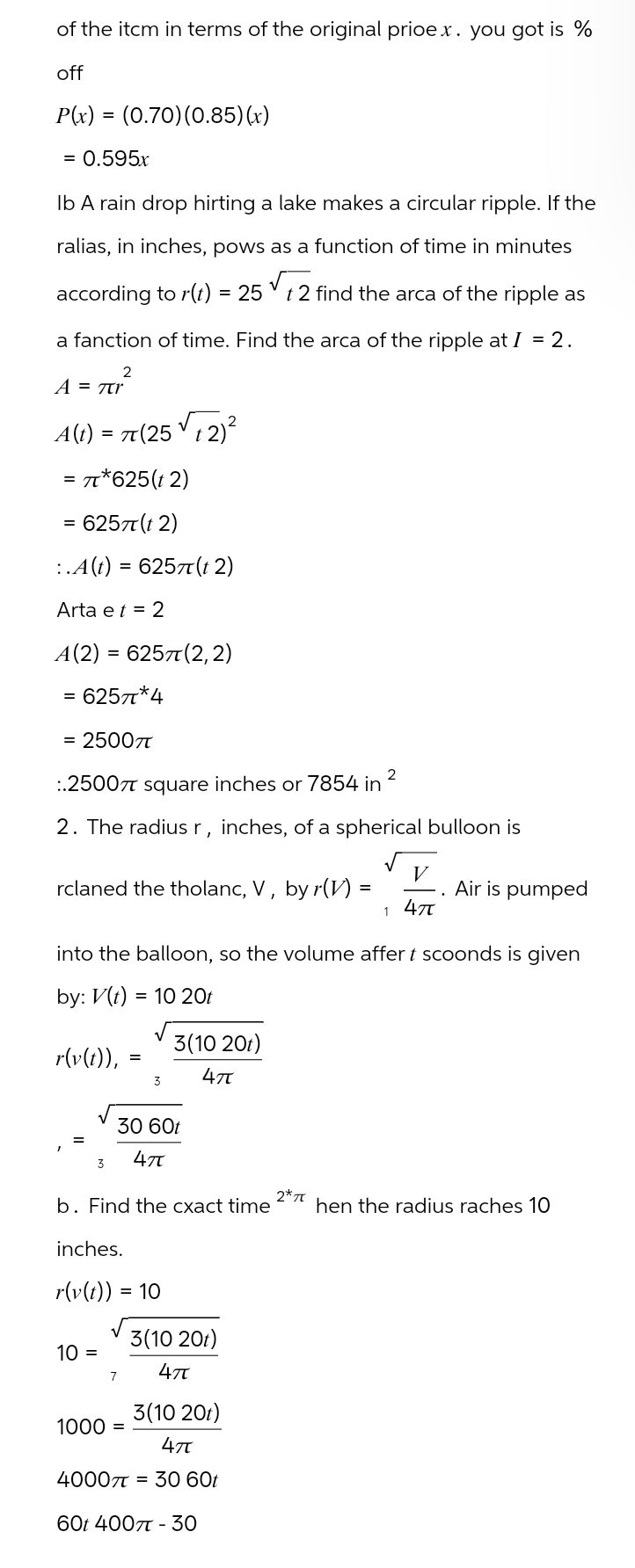 of the itcm in terms of the original price x. you got is %
off
P(x) = (0.70)(0.85) (x)
=0.595¢
Ib A rain drop hirting a lake makes a circular ripple. If the
ralias, in inches, pows as a function of time in minutes
according to r(t) = 25 Via find the arca of the ripple as
a fanction of time. Find the arca of the ripple at = 2.
A= po
Al) = m25V 12)?
= 71%625(1 2)
=6257(t 2)
1 A(t) = 62571(t 2)
Artaet=2
A(2) = 6257(2,2)
= 625714
= 25007
1.250077 square inches or 7854 in 5
2. The radius r, inches, of a spherical bulloon is
Ty
rclaned the tholanc, V, by r(V) = —. Airis pumped
1 Arr
into the balloon, so the volume affer ¢ scoonds is given
by: V(t) = 10 20¢
sot, = 31020)
3 4m
"os 4m
b. Find the cxact time 2” hen the radius raches 10
inches.
r(v(1)) =10
10= ¥ 3(10 201)
7 4
1000 = 3(10 201)
4
40007t = 30 60¢
60r 40077 - 30