 VIPSolutions
give answer in 2 step with explanation at the end of each step and final answer at the end:de] £ 8 3 ey its Se fis H = 1 El
Question:
give answer in 2 step with explanation at the end of each step and final answer at the end: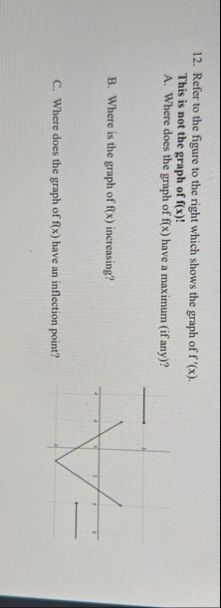 de]
£ 8 3
ey its
Se fis
H = 1
El
This is AI generated Response.
Asked by: Rahul
Created at: 2025-12-05 04:38:39
Asked by: Rahul
Created at: 2025-12-05 04:38:39
Final Answer:
Rendered
Raw Text
Did you like this answer?
Let's solve the problem step by step. The graph shown is **NOT** the graph of \( f(x) \), but of \( f'(x) \) (the derivative of \( f(x) \)).
---
### **Step 1: Maximum of \( f(x) \)**
**Question:** Where does the graph of \( f(x) \) have a maximum (if any)?
#### **Explanation:**
A maximum of \( f(x) \) occurs when \( f'(x) \) (the graph shown) changes from positive to negative (crosses the x-axis from above to below).
- From the graph, \( f'(x) \) crosses the x-axis at \( x = -1 \).
#### **Conclusion:**
- **At \( x = -1 \), \( f(x) \) has a maximum.**
---
### **Step 2: Where is \( f(x) \) increasing?**
**Question:** Where is the graph of \( f(x) \) increasing?
#### **Explanation:**
\( f(x) \) is increasing wherever \( f'(x) > \) (i.e., above the x-axis).
- From the graph, \( f'(x) \) is above the x-axis between \( x = -3 \) and \( x = -1 \).
#### **Conclusion:**
- **\( f(x) \) is increasing on the interval \( (-3, -1) \).**
---
### **Final Answers:**
**A.** The graph of \( f(x) \) has a maximum at \( x = -1 \).
**B.** The graph of \( f(x) \) is increasing on the interval \( (-3, -1) \).
Question:
All parts solved please
This is AI generated Response.
Asked by: Rahul
Created at: 2025-12-05 04:39:11
Asked by: Rahul
Created at: 2025-12-05 04:39:11
Final Answer:
Rendered
Raw Text
Did you like this answer?
# Analysis of the Graph of \( f'(x) \)
The graph provided represents the derivative \( f'(x) \) of a function \( f(x) \). We will analyze the graph to determine where \( f(x) \) has a maximum and where it is increasing.
---
## Step 1: Identifying Maximum of \( f(x) \)
### Question: Where does \( f(x) \) have a maximum?
#### Explanation:
A maximum of \( f(x) \) occurs when \( f'(x) \) transitions from positive to negative, indicating that the slope of \( f(x) \) is changing from increasing to decreasing.
- From the graph, we see that \( f'(x) \) crosses the x-axis at \( x = -1 \).
- Prior to \( x = -1 \), \( f'(x) \) is positive, and after \( x = -1 \), it is negative.
#### Conclusion:
- **At \( x = -1 \), \( f(x) \) has a maximum.**
---
## Step 2: Determining Where \( f(x) \) is Increasing
### Question: Where is \( f(x) \) increasing?
#### Explanation:
The function \( f(x) \) is increasing where \( f'(x) > 0 \) (i.e., where the graph of \( f'(x) \) is above the x-axis).
- From the graph, \( f'(x) \) is above the x-axis on the interval \( (-3, -1) \).
#### Conclusion:
- **\( f(x) \) is increasing on the interval \( (-3, -1) \).**
---
## Final Answers:
- **A.** The graph of \( f(x) \) has a maximum at \( x = -1 \).
- **B.** The graph of \( f(x) \) is increasing on the interval \( (-3, -1) \).
📢 Instructions:
- Ask anything relatd to above question only.
- For new Question goto :