 VIPSolutions
Give step-by-step solution with explanation and final answer:1. Equations of motion. For the following rotational mechanical systems. draw a free-body diagram for each inertia and find the equation(s) of motion for the angular position 6(t) (or 04(t), B(2). ete. if there are multiple inertias) as a function of the applied torque T,(f). (a) Rotational mechanical system 1 bh Cigar kOe T \ \ 3 Viscous friction Viscous friction coefficient by coefficient (b) Rotational mechanical system 2. SII . sa Assume the pendulum rod is \+/ + i rigid and massless, and the h angles 0; and 6 are small, so = lo the spring remains approsi- Ek mately horizontal dy Fa 3 —-@ @ [A [A
Question:
Give step-by-step solution with explanation and final answer: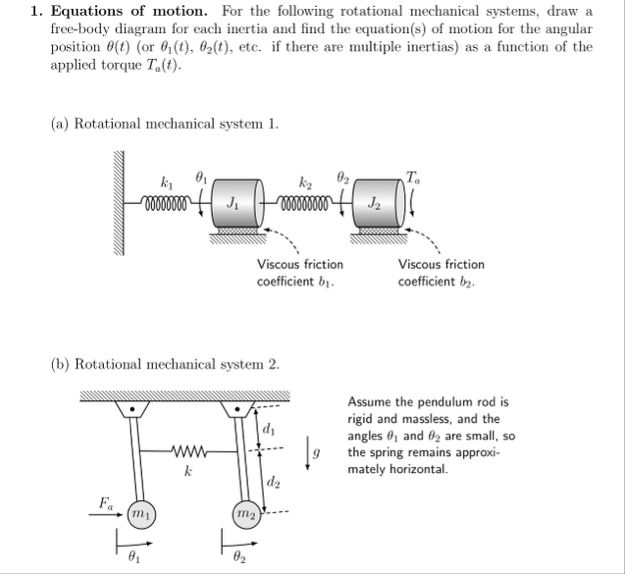 1. Equations of motion. For the following rotational mechanical systems. draw a
free-body diagram for each inertia and find the equation(s) of motion for the angular
position 6(t) (or 04(t), B(2). ete. if there are multiple inertias) as a function of the
applied torque T,(f).
(a) Rotational mechanical system 1
bh Cigar kOe T
\ \ 3
Viscous friction Viscous friction
coefficient by coefficient
(b) Rotational mechanical system 2.
SII .
sa Assume the pendulum rod is
\+/ + i rigid and massless, and the
h angles 0; and 6 are small, so
= lo the spring remains approsi-
Ek mately horizontal
dy
Fa 3
—-@ @
[A [A
This is AI generated Response.
Asked by: Rahul
Created at: 2026-01-22 02:39:19
Asked by: Rahul
Created at: 2026-01-22 02:39:19
Final Answer:
Rendered
Raw Text
Did you like this answer?
Let's solve **part (a): Rotational Mechanical System 1** step-by-step.
---
## 1. **Free-Body Diagram and Torques**
We have two rotating inertias \( J_1 \) and \( J_2 \), coupled by springs and dampers, with an applied torque \( T_a \) on \( J_2 \):
- \( J_1 \) rotates by \( \theta_1(t) \)
- \( J_2 \) rotates by \( \theta_2(t) \)
- \( k_1 \), \( b_1 \): spring and damper connected to ground on \( J_1 \)
- \( k_2 \), \( b_2 \): spring and damper between \( J_1 \) and \( J_2 \)
- \( T_a \): applied to \( J_2 \)
---
### **Torques acting on \( J_1 \):**
- **Spring \( k_1 \):** \( -k_1 \theta_1 \) (restoring torque)
- **Damper \( b_1 \):** \( -b_1 \dot{\theta}_1 \) (resistive torque)
- **Spring \( k_2 \):** \( -k_2 (\theta_1 - \theta_2) \) (opposes relative motion)
- **Damper \( b_2 \):** \( -b_2 (\dot{\theta}_1 - \dot{\theta}_2) \) (opposes relative angular speed)
#### **Equation for \( J_1 \):**
\[
J_1 \ddot{\theta}_1 = -k_1 \theta_1 - b_1 \dot{\theta}_1 - k_2 (\theta_1 - \theta_2) - b_2 (\dot{\theta}_1 - \dot{\theta}_2)
\]
Simplify:
\[
J_1 \ddot{\theta}_1 + (b_1 + b_2)\dot{\theta}_1 + (k_1 + k_2)\theta_1 - b_2 \dot{\theta}_2 - k_2 \theta_2 =
\]
---
### **Torques acting on \( J_2 \):**
- **Spring \( k_2 \):** \( +k_2 (\theta_1 - \theta_2) \)
- **Damper \( b_2 \):** \( +b_2 (\dot{\theta}_1 - \dot{\theta}_2) \)
- **Applied torque:** \( +T_a \)
#### **Equation for \( J_2 \):**
\[
J_2 \ddot{\theta}_2 = k_2 (\theta_1 - \theta_2) + b_2 (\dot{\theta}_1 - \dot{\theta}_2) + T_a
\]
Simplify:
\[
J_2 \ddot{\theta}_2 + b_2 \dot{\theta}_2 + k_2 \theta_2 = b_2 \dot{\theta}_1 + k_2 \theta_1 + T_a
\]
---
## 2. **Final Equations of Motion**
### **For \( J_1 \):**
\[
\boxed{
J_1 \ddot{\theta}_1 + (b_1 + b_2)\dot{\theta}_1 + (k_1 + k_2)\theta_1 - b_2 \dot{\theta}_2 - k_2 \theta_2 =
}
\]
### **For \( J_2 \):**
\[
\boxed{
J_2 \ddot{\theta}_2 + b_2 \dot{\theta}_2 + k_2 \theta_2 = b_2 \dot{\theta}_1 + k_2 \theta_1 + T_a
}
\]
---
## 3. **Summary**
- The system is described by the coupled 2nd-order ODEs above.
- The variables \( \theta_1(t) \) and \( \theta_2(t) \) describe the angular positions of the inertias as a function of the applied torque \( T_a(t) \).
---
If you want the equations for part (b) as well, please let me know!
Question:
All parts solved
This is AI generated Response.
Asked by: Rahul
Created at: 2026-01-22 02:40:05
Asked by: Rahul
Created at: 2026-01-22 02:40:05
Final Answer:
Rendered
Raw Text
Did you like this answer?
# Step-by-Step Solution for Rotational Mechanical Systems
## Part (a): Rotational Mechanical System 1
### 1. **Free-Body Diagram and Torques**
For the system with two inertias \( J_1 \) and \( J_2 \):
- **Inertia \( J_1 \)** rotates by \( \theta_1(t) \)
- **Inertia \( J_2 \)** rotates by \( \theta_2(t) \)
- Applied torque \( T_a \) acts on \( J_2 \)
- Springs and dampers are connected as follows:
- \( k_1, b_1 \): connected to ground on \( J_1 \)
- \( k_2, b_2 \): between \( J_1 \) and \( J_2 \)
### 2. **Torques Acting on \( J_1 \)**
- **Restoring torque from spring \( k_1 \):** \( -k_1 \theta_1 \)
- **Resistive torque from damper \( b_1 \):** \( -b_1 \dot{\theta}_1 \)
- **Restoring torque from spring \( k_2 \):** \( -k_2 (\theta_1 - \theta_2) \)
- **Resistive torque from damper \( b_2 \):** \( -b_2 (\dot{\theta}_1 - \dot{\theta}_2) \)
#### **Equation for \( J_1 \)**
\[
J_1 \ddot{\theta}_1 = -k_1 \theta_1 - b_1 \dot{\theta}_1 - k_2 (\theta_1 - \theta_2) - b_2 (\dot{\theta}_1 - \dot{\theta}_2)
\]
Simplifying:
\[
J_1 \ddot{\theta}_1 + (b_1 + b_2)\dot{\theta}_1 + (k_1 + k_2)\theta_1 - b_2 \dot{\theta}_2 - k_2 \theta_2 = 0
\]
---
### 3. **Torques Acting on \( J_2 \)**
- **Restoring torque from spring \( k_2 \):** \( +k_2 (\theta_1 - \theta_2) \)
- **Resistive torque from damper \( b_2 \):** \( +b_2 (\dot{\theta}_1 - \dot{\theta}_2) \)
- **Applied torque:** \( +T_a \)
#### **Equation for \( J_2 \)**
\[
J_2 \ddot{\theta}_2 = k_2 (\theta_1 - \theta_2) + b_2 (\dot{\theta}_1 - \dot{\theta}_2) + T_a
\]
Simplifying:
\[
J_2 \ddot{\theta}_2 + b_2 \dot{\theta}_2 + k_2 \theta_2 = b_2 \dot{\theta}_1 + k_2 \theta_1 + T_a
\]
---
## 4. **Final Equations of Motion**
### **For \( J_1 \):**
\[
\boxed{
J_1 \ddot{\theta}_1 + (b_1 + b_2)\dot{\theta}_1 + (k_1 + k_2)\theta_1 - b_2 \dot{\theta}_2 - k_2 \theta_2 = 0
}
\]
### **For \( J_2 \):**
\[
\boxed{
J_2 \ddot{\theta}_2 + b_2 \dot{\theta}_2 + k_2 \theta_2 = b_2 \dot{\theta}_1 + k_2 \theta_1 + T_a
}
\]
---
## Part (b): Rotational Mechanical System 2
### 1. **System Description**
- Assume a massless, rigid pendulum with angles \( \theta_1 \) and \( \theta_2 \) being small.
- The spring remains approximately horizontal.
### 2. **Free-Body Diagram and Forces**
- **Forces acting on the pendulum:**
- Gravitational force
- Spring force
- Viscous damping
### 3. **Equations of Motion**
For small angles, the equations of motion can be derived based on the following considerations:
- **Torque due to gravity:** \( -mgL \sin(\theta) \approx -mgL \theta \) for small \( \theta \)
- **Restoring torque from spring:** \( -k\theta \)
- **Damping torque:** \( -b\dot{\theta} \)
#### **Equation for Pendulum Motion:**
Combining these effects:
\[
J \ddot{\theta} + b \dot{\theta} + k \theta = 0
\]
---
## 4. **Final Equation of Motion for System 2**
\[
\boxed{
J \ddot{\theta} + b \dot{\theta} + k \theta = 0
}
\]
---
## Summary
Both systems are described by second-order differential equations that relate the angular positions and velocities to the applied torques, springs, and damping forces. The equations can be solved for the angular positions \( \theta_1(t) \) and \( \theta_2(t) \) as functions of time given specific initial conditions.
📢 Instructions:
- Ask anything relatd to above question only.
- For new Question goto :