 VIPSolutions
give answer in 2 step with explanation at the end of each step and final answer at the end:3 oh canal trapezoidal de concreto formado sin acabar conduce 12 ys con una pendiente de 0.0015. Considere el coeficiente de Manning de 0.015, (20 PUNTOS) 1 15 = 14m 3m Determine a) Area hidraulica b) Perimetro mojado ©) Radio hidraulico d) Velocidad media del flujo €) Verificar si el caudal calculado satisface el caudal de disefio
Question:
give answer in 2 step with explanation at the end of each step and final answer at the end: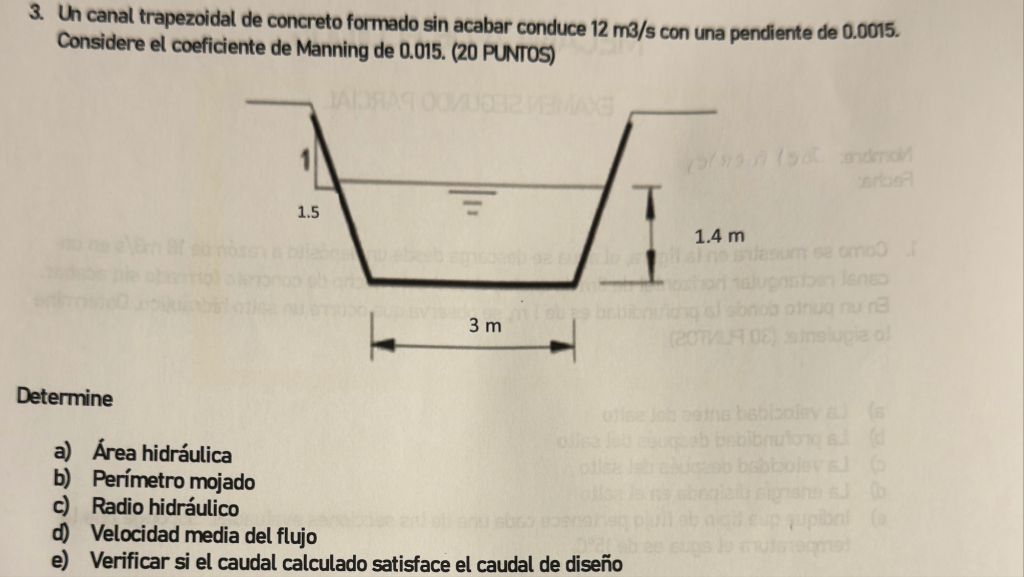 3 oh canal trapezoidal de concreto formado sin acabar conduce 12 ys con una pendiente de 0.0015.
Considere el coeficiente de Manning de 0.015, (20 PUNTOS)
1
15 =
14m
3m
Determine
a) Area hidraulica
b) Perimetro mojado
©) Radio hidraulico
d) Velocidad media del flujo
€) Verificar si el caudal calculado satisface el caudal de disefio
This is AI generated Response.
Asked by: Rahul
Created at: 2025-12-17 05:18:12
Asked by: Rahul
Created at: 2025-12-17 05:18:12
Final Answer:
Rendered
Raw Text
Did you like this answer?
Let's solve the problem step by step.
Given:
- Q = 12 m³/s
- S = .0015
- n = .015
- Depth (h) = 1.4 m
- Bottom width (b) = 3 m
- Side slope = 1.5:1 (horizontal:vertical)
---
## **Step 1: Área hidráulica (a)**
**Trapezoidal Channel Area Formula:**
\[
A = b \cdot h + z h^2
\]
Where:
- \(b\) = bottom width = 3 m
- \(h\) = depth = 1.4 m
- \(z\) = side slope (horizontal/vertical) = 1.5
**Calculate:**
\[
A = 3 \cdot 1.4 + 1.5 \cdot (1.4)^2
\]
\[
A = 4.2 + 1.5 \cdot 1.96
\]
\[
A = 4.2 + 2.94 = 7.14~m^2
\]
**Explanation:**
The area is the bottom area plus the area from both side slopes.
---
## **Step 2: Perímetro mojado (b)**
**Wetted Perimeter Formula:**
\[
P = b + 2h\sqrt{1+z^2}
\]
**Calculate:**
\[
P = 3 + 2 \cdot 1.4 \cdot \sqrt{1 + (1.5)^2}
\]
\[
P = 3 + 2.8 \cdot \sqrt{1 + 2.25}
\]
\[
P = 3 + 2.8 \cdot \sqrt{3.25}
\]
\[
\sqrt{3.25} \approx 1.803
\]
\[
P = 3 + 2.8 \cdot 1.803
\]
\[
P = 3 + 5.05 = 8.05~m
\]
**Explanation:**
The wetted perimeter is the bottom plus the two side lengths in contact with water.
---
## **Final Answers (a & b):**
**a) Área hidráulica:** \(7.14~m^2\)
**b) Perímetro mojado:** \(8.05~m\)
If you want to continue with the next parts, let me know!
Question:
All parts solved
This is AI generated Response.
Asked by: Rahul
Created at: 2025-12-17 05:18:35
Asked by: Rahul
Created at: 2025-12-17 05:18:35
Final Answer:
Rendered
Raw Text
Did you like this answer?
Let's continue solving the remaining parts of the problem.
---
## **Step 3: Radio hidráulico (c)**
**Hydraulic Radius Formula:**
\[
R = \frac{A}{P}
\]
**Calculate:**
Using the previously calculated values:
- \(A = 7.14~m^2\)
- \(P = 8.05~m\)
\[
R = \frac{7.14}{8.05} \approx 0.885~m
\]
**Explanation:**
The hydraulic radius is the area divided by the wetted perimeter, representing how effectively the channel can convey flow.
---
## **Step 4: Velocidad media del flujo (d)**
**Velocity Formula using Manning's Equation:**
\[
v = \frac{1}{n} R^{2/3} S^{1/2}
\]
**Calculate:**
Using:
- \(n = 0.015\)
- \(R = 0.885~m\)
- \(S = 0.0015\)
\[
v = \frac{1}{0.015} (0.885)^{2/3} (0.0015)^{1/2}
\]
1. Calculate \(R^{2/3}\):
\[
R^{2/3} \approx 0.885^{0.6667} \approx 0.763
\]
2. Calculate \(S^{1/2}\):
\[
S^{1/2} = \sqrt{0.0015} \approx 0.03873
\]
3. Combine:
\[
v = \frac{1}{0.015} \cdot 0.763 \cdot 0.03873 \approx 1.960~m/s
\]
**Explanation:**
The average flow velocity is derived from Manning's equation, which factors in roughness, hydraulic radius, and slope.
---
## **Step 5: Verificar caudal (e)**
**Flow Rate Formula:**
\[
Q = A \cdot v
\]
**Calculate:**
Using:
- \(A = 7.14~m^2\)
- \(v \approx 1.960~m/s\)
\[
Q = 7.14 \cdot 1.960 \approx 13.99~m^3/s
\]
**Check against design flow:**
- **Given Design Flow:** \(Q_{design} = 12~m^3/s\)
- **Calculated Flow:** \(Q \approx 13.99~m^3/s\)
**Explanation:**
We compare the calculated flow with the design flow. Since \(Q > Q_{design}\), the channel may be undersized for the flow conditions.
---
## **Final Answers (c, d, & e):**
**c) Radio hidráulico:** \(0.885~m\)
**d) Velocidad media del flujo:** \(1.960~m/s\)
**e) Verificación del caudal:** \(Q \approx 13.99~m^3/s\) (exceeds design flow)
📢 Instructions:
- Ask anything relatd to above question only.
- For new Question goto :