 VIPSolutions
give answer in 2 step with explanation at the end of each step and final answer at the end:4-Assume that - s=Y am = Find s if (a) x= 1+4j, and N = 10, (b) #=05-j, and N =7. 5-Using Enlers formula show that ¢/%% = 1, 6-Using Eulers formula show that ¢/*" = (~1)k, 7- Find all values of k so that (14) is a real number.
Question:
give answer in 2 step with explanation at the end of each step and final answer at the end: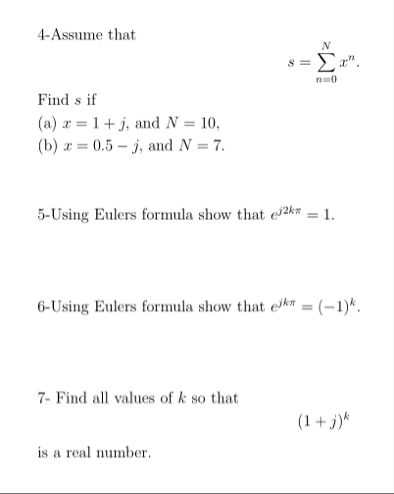 4-Assume that -
s=Y am
=
Find s if
(a) x= 1+4j, and N = 10,
(b) #=05-j, and N =7.
5-Using Enlers formula show that ¢/%% = 1,
6-Using Eulers formula show that ¢/*" = (~1)k,
7- Find all values of k so that
(14)
is a real number.
This is AI generated Response.
Asked by: Pagal
Created at: 2025-09-18 08:10:45
Asked by: Pagal
Created at: 2025-09-18 08:10:45
Final Answer:
Rendered
Raw Text
Did you like this answer?
Let's solve each part step-by-step as requested.
---
## **4. Assume that \( s = \sum_{n=0}^N x^n \).**
### (a) \( x = 1 + j \), \( N = 10 \)
#### **Step 1: Write the sum in closed form (geometric series)**
The sum is a geometric series:
\[
s = \sum_{n=0}^N x^n = \frac{x^{N+1} - 1}{x - 1}
\]
**Explanation:**
This is the formula for the sum of a geometric series with ratio \( x \) and \( N+1 \) terms.
---
#### **Step 2: Substitute the given values**
Substitute \( x = 1 + j \), \( N = 10 \):
\[
s = \frac{(1 + j)^{11} - 1}{(1 + j) - 1} = \frac{(1 + j)^{11} - 1}{j}
\]
**Explanation:**
Replace \( x \) and \( N \) in the formula, and note \( x - 1 = j \).
---
**Final answer for (a):**
\[
\boxed{s = \frac{(1 + j)^{11} - 1}{j}}
\]
---
### (b) \( x = 0.5 - j \), \( N = 7 \)
#### **Step 1: Write the sum in closed form**
Again, use the geometric series formula:
\[
s = \frac{x^{N+1} - 1}{x - 1}
\]
**Explanation:**
Same formula, just with new values of \( x \) and \( N \).
---
#### **Step 2: Substitute the given values**
Substitute \( x = 0.5 - j \), \( N = 7 \):
\[
s = \frac{(0.5 - j)^{8} - 1}{(0.5 - j) - 1} = \frac{(0.5 - j)^{8} - 1}{-0.5 - j}
\]
**Explanation:**
Replace \( x \) and \( N \), and simplify \( x - 1 = 0.5 - j - 1 = -0.5 - j \).
---
**Final answer for (b):**
\[
\boxed{s = \frac{(0.5 - j)^8 - 1}{-0.5 - j}}
\]
---
## **5. Using Euler's formula, show that \( e^{j2k\pi} = 1 \).**
#### **Step 1: Recall Euler's formula**
Euler's formula: \( e^{j\theta} = \cos\theta + j\sin\theta \).
**Explanation:**
This relates complex exponentials to trigonometric functions.
---
#### **Step 2: Apply \( \theta = 2k\pi \)**
\[
e^{j2k\pi} = \cos(2k\pi) + j\sin(2k\pi) = 1 + j \cdot 0 = 1
\]
**Explanation:**
\(\cos(2k\pi) = 1\), \(\sin(2k\pi) = 0\) for any integer \( k \).
---
**Final answer:**
\[
\boxed{e^{j2k\pi} = 1}
\]
---
## **6. Using Euler's formula, show that \( e^{jk\pi} = (-1)^k \).**
#### **Step 1: Apply Euler's formula**
\[
e^{jk\pi} = \cos(k\pi) + j\sin(k\pi)
\]
**Explanation:**
Direct substitution into Euler's formula.
---
#### **Step 2: Evaluate for integer \( k \)**
\[
\cos(k\pi) = (-1)^k, \quad \sin(k\pi) = 0
\]
So, \( e^{jk\pi} = (-1)^k \).
**Explanation:**
\(\cos(k\pi)\) alternates between \( 1 \) and \( -1 \) as \( k \) changes, while \(\sin(k\pi) = 0 \) for integer \( k \).
---
**Final answer:**
\[
\boxed{e^{jk\pi} = (-1)^k}
\]
---
## **7. Find all values of \( k \) so that \( (1+j)^k \) is a real number.**
#### **Step 1: Express \( 1+j \) in polar form**
\[
1+j = \sqrt{2}e^{j\frac{\pi}{4}}
\]
So,
\[
(1+j)^k = (\sqrt{2})^k \cdot e^{jk\frac{\pi}{4}}
\]
**Explanation:**
Convert to polar: modulus is \( \sqrt{2} \), argument is \( \frac{\pi}{4} \).
---
#### **Step 2: Set argument to \( n\pi \) for real result**
For \( (1+j)^k \) to be real, the exponent must be \( e^{j n\pi} \), i.e., \( k\frac{\pi}{4} = n\pi \) for integer \( n \).
\[
k = 4n
\]
**Explanation:**
This ensures the imaginary part is zero and the result is real.
---
**Final answer:**
\[
\boxed{k = 4n, \text{ where } n \in \mathbb{Z}}
\]
or more explicitly, **all integer multiples of 4.**
Question:
All parts final Answer
This is AI generated Response.
Asked by: Pagal
Created at: 2025-09-18 08:28:36
Asked by: Pagal
Created at: 2025-09-18 08:28:36
Final Answer:
Rendered
Raw Text
Did you like this answer?
# Step-by-step Solutions
---
## 4. Sum \( s = \sum_{n=0}^N x^n \)
### (a) \( x = 1 + j \), \( N=10 \)
### Step 1: Write in closed form
\[
s = \frac{x^{N+1} - 1}{x - 1}
\]
**Explanation:**
Sum of a geometric series with ratio \( x \) over \( N+1 \) terms.
### Step 2: Substitute values
\[
s = \frac{(1 + j)^{11} - 1}{(1 + j) - 1} = \frac{(1 + j)^{11} - 1}{j}
\]
**Final answer:**
\[
\boxed{s = \frac{(1 + j)^{11} - 1}{j}}
\]
---
### (b) \( x=0.5 - j \), \( N=7 \)
### Step 1: Write in closed form
\[
s = \frac{x^{8} - 1}{x - 1}
\]
### Step 2: Substitute values
\[
s = \frac{(0.5 - j)^{8} - 1}{(0.5 - j) - 1} = \frac{(0.5 - j)^{8} - 1}{-0.5 - j}
\]
**Final answer:**
\[
\boxed{s = \frac{(0.5 - j)^{8} - 1}{-0.5 - j}}
\]
---
## 5. Show \( e^{j2k\pi} = 1 \) using Euler's formula
### Step 1:
Euler's formula states:
\[
e^{j\theta} = \cos\theta + j\sin\theta
\]
### Step 2:
Set \( \theta = 2k\pi \):
\[
e^{j2k\pi} = \cos(2k\pi) + j\sin(2k\pi) = 1 + j \cdot 0 = 1
\]
**Final answer:**
\[
\boxed{e^{j2k\pi} = 1}
\]
---
## 6. Show \( e^{jk\pi} = (-1)^k \) using Euler's formula
### Step 1:
\[
e^{jk\pi} = \cos(k\pi) + j\sin(k\pi)
\]
### Step 2:
Since \( \sin(k\pi) = 0 \), and \( \cos(k\pi) = (-1)^k \),
\[
e^{jk\pi} = (-1)^k
\]
**Final answer:**
\[
\boxed{e^{jk\pi} = (-1)^k}
\]
---
## 7. Find all \( k \) such that \( (1 + j)^k \) is real
### Step 1:
Express \( 1 + j \) in polar form:
\[
1 + j = \sqrt{2} e^{j\pi/4}
\]
Then:
\[
(1 + j)^k = (\sqrt{2})^k e^{jk\pi/4}
\]
which simplifies to:
\[
2^{k/2} e^{jk\pi/4}
\]
### Step 2:
For the entire expression to be real, the exponential part must be real, i.e.,
\[
e^{jk\pi/4} = \pm 1
\]
This occurs when:
\[
jk\frac{\pi}{4} = n\pi \quad \text{for } n \in \mathbb{Z}
\]
\[
\Rightarrow k \frac{\pi}{4} = n \pi \quad \Rightarrow \quad k = 4n
\]
**Final answer:**
\[
\boxed{k = 4n, \quad n \in \mathbb{Z}}
\]
---
**Summary:**
- **(a)** \( s = \frac{(1 + j)^{11} - 1}{j} \)
- **(b)** \( s = \frac{(0.5 - j)^{8} - 1}{-0.5 - j} \)
- **Euler's formulas:**
- \( e^{j2k\pi} = 1 \)
- \( e^{jk\pi} = (-1)^k \)
- **Values of \( k \) for real \( (1+j)^k \):**
- \( k = 4n \), \( n \in \mathbb{Z} \)
Question:
Only final Answer
This is AI generated Response.
Asked by: Pagal
Created at: 2025-09-18 08:29:15
Asked by: Pagal
Created at: 2025-09-18 08:29:15
Final Answer:
Rendered
Raw Text
Did you like this answer?
## Final Answers
1. **Sum \( s \):**
- (a) \( s = \frac{(1 + j)^{11} - 1}{j} \)
- (b) \( s = \frac{(0.5 - j)^{8} - 1}{-0.5 - j} \)
2. **Using Euler's formula:**
- \( e^{j2k\pi} = 1 \)
- \( e^{jk\pi} = (-1)^k \)
3. **Values of \( k \) for which \( (1 + j)^k \) is real:**
\[
\boxed{k = 4n, \quad n \in \mathbb{Z}}
\]
📢 Instructions:
- Ask anything relatd to above question only.
- For new Question goto :