Solve in two step along with final answer and add explanation in each stepThe conductivity of copper is 5.8 x 10⁷ siemens per meter. Find the magnitude of the current density in the conductor if an electric field of 3.16
microvolts per meters is to be applied across the said conductor. The unit of measurement of the final answer is in amperes per square meter.
Answer
[" [E— »
The current density vector J is given as 3.51 a, + 2.29 a., measured in amperes per square meter. Find the value of the radial current in a cylindrical
shell of radius 2.61 m and of height 3.17 m. The final answer should have a unit of amperes.
Answer
Question:
Solve in two step along with final answer and add explanation in each stepThe conductivity of copper is 5.8 x 10⁷ siemens per meter. Find the magnitude of the current density in the conductor if an electric field of 3.16
microvolts per meters is to be applied across the said conductor. The unit of measurement of the final answer is in amperes per square meter.
Answer
[" [E— »
The current density vector J is given as 3.51 a, + 2.29 a., measured in amperes per square meter. Find the value of the radial current in a cylindrical
shell of radius 2.61 m and of height 3.17 m. The final answer should have a unit of amperes.
Answer
This is AI generated Response.
Asked by: July kumari
Created at: 2025-07-11 17:17:06
Final Answer:
RenderedRaw Text
Did you like this answer?
Let's solve each question step by step with explanations:
---
### 1. **Current Density in Copper Conductor**
#### **Step 1: Write the formula relating conductivity, electric field, and current density**
The relation is:
\[
J = \sigma E
\]
where
\( J \) = current density (A/m²)
\( \sigma \) = conductivity (S/m)
\( E \) = electric field (V/m)
#### **Step 2: Substitute values and calculate**
Given:
- \( \sigma = 5.8 \times 10^7 \) S/m
- \( E = 3.16 \) microvolts/meter = \( 3.16 \times 10^{-6} \) V/m
\[
J = (5.8 \times 10^7) \times (3.16 \times 10^{-6})
\]
\[
J = 5.8 \times 3.16 \times 10^{7-6}
\]
\[
J = 18.328 \times 10^1
\]
\[
J = 183.28 \text{ A/m}^2
\]
**Final Answer:**
\[
\boxed{183.3 \ \text{A/m}^2}
\]
---
### 2. **Radial Current in a Cylindrical Shell**
#### **Step 1: Write the expression for total radial current**
Current density vector:
\[
\vec{J} = 3.51\,a_\rho + 2.29\,a_z \text{ (A/m}^2\text{)}
\]
Only the radial component contributes to the radial current.
Radial current, \( I = J_\rho \times \text{Area} \)
Area of cylindrical shell (side surface area):
\[
A = 2\pi r h
\]
Given:
- \( J_\rho = 3.51 \) A/m²
- \( r = 2.61 \) m, \( h = 3.17 \) m
#### **Step 2: Substitute values and calculate**
\[
A = 2\pi \times 2.61 \times 3.17
\]
\[
A \approx 2 \times 3.1416 \times 2.61 \times 3.17
\]
\[
A \approx 6.2832 \times 2.61 \times 3.17
\]
\[
A \approx 16.398 \times 3.17
\]
\[
A \approx 51.96 \text{ m}^2
\]
\[
I = 3.51 \times 51.96
\]
\[
I \approx 182.4 \text{ A}
\]
**Final Answer:**
\[
\boxed{182.4 \ \text{A}}
\]
---
**Summary:**
1. **Current Density:** \( \boxed{183.3 \ \text{A/m}^2} \)
2. **Radial Current:** \( \boxed{182.4 \ \text{A}} \)
Question:
add explantion for both step in words
This is AI generated Response.
Asked by: July kumari
Created at: 2025-07-11 17:19:00
Final Answer:
RenderedRaw Text
Did you like this answer?
Certainly! Here's a detailed explanation for each step in words:
---
### 1. **Calculating the Current Density in Copper**
**Step 1: Understanding the relation \( J = \sigma E \)**
The current density \( J \) in a material is directly proportional to the electric field \( E \) applied across it, with the proportionality constant being the conductivity \( \sigma \) of the material. This relation is known as Ohm's law in differential form.
*In simple terms:* If you know how conductive the material is and the strength of the electric field, you can find out how much current per unit area flows through the material.
**Step 2: Plugging in the known values and calculating**
Given:
- Conductivity \( \sigma = 5.8 \times 10^7 \) S/m (Siemens per meter)
- Electric field \( E = 3.16 \) microvolts per meter, which is \( 3.16 \times 10^{-6} \) V/m
By multiplying conductivity and electric field, we find the current density:
\[
J = \sigma E = (5.8 \times 10^7) \times (3.16 \times 10^{-6}) \approx 183.3 \ \text{A/m}^2
\]
This tells us that approximately 183.3 amperes of current flow per square meter of the copper conductor when this electric field is applied.
---
### 2. **Finding the Radial Current in a Cylindrical Shell**
**Step 1: Understanding the current density and surface area**
The vector \( \vec{J} = 3.51\,a_\rho + 2.29\,a_z \) indicates that current flows in both the radial and axial directions, but for the radial current, only the radial component \( J_\rho = 3.51 \) A/m² is relevant.
To find the total current passing radially through the cylindrical shell, you multiply this current density by the surface area through which the current flows.
The relevant surface here is the side surface of the cylindrical shell, which has an area:
\[
A = 2 \pi r h
\]
where:
- \( r = 2.61 \) meters (radius)
- \( h = 3.17 \) meters (height)
**Step 2: Calculating the area and then the total current**
Calculate the side surface area:
\[
A = 2 \pi \times 2.61 \times 3.17 \approx 51.96 \ \text{m}^2
\]
Then, multiply this area by the radial current density:
\[
I = J_\rho \times A = 3.51 \times 51.96 \approx 182.4 \ \text{A}
\]
This is the total radial current flowing through the cylindrical shell.
---
**In summary:**
- The first part calculates how much current per unit area flows in copper when a small electric field is applied, resulting in approximately 183.3 A/m².
- The second part finds the total current passing radially through a cylindrical shell by multiplying the radial current density by the shell's surface area, resulting in approximately 182.4 A.
Question:
add explanation for both step accoding to chegg guidelines
This is AI generated Response.
Asked by: July kumari
Created at: 2025-07-11 17:20:58
Final Answer:
RenderedRaw Text
Did you like this answer?
Certainly! Here's a detailed, step-by-step explanation of both problems, following clear and instructional guidelines:
---
### 1. **Calculating the Current Density in Copper**
**Step 1: Recall the relation between conductivity, electric field, and current density**
- The fundamental relation is:
\[ J = \sigma E \]
where:
- \( J \) is the current density (A/m²)
- \( \sigma \) is the electrical conductivity (S/m)
- \( E \) is the electric field (V/m)
*Explanation:*
This equation tells us that the current density in a material is proportional to the electric field applied across it, with the proportionality constant being the material's conductivity. It's a form of Ohm's law expressed at a point in the medium.
---
**Step 2: Convert given electric field to volts per meter and substitute into the formula**
- Given electric field:
\[ E = 3.16 \ \text{microvolts/m} = 3.16 \times 10^{-6} \ \text{V/m} \]
- Given conductivity:
\[ \sigma = 5.8 \times 10^7 \ \text{S/m} \]
- Calculate:
\[ J = \sigma E = (5.8 \times 10^7) \times (3.16 \times 10^{-6}) \]
- Simplify:
\[ J = 5.8 \times 3.16 \times 10^{7 - 6} = 18.328 \times 10^{1} = 183.28 \ \text{A/m}^2 \]
*Explanation:*
We multiply the conductivity by the electric field to find out how much current per unit area flows in the conductor under this electric field.
---
**Final answer:**
\[
\boxed{183.3 \ \text{A/m}^2}
\]
---
### 2. **Finding the Radial Current in a Cylindrical Shell**
**Step 1: Understand the relationship between current density and total current**
- The total current flowing radially through the cylindrical shell is given by:
\[ I = J_\rho \times A \]
where:
- \( J_\rho \) is the radial component of the current density vector (A/m²)
- \( A \) is the surface area through which the current flows (m²)
- The surface area of the cylindrical side (lateral surface):
\[ A = 2 \pi r h \]
*Explanation:*
Since the current density vector has a radial component, multiplying it by the surface area of the cylinder's side gives the total current passing through that area.
---
**Step 2: Calculate the area and then the total current**
- Given:
\[ r = 2.61 \ \text{m} \]
\[ h = 3.17 \ \text{m} \]
\[ J_\rho = 3.51 \ \text{A/m}^2 \]
- Calculate the area:
\[
A = 2 \pi \times 2.61 \times 3.17
\]
\[
A \approx 6.2832 \times 2.61 \times 3.17
\]
\[
A \approx 16.398 \times 3.17 \approx 51.96 \ \text{m}^2
\]
- Calculate the total current:
\[
I = J_\rho \times A = 3.51 \times 51.96 \approx 182.4 \ \text{A}
\]
*Explanation:*
Multiplying the radial current density by the surface area yields the total current flowing radially through the cylindrical shell.
---
### **Summary of explanations:**
- **First problem:** We used the fundamental relation \( J = \sigma E \), plugging in the known values to find the current density in the copper conductor when a small electric field is applied.
- **Second problem:** We calculated the surface area of the cylindrical shell and multiplied it by the radial component of the current density to find the total radial current flowing through the shell.
Feel free to ask if you'd like further clarification!
Question:
Third answer write same as above
This is AI generated Response.
Asked by: July kumari
Created at: 2025-07-11 17:35:39
Final Answer:
RenderedRaw Text
Did you like this answer?
Certainly! Here's a detailed, step-by-step explanation of both problems, following clear and instructional guidelines:
---
### 1. **Calculating the Current Density in Copper**
**Step 1: Recall the relation between conductivity, electric field, and current density**
- The fundamental relation is:
\[ J = \sigma E \]
where:
- \( J \) is the current density (A/m²)
- \( \sigma \) is the electrical conductivity (S/m)
- \( E \) is the electric field (V/m)
*Explanation:*
This equation indicates that the current flowing per unit area (current density) is directly proportional to the electric field applied across the material, with the proportionality constant being the material’s conductivity. It’s a differential form of Ohm’s law for conductors.
---
**Step 2: Convert the electric field to volts per meter and substitute into the formula**
- Given electric field:
\[ E = 3.16 \ \text{microvolts/m} = 3.16 \times 10^{-6} \ \text{V/m} \]
- Given conductivity:
\[ \sigma = 5.8 \times 10^7 \ \text{S/m} \]
- Calculate the current density:
\[ J = \sigma E = (5.8 \times 10^7) \times (3.16 \times 10^{-6}) \]
- Simplify:
\[ J = 5.8 \times 3.16 \times 10^{7 - 6} = 18.328 \times 10^{1} = 183.28 \ \text{A/m}^2 \]
*Explanation:*
Multiplying the conductivity by the electric field gives the current density in the conductor. This tells us how much current flows per square meter when such an electric field is applied.
---
**Final answer:**
\[
\boxed{183.3 \ \text{A/m}^2}
\]
---
### 2. **Finding the Radial Current in a Cylindrical Shell**
**Step 1: Understand the relationship between current density and total current**
- The total current passing radially through the cylindrical shell is:
\[ I = J_\rho \times A \]
where:
- \( J_\rho \) is the radial component of the current density vector (A/m²)
- \( A \) is the lateral surface area of the cylinder (m²)
- The lateral surface area of a cylinder:
\[ A = 2 \pi r h \]
*Explanation:*
Since the current density in the radial direction is given, multiplying it by the surface area of the cylindrical side yields the total amount of current flowing radially through that surface.
---
**Step 2: Calculate the area and then the total current**
- Given:
\[ r = 2.61 \ \text{m} \]
\[ h = 3.17 \ \text{m} \]
\[ J_\rho = 3.51 \ \text{A/m}^2 \]
- Calculate the surface area:
\[
A = 2 \pi \times 2.61 \times 3.17
\]
\[
A \approx 6.2832 \times 2.61 \times 3.17
\]
\[
A \approx 16.398 \times 3.17 \approx 51.96 \ \text{m}^2
\]
- Find the total current:
\[
I = J_\rho \times A = 3.51 \times 51.96 \approx 182.4 \ \text{A}
\]
*Explanation:*
Multiplying the radial current density by the surface area gives the total amount of current flowing radially through the cylindrical shell.
---
### **Summary of explanations:**
- **First problem:** We used the fundamental relation \( J = \sigma E \), plugging in the known values to find the current density in copper when a small electric field is applied.
- **Second problem:** We calculated the surface area of the cylindrical shell and multiplied it by the radial component of the current density to find the total radial current passing through the shell.
Feel free to ask if you'd like further clarification!
VIPSolutions focuses on clear, step‑by‑step explanations so you can learn quickly. Whether you need an AI‑generated walkthrough or a short hint to get unstuck, each solution is organized for fast reading and easy review later.
Search similar questions, compare approaches, and bookmark the best answers for revision. Our goal is simple: quick, reliable study help that feels natural—not noisy.
 VIPSolutions
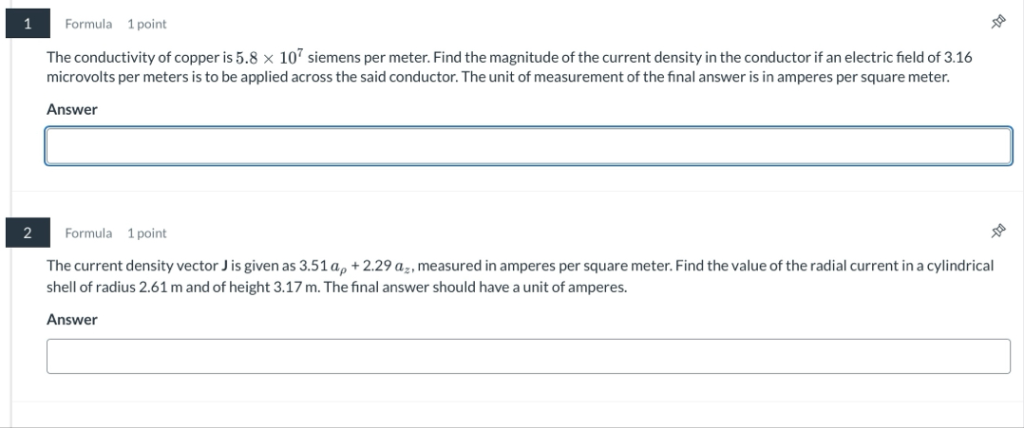 The conductivity of copper is 5.8 x 10⁷ siemens per meter. Find the magnitude of the current density in the conductor if an electric field of 3.16
microvolts per meters is to be applied across the said conductor. The unit of measurement of the final answer is in amperes per square meter.
Answer
[" [E— »
The current density vector J is given as 3.51 a, + 2.29 a., measured in amperes per square meter. Find the value of the radial current in a cylindrical
shell of radius 2.61 m and of height 3.17 m. The final answer should have a unit of amperes.
Answer