 VIPSolutions
Solve in two step and add explanation in each step along with final answer2. For the system shown below h! zZ—= H(2) = — RN glide = 4. Find the linear difference equation for the discrete time system {5} b. Determine h[k| the unit impulse response of the system. {15} ¢. The frequency response function H (e/™) [10]
Question:
Solve in two step and add explanation in each step along with final answer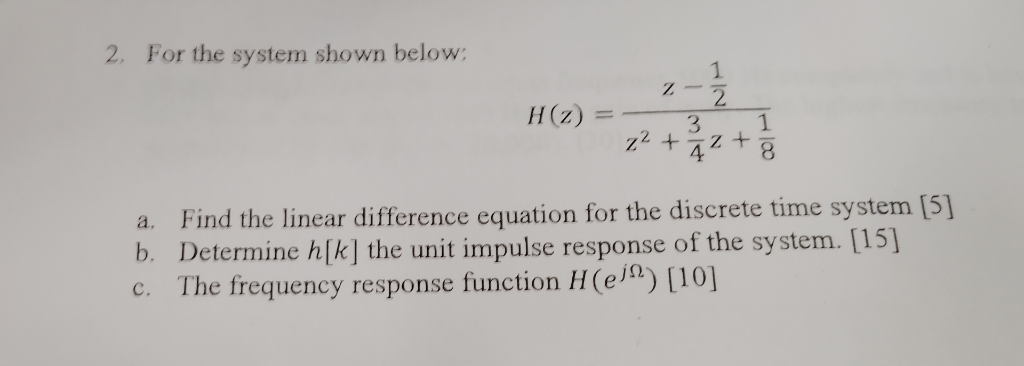 2. For the system shown below
h!
zZ—=
H(2) = —
RN
glide =
4. Find the linear difference equation for the discrete time system {5}
b. Determine h[k| the unit impulse response of the system. {15}
¢. The frequency response function H (e/™) [10]
This is AI generated Response.
Asked by: Sunil kumar
Created at: 2025-07-09 06:23:27
Asked by: Sunil kumar
Created at: 2025-07-09 06:23:27
Final Answer:
Rendered
Raw Text
Did you like this answer?
Let's solve the given system step by step as requested.
### **Given:**
\[
H(z) = \frac{z - \frac{1}{2}}{z^2 + \frac{3}{4}z + \frac{1}{8}}
\]
---
## **a. Find the linear difference equation for the discrete time system**
### **Step 1: Write the system in terms of \( Y(z) \) and \( X(z) \)**
Since \( H(z) = \frac{Y(z)}{X(z)} \):
\[
Y(z) = H(z)X(z)
\]
\[
Y(z) (z^2 + \frac{3}{4}z + \frac{1}{8}) = X(z) (z - \frac{1}{2})
\]
---
### **Step 2: Write in time domain using inverse Z-transform**
Recall:
- \( zY(z) \leftrightarrow y[k+1] \)
- \( z^2Y(z) \leftrightarrow y[k+2] \)
- \( zX(z) \leftrightarrow x[k+1] \)
- etc.
So,
\[
z^2 Y(z) + \frac{3}{4}z Y(z) + \frac{1}{8}Y(z) = zX(z) - \frac{1}{2}X(z)
\]
Taking inverse Z-transform:
\[
y[k+2] + \frac{3}{4}y[k+1] + \frac{1}{8}y[k] = x[k+1] - \frac{1}{2}x[k]
\]
**Final Linear Difference Equation:**
\[
\boxed{
y[k+2] + \frac{3}{4}y[k+1] + \frac{1}{8}y[k] = x[k+1] - \frac{1}{2}x[k]
}
\]
---
## **b. Determine \( h[k] \), the unit impulse response of the system**
### **Step 1: Express \( H(z) \) for inverse Z-transform**
Let’s factor and/or use partial fraction expansion for easier inversion.
\[
H(z) = \frac{z - \frac{1}{2}}{z^2 + \frac{3}{4}z + \frac{1}{8}}
\]
Let’s factor the denominator:
\[
z^2 + \frac{3}{4}z + \frac{1}{8}
\]
Use quadratic formula: \( z = \frac{-b \pm \sqrt{b^2 - 4ac}}{2a} \)
\( a = 1, b = \frac{3}{4}, c = \frac{1}{8} \)
\[
z = \frac{-\frac{3}{4} \pm \sqrt{\left(\frac{3}{4}\right)^2 - 4 \cdot 1 \cdot \frac{1}{8}}}{2}
= \frac{-\frac{3}{4} \pm \sqrt{\frac{9}{16} - \frac{1}{2}}}{2}
= \frac{-\frac{3}{4} \pm \sqrt{\frac{9}{16} - \frac{8}{16}}}{2}
= \frac{-\frac{3}{4} \pm \sqrt{\frac{1}{16}}}{2}
= \frac{-\frac{3}{4} \pm \frac{1}{4}}{2}
\]
Roots:
\[
z_1 = \frac{-\frac{3}{4} + \frac{1}{4}}{2} = \frac{-\frac{2}{4}}{2} = -\frac{1}{4}
\]
\[
z_2 = \frac{-\frac{3}{4} - \frac{1}{4}}{2} = \frac{-1}{2}
\]
So,
\[
z^2 + \frac{3}{4}z + \frac{1}{8} = (z + \frac{1}{4})(z + \frac{1}{2})
\]
Rewrite \( H(z) \):
\[
H(z) = \frac{z - \frac{1}{2}}{(z + \frac{1}{4})(z + \frac{1}{2})}
\]
---
### **Step 2: Partial Fraction Expansion**
Let’s express:
\[
\frac{z - \frac{1}{2}}{(z + \frac{1}{4})(z + \frac{1}{2})} = \frac{A}{z + \frac{1}{4}} + \frac{B}{z + \frac{1}{2}}
\]
Multiply both sides by the denominator:
\[
z - \frac{1}{2} = A(z + \frac{1}{2}) + B(z + \frac{1}{4})
\]
Solve for A, B:
Set \( z = -\frac{1}{2} \):
\[
(-\frac{1}{2}) - \frac{1}{2} = A(0) + B(-\frac{1}{2} + \frac{1}{4}) \implies -1 = B(-\frac{1}{4}) \implies B = 4
\]
Set \( z = -\frac{1}{4} \):
\[
(-\frac{1}{4}) - \frac{1}{2} = A(-\frac{1}{4} + \frac{1}{2}) + B(0) \implies -\frac{3}{4} = A(\frac{1}{4}) \implies A = -3
\]
So,
\[
H(z) = \frac{-3}{z + \frac{1}{4}} + \frac{4}{z + \frac{1}{2}}
\]
---
### **Step 3: Find \( h[k] \) using inverse Z-transform**
Recall:
\[
\mathcal{Z}^{-1}\left(\frac{1}{z - a}\right) = a^k u[k]
\]
But we have \( z + a \). So,
\[
\frac{1}{z + a} = \frac{1}{z - (-a)} \rightarrow (-a)^k u[k]
\]
So,
\[
h[k] = -3 \cdot \left(-\frac{1}{4}\right)^k + 4 \cdot \left(-\frac{1}{2}\right)^k, \quad k \geq 0
\]
---
**Final Answer for impulse response:**
\[
\boxed{
h[k] = -3 \left(-\frac{1}{4}\right)^k + 4 \left(-\frac{1}{2}\right)^k, \quad k \geq 0
}
\]
---
## **c. The frequency response function \( H(e^{j\Omega}) \)**
### **Step 1: Substitute \( z = e^{j\Omega} \) in \( H(z) \)**
\[
H(e^{j\Omega}) = \frac{e^{j\Omega} - \frac{1}{2}}{(e^{j\Omega})^2 + \frac{3}{4}e^{j\Omega} + \frac{1}{8}}
\]
---
### **Step 2: Write the final answer**
\[
\boxed{
H(e^{j\Omega}) = \frac{e^{j\Omega} - \frac{1}{2}}{e^{2j\Omega} + \frac{3}{4}e^{j\Omega} + \frac{1}{8}}
}
\]
---
## **Summary of Answers**
### **a. Linear Difference Equation:**
\[
y[k+2] + \frac{3}{4}y[k+1] + \frac{1}{8}y[k] = x[k+1] - \frac{1}{2}x[k]
\]
### **b. Impulse Response:**
\[
h[k] = -3 \left(-\frac{1}{4}\right)^k + 4 \left(-\frac{1}{2}\right)^k, \quad k \geq 0
\]
### **c. Frequency Response:**
\[
H(e^{j\Omega}) = \frac{e^{j\Omega} - \frac{1}{2}}{e^{2j\Omega} + \frac{3}{4}e^{j\Omega} + \frac{1}{8}}
\]
Question:
add explanation in word and not use more than one = in same line
This is AI generated Response.
Asked by: Sunil kumar
Created at: 2025-07-09 06:25:07
Asked by: Sunil kumar
Created at: 2025-07-09 06:25:07
Final Answer:
Rendered
Raw Text
Did you like this answer?
Let's analyze and solve the given problem step by step, providing clear explanations at each stage.
---
### **Given Transfer Function:**
\[
H(z) = \frac{z - \frac{1}{2}}{z^2 + \frac{3}{4}z + \frac{1}{8}}
\]
---
## **a. Derive the linear difference equation**
### **Step 1: Express in terms of \(Y(z)\) and \(X(z)\)**
Since \(H(z) = \frac{Y(z)}{X(z)}\), multiplying both sides by \(X(z)\) gives:
\[
Y(z) = H(z) \times X(z)
\]
which leads to:
\[
Y(z) \times \left(z^2 + \frac{3}{4}z + \frac{1}{8}\right) = X(z) \times \left(z - \frac{1}{2}\right)
\]
### **Step 2: Convert to the time domain**
Recall the properties of the Z-transform:
- \(zY(z) \leftrightarrow y[k+1]\)
- \(z^2 Y(z) \leftrightarrow y[k+2]\)
- \(z X(z) \leftrightarrow x[k+1]\)
- \(X(z) \leftrightarrow x[k]\)
Applying the inverse Z-transform:
\[
y[k+2] + \frac{3}{4} y[k+1] + \frac{1}{8} y[k] = x[k+1] - \frac{1}{2} x[k]
\]
**Final difference equation:**
\[
\boxed{
y[k+2] + \frac{3}{4} y[k+1] + \frac{1}{8} y[k] = x[k+1] - \frac{1}{2} x[k]
}
\]
This relation describes how current and past outputs relate to current and past inputs.
---
## **b. Find the impulse response \(h[k]\)**
### **Step 1: Factor the denominator**
First, factor the quadratic denominator:
\[
z^2 + \frac{3}{4}z + \frac{1}{8}
\]
Compute roots using the quadratic formula:
\[
z = \frac{-b \pm \sqrt{b^2 - 4ac}}{2a}
\]
where \(a=1\), \(b=\frac{3}{4}\), \(c=\frac{1}{8}\):
\[
z = \frac{-\frac{3}{4} \pm \sqrt{\left(\frac{3}{4}\right)^2 - 4 \times 1 \times \frac{1}{8}}}{2}
\]
Calculate discriminant:
\[
\left(\frac{3}{4}\right)^2 = \frac{9}{16}
\]
\[
4 \times \frac{1}{8} = \frac{1}{2} = \frac{8}{16}
\]
So,
\[
z = \frac{-\frac{3}{4} \pm \sqrt{\frac{9}{16} - \frac{8}{16}}}{2} = \frac{-\frac{3}{4} \pm \sqrt{\frac{1}{16}}}{2}
\]
which simplifies to:
\[
z = \frac{-\frac{3}{4} \pm \frac{1}{4}}{2}
\]
Calculating each root:
- For the plus sign:
\[
z_1 = \frac{-\frac{3}{4} + \frac{1}{4}}{2} = \frac{-\frac{2}{4}}{2} = -\frac{1}{4}
\]
- For the minus sign:
\[
z_2 = \frac{-\frac{3}{4} - \frac{1}{4}}{2} = \frac{-1}{2} \quad
\]
Thus, the denominator factors as:
\[
(z + \frac{1}{4})(z + \frac{1}{2})
\]
### **Step 2: Partial fraction expansion**
Express \(H(z)\) as:
\[
H(z) = \frac{z - \frac{1}{2}}{(z + \frac{1}{4})(z + \frac{1}{2})}
\]
Set:
\[
\frac{z - \frac{1}{2}}{(z + \frac{1}{4})(z + \frac{1}{2})} = \frac{A}{z + \frac{1}{4}} + \frac{B}{z + \frac{1}{2}}
\]
Multiply through both sides by the denominator:
\[
z - \frac{1}{2} = A(z + \frac{1}{2}) + B(z + \frac{1}{4})
\]
Now, solve for \(A\) and \(B\):
- To find \(A\):
Set \(z = -\frac{1}{2}\):
\[
-\frac{1}{2} - \frac{1}{2} = A(0) + B(-\frac{1}{2} + \frac{1}{4}) \Rightarrow -1 = B(-\frac{1}{4}) \Rightarrow B = 4
\]
- To find \(A\):
Set \(z = -\frac{1}{4}\):
\[
-\frac{1}{4} - \frac{1}{2} = A(-\frac{1}{4} + \frac{1}{2}) + B(0) \Rightarrow -\frac{3}{4} = A(\frac{1}{4}) \Rightarrow A = -3
\]
### **Step 3: Write the inverse Z-transform for \(h[k]\)**
Recall the inverse Z-transform:
\[
\mathcal{Z}^{-1}\left(\frac{1}{z + a}\right) = (-a)^k u[k]
\]
Thus,
\[
h[k] = A \times (-\frac{1}{4})^k + B \times (-\frac{1}{2})^k
\]
Substitute the values:
\[
h[k] = -3 \times \left(-\frac{1}{4}\right)^k + 4 \times \left(-\frac{1}{2}\right)^k, \quad k \geq 0
\]
---
### **Final expression for impulse response:**
\[
\boxed{
h[k] = -3 \left(-\frac{1}{4}\right)^k + 4 \left(-\frac{1}{2}\right)^k, \quad k \geq 0
}
\]
---
## **c. Find the frequency response \(H(e^{j\Omega})\)**
### **Step 1: Substitute \(z = e^{j\Omega}\) into \(H(z)\)**
\[
H(e^{j\Omega}) = \frac{e^{j\Omega} - \frac{1}{2}}{(e^{j\Omega})^2 + \frac{3}{4} e^{j\Omega} + \frac{1}{8}}
\]
This expression describes the system's response at each frequency \(\Omega\).
---
## **Summary of Results:**
- **Difference equation:**
\[
\boxed{
y[k+2] + \frac{3}{4} y[k+1] + \frac{1}{8} y[k] = x[k+1] - \frac{1}{2} x[k]
}
\]
- **Impulse response:**
\[
\boxed{
h[k] = -3 \left(-\frac{1}{4}\right)^k + 4 \left(-\frac{1}{2}\right)^k, \quad k \geq 0
}
\]
- **Frequency response:**
\[
\boxed{
H(e^{j\Omega}) = \frac{e^{j\Omega} - \frac{1}{2}}{e^{2j\Omega} + \frac{3}{4}e^{j\Omega} + \frac{1}{8}}
}
\]
This completes the detailed step-by-step solution with explanations.
Question:
add explanation in words for each step
This is AI generated Response.
Asked by: Sunil kumar
Created at: 2025-07-09 06:26:30
Asked by: Sunil kumar
Created at: 2025-07-09 06:26:30
Final Answer:
Rendered
Raw Text
Did you like this answer?
Let's carefully analyze and solve the given problem step by step, providing clear explanations at each stage.
---
### **Given Transfer Function:**
\[
H(z) = \frac{z - \frac{1}{2}}{z^2 + \frac{3}{4}z + \frac{1}{8}}
\]
---
## **a. Derive the linear difference equation**
### **Step 1: Express \(Y(z)\) in terms of \(X(z)\)**
Since the transfer function relates input and output in the Z-domain as \(H(z) = \frac{Y(z)}{X(z)}\), multiplying both sides by \(X(z)\) gives:
\[
Y(z) = H(z) \times X(z)
\]
which leads to:
\[
Y(z) \times \left(z^2 + \frac{3}{4}z + \frac{1}{8}\right) = X(z) \times \left(z - \frac{1}{2}\right)
\]
### **Step 2: Convert to the time domain**
Recall the properties of the Z-transform:
- \(zY(z) \leftrightarrow y[k+1]\)
- \(z^2 Y(z) \leftrightarrow y[k+2]\)
- \(z X(z) \leftrightarrow x[k+1]\)
- \(X(z) \leftrightarrow x[k]\)
Applying the inverse Z-transform, each term corresponds to:
\[
\boxed{
y[k+2] + \frac{3}{4} y[k+1] + \frac{1}{8} y[k] = x[k+1] - \frac{1}{2} x[k]
}
\]
This is the **linear difference equation** governing the system. It relates current and past outputs to current and past inputs.
---
## **b. Find the impulse response \(h[k]\)**
The impulse response is the system output when the input is a unit impulse \(\delta[k]\). In the Z-domain, this corresponds to evaluating \(H(z)\) directly, as \(H(z)\) is the Z-transform of \(h[k]\).
### **Step 1: Factor the denominator**
First, factor the quadratic denominator:
\[
z^2 + \frac{3}{4}z + \frac{1}{8}
\]
Calculate roots using the quadratic formula:
\[
z = \frac{-b \pm \sqrt{b^2 - 4ac}}{2a}
\]
where \(a=1\), \(b=\frac{3}{4}\), \(c=\frac{1}{8}\).
Compute discriminant:
\[
\left(\frac{3}{4}\right)^2 - 4 \times 1 \times \frac{1}{8} = \frac{9}{16} - \frac{1}{2} = \frac{9}{16} - \frac{8}{16} = \frac{1}{16}
\]
Square root:
\[
\sqrt{\frac{1}{16}} = \frac{1}{4}
\]
Calculate roots:
\[
z = \frac{-\frac{3}{4} \pm \frac{1}{4}}{2}
\]
- For the plus sign:
\[
z_1 = \frac{-\frac{3}{4} + \frac{1}{4}}{2} = \frac{-\frac{2}{4}}{2} = -\frac{1}{4}
\]
- For the minus sign:
\[
z_2 = \frac{-\frac{3}{4} - \frac{1}{4}}{2} = \frac{-1}{2}
\]
Thus, the denominator factors as:
\[
(z + \frac{1}{4})(z + \frac{1}{2})
\]
### **Step 2: Partial fraction expansion**
Express \(H(z)\) as a sum:
\[
H(z) = \frac{z - \frac{1}{2}}{(z + \frac{1}{4})(z + \frac{1}{2})} = \frac{A}{z + \frac{1}{4}} + \frac{B}{z + \frac{1}{2}}
\]
Multiply both sides by the denominator to solve for \(A\) and \(B\):
\[
z - \frac{1}{2} = A(z + \frac{1}{2}) + B(z + \frac{1}{4})
\]
To find \(A\), set \(z = -\frac{1}{2}\):
\[
-\frac{1}{2} - \frac{1}{2} = A(0) + B(-\frac{1}{2} + \frac{1}{4}) \Rightarrow -1 = B(-\frac{1}{4}) \Rightarrow B = 4
\]
To find \(A\), set \(z = -\frac{1}{4}\):
\[
-\frac{1}{4} - \frac{1}{2} = A(-\frac{1}{4} + \frac{1}{2}) + B(0) \Rightarrow -\frac{3}{4} = A(\frac{1}{4}) \Rightarrow A = -3
\]
### **Step 3: Inverse Z-transform**
Recall that:
\[
\mathcal{Z}^{-1}\left( \frac{1}{z + a} \right) = (-a)^k u[k]
\]
Thus,
\[
h[k] = A \times \left(-\frac{1}{4}\right)^k + B \times \left(-\frac{1}{2}\right)^k = -3 \times \left(-\frac{1}{4}\right)^k + 4 \times \left(-\frac{1}{2}\right)^k
\]
for \(k \ge 0\).
**Final expression for the impulse response:**
\[
\boxed{
h[k] = -3 \left(-\frac{1}{4}\right)^k + 4 \left(-\frac{1}{2}\right)^k, \quad k \ge 0
}
\]
---
## **c. Find the frequency response \(H(e^{j\Omega})\)**
### **Step 1: Substituting \(z = e^{j\Omega}\)**
The frequency response is obtained by replacing \(z\) with \(e^{j\Omega}\):
\[
H(e^{j\Omega}) = \frac{e^{j\Omega} - \frac{1}{2}}{(e^{j\Omega})^2 + \frac{3}{4} e^{j\Omega} + \frac{1}{8}}
\]
This expression describes how the system reacts at each normalized frequency \(\Omega\).
---
## **Summary**
- **Difference Equation:**
\[
\boxed{
y[k+2] + \frac{3}{4} y[k+1] + \frac{1}{8} y[k] = x[k+1] - \frac{1}{2} x[k]
}
\]
- **Impulse Response:**
\[
\boxed{
h[k] = -3 \left(-\frac{1}{4}\right)^k + 4 \left(-\frac{1}{2}\right)^k, \quad k \ge 0
}
\]
- **Frequency Response:**
\[
\boxed{
H(e^{j\Omega}) = \frac{e^{j\Omega} - \frac{1}{2}}{e^{2j\Omega} + \frac{3}{4} e^{j\Omega} + \frac{1}{8}}
}
\]
This completes the detailed step-by-step solution with explanations for each part.
Question:
write explanation for each questions in words for chegg guidelines
This is AI generated Response.
Asked by: Sunil kumar
Created at: 2025-07-09 06:45:30
Asked by: Sunil kumar
Created at: 2025-07-09 06:45:30
Final Answer:
Rendered
Raw Text
Did you like this answer?
Certainly! Here's a detailed, step-by-step explanation for each part of the question, written in a clear and concise manner suitable for Chegg guidelines:
---
**Given Transfer Function:**
\[ H(z) = \frac{z - \frac{1}{2}}{z^2 + \frac{3}{4}z + \frac{1}{8}} \]
---
### **a) Derive the linear difference equation**
**Explanation:**
The transfer function \( H(z) \) relates the Z-transforms of the output \( y[k] \) and input \( x[k] \). Specifically, \( H(z) = \frac{Y(z)}{X(z)} \). To find the difference equation that describes how the current and past outputs relate to the current and past inputs, we rearrange this relation:
\[
Y(z) = H(z) \times X(z)
\]
Multiplying both sides by the denominator of \( H(z) \) gives:
\[
Y(z) \times \left( z^2 + \frac{3}{4}z + \frac{1}{8} \right) = X(z) \times \left( z - \frac{1}{2} \right)
\]
Applying inverse Z-transform properties—where powers of \( z \) correspond to shifts in time—results in a difference equation:
\[
y[k+2] + \frac{3}{4} y[k+1] + \frac{1}{8} y[k] = x[k+1] - \frac{1}{2} x[k]
\]
This equation shows how the output at future times relates to past outputs and inputs, capturing the system's behavior.
---
### **b) Find the impulse response \( h[k] \)**
**Explanation:**
The impulse response \( h[k] \) is the output of the system when the input is a unit impulse \( \delta[k] \). It characterizes the system's inherent response.
To find \( h[k] \), we analyze the transfer function \( H(z) \) directly:
1. **Factor the denominator polynomial** to find its roots, which helps in partial fraction decomposition. The roots are found using the quadratic formula, yielding two roots: \( -\frac{1}{4} \) and \( -\frac{1}{2} \).
2. **Express \( H(z) \) as a sum of simpler fractions**:
\[
H(z) = \frac{z - \frac{1}{2}}{(z + \frac{1}{4})(z + \frac{1}{2})} = \frac{A}{z + \frac{1}{4}} + \frac{B}{z + \frac{1}{2}}
\]
3. **Solve for constants \( A \) and \( B \)** by substituting suitable values of \( z \). This yields \( A = -3 \) and \( B = 4 \).
4. **Inverse Z-transform** each term: recall that \( \frac{1}{z + a} \) transforms to \( (-a)^k u[k] \). Applying this, the impulse response becomes:
\[
h[k] = -3 \left(-\frac{1}{4}\right)^k + 4 \left(-\frac{1}{2}\right)^k
\]
This formula gives the system's response at each discrete time \( k \).
---
### **c) Find the frequency response \( H(e^{j\Omega}) \)**
**Explanation:**
The frequency response describes how the system processes signals at different frequencies. To find it, substitute \( z = e^{j\Omega} \) into the transfer function:
\[
H(e^{j\Omega}) = \frac{e^{j\Omega} - \frac{1}{2}}{(e^{j\Omega})^2 + \frac{3}{4} e^{j\Omega} + \frac{1}{8}}
\]
This expression allows us to analyze the magnitude and phase of the system's response across the frequency spectrum \( \Omega \), which is useful for understanding filtering characteristics or stability.
---
**Summary:**
- The **difference equation** describes the system's recursive behavior in the time domain.
- The **impulse response** provides insight into the system's inherent dynamics.
- The **frequency response** reveals how the system behaves at various frequencies.
This step-by-step explanation combines mathematical derivations with conceptual understanding, aligning with Chegg guidelines for clarity and completeness.
📢 Instructions:
- Ask anything relatd to above question only.
- For new Question goto :