VIPSolutions logo ✨ VIPSolutions

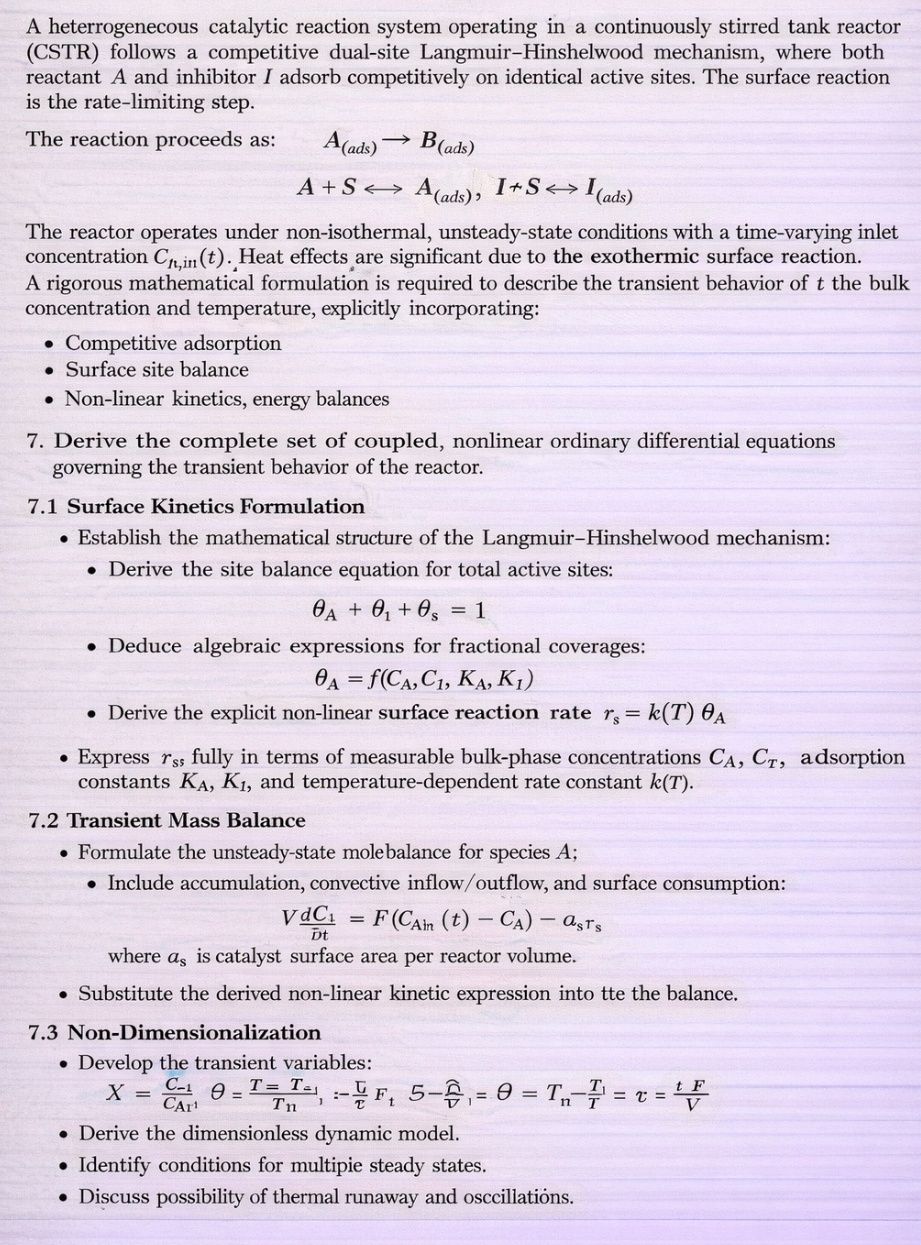
Act like a helpful tutor and explain step-by-step solution with explanation and final answer:A heterrogenecous catalytic reaction system operating in a continuously stirred tank reactor (CSTR) follows a competitive dual-site Langmuir-Hinshelwood mechanism, where both reactant A and inhibitor I adsorb competitively on identical active sites. The surface reaction is the rate-limiting step. The reaction proceeds as: Aut) = Busy A+S Ay, IS 1, The reactor operates under non-isothermal, unsteady-state conditions with a time-varying inlet concentration Cy, j, (t). Heat effects are significant due to the exothermic surface reaction. A rigorous mathematical formulation is required to describe the transient behavior of t the bulk concentration and temperature, explicitly incorporating: « Competitive adsorption Surface site balance o Non-linear kinetics, energy balances 7. Derive the complete set of coupled, nonlinear ordinary differential equations governing the transient behavior of the reactor. 7.1 Surface Kinetics Formulation eo Establish the mathematical structure of the Langmuir-Hinshelwood mechanism: o Derive the site balance equation for total active sites: Gs +6,+6; =1 * Deduce algebraic expressions for fractional coverages: 0a = f(Ca, C1, Ki, K1) © Derive the explicit non-linear surface reaction rate r,= k(T) 64 « Express rg fully in terms of measurable bulk-phase concentrations C4, Cr, adsorption constants Kj, Kj, and temperature-dependent rate constant k(T). 7.2 Transient Mass Balance « Formulate the unsteady-state molebalance for species A; o Include accumulation, convective inflow/outflow, and surface consumption: Vdc, =F (Can (t) = Ca) — ar, where ay is catalyst surface area per reactor volume. « Substitute the derived non-linear kinetic expression into tte the balance. 7.3 Non-Dimensionalization Develop the transient variables: lw? © = i — k ci 20 i) Gmina =e Uy 5-8,-0=TFT=p=FL eo Derive the dimensionless dynamic model. Identify conditions for multipie steady states. e Discuss possibility of thermal runaway and osccillations.

Question:

Act like a helpful tutor and explain step-by-step solution with explanation and final answer:Uploaded ImageA heterrogenecous catalytic reaction system operating in a continuously stirred tank reactor (CSTR) follows a competitive dual-site Langmuir-Hinshelwood mechanism, where both reactant A and inhibitor I adsorb competitively on identical active sites. The surface reaction is the rate-limiting step. The reaction proceeds as: Aut) = Busy A+S Ay, IS 1, The reactor operates under non-isothermal, unsteady-state conditions with a time-varying inlet concentration Cy, j, (t). Heat effects are significant due to the exothermic surface reaction. A rigorous mathematical formulation is required to describe the transient behavior of t the bulk concentration and temperature, explicitly incorporating: « Competitive adsorption Surface site balance o Non-linear kinetics, energy balances 7. Derive the complete set of coupled, nonlinear ordinary differential equations governing the transient behavior of the reactor. 7.1 Surface Kinetics Formulation eo Establish the mathematical structure of the Langmuir-Hinshelwood mechanism: o Derive the site balance equation for total active sites: Gs +6,+6; =1 * Deduce algebraic expressions for fractional coverages: 0a = f(Ca, C1, Ki, K1) © Derive the explicit non-linear surface reaction rate r,= k(T) 64 « Express rg fully in terms of measurable bulk-phase concentrations C4, Cr, adsorption constants Kj, Kj, and temperature-dependent rate constant k(T). 7.2 Transient Mass Balance « Formulate the unsteady-state molebalance for species A; o Include accumulation, convective inflow/outflow, and surface consumption: Vdc, =F (Can (t) = Ca) — ar, where ay is catalyst surface area per reactor volume. « Substitute the derived non-linear kinetic expression into tte the balance. 7.3 Non-Dimensionalization Develop the transient variables: lw? © = i — k ci 20 i) Gmina =e Uy 5-8,-0=TFT=p=FL eo Derive the dimensionless dynamic model. Identify conditions for multipie steady states. e Discuss possibility of thermal runaway and osccillations.
This is AI generated Response.
Asked by: Francis
Created at: 2026-02-17 08:47:55

Final Answer:

Rendered Raw Text
Did you like this answer?
Let's work **step-by-step** through the derivation and explanation, as requested in the image. --- # 1. **Langmuir–Hinshelwood Mechanism: Surface Kinetics Formulation** ## **a. Surface Site Balance** For two species (A and I) competing for the same surface sites \( S \): \[ \theta_A + \theta_I + \theta_S = 1 \] Where: - \( \theta_A \): Fraction of sites occupied by A - \( \theta_I \): Fraction by I - \( \theta_S \): Fraction unoccupied ## **b. Adsorption Isotherms** Assume adsorption–desorption equilibrium: \[ A + S \rightleftharpoons A_{ads} \] \[ I + S \rightleftharpoons I_{ads} \] Langmuir isotherms: \[ \theta_A = \frac{K_A C_A \theta_S}{1} \] \[ \theta_I = \frac{K_I C_I \theta_S}{1} \] Solve for \( \theta_S \) using the site balance: \[ \theta_A + \theta_I + \theta_S = 1 \implies K_A C_A \theta_S + K_I C_I \theta_S + \theta_S = 1 \implies \theta_S (1 + K_A C_A + K_I C_I) = 1 \implies \theta_S = \frac{1}{1 + K_A C_A + K_I C_I} \] Now, \[ \theta_A = \frac{K_A C_A}{1 + K_A C_A + K_I C_I} \] \[ \theta_I = \frac{K_I C_I}{1 + K_A C_A + K_I C_I} \] ## **c. Surface Reaction Rate** If the **rate-limiting** step is the reaction of adsorbed A: \[ r_s = k(T) \theta_A \] where \( k(T) \) is the temperature-dependent rate constant. So, \[ r_s = k(T) \frac{K_A C_A}{1 + K_A C_A + K_I C_I} \] --- # 2. **Transient Mass Balance** For species \( A \) in a CSTR: \[ V \frac{dC_A}{dt} = F \left[C_{A,in}(t) - C_A \right] - a_s r_s \] where: - \( V \): reactor volume - \( F \): volumetric flow rate - \( C_A \): bulk concentration of A - \( C_{A,in}(t) \): inlet concentration (can be time-varying) - \( a_s \): catalyst surface area per reactor volume - \( r_s \): surface reaction rate (from above) Substitute \( r_s \): \[ V \frac{dC_A}{dt} = F \left[C_{A,in}(t) - C_A \right] - a_s k(T) \frac{K_A C_A}{1 + K_A C_A + K_I C_I} \] A similar equation can be written for \( C_I \) if there is consumption or reaction for I. --- # 3. **Energy (Thermal) Balance** Since the reaction is **exothermic**, include temperature: \[ \rho C_p V \frac{dT}{dt} = F \rho C_p (T_{in} - T) + (-\Delta H_r) a_s r_s - Q_{loss} \] - \( \rho C_p \): heat capacity per volume - \( T \): reactor temperature - \( T_{in} \): inlet temperature - \( \Delta H_r \): heat of reaction (negative for exothermic) - \( Q_{loss} \): heat loss term --- # 4. **Coupled Nonlinear ODE System** Together, you have a **coupled, nonlinear ODE system** for \( C_A(t) \), \( C_I(t) \), and \( T(t) \): \[ \boxed{ \begin{align*} V \frac{dC_A}{dt} &= F \left[C_{A,in}(t) - C_A \right] - a_s k(T) \frac{K_A C_A}{1 + K_A C_A + K_I C_I} \\ V \frac{dC_I}{dt} &= F \left[C_{I,in}(t) - C_I \right] \\ \rho C_p V \frac{dT}{dt} &= F \rho C_p (T_{in} - T) + (-\Delta H_r) a_s k(T) \frac{K_A C_A}{1 + K_A C_A + K_I C_I} - Q_{loss} \end{align*} } \] --- # 5. **Non-Dimensionalization** Define dimensionless variables (as in the image): \[ X = \frac{C_A}{C_{A1}}, \quad Q = \frac{T - T_{in}}{T_n}, \quad \tau = \frac{t F}{V} \] Re-write the ODEs using these variables to get a dimensionless dynamical system. --- # **Summary (Final Answer)** **The complete set of coupled, nonlinear ODEs** governing the transient behavior of the reactor are: \[ \boxed{ \begin{align*} V \frac{dC_A}{dt} &= F \left[C_{A,in}(t) - C_A \right] - a_s k(T) \frac{K_A C_A}{1 + K_A C_A + K_I C_I} \\ V \frac{dC_I}{dt} &= F \left[C_{I,in}(t) - C_I \right] \\ \rho C_p V \frac{dT}{dt} &= F \rho C_p (T_{in} - T) + (-\Delta H_r) a_s k(T) \frac{K_A C_A}{1 + K_A C_A + K_I C_I} - Q_{loss} \end{align*} } \] where all terms, reaction rates, and coverages are explicitly defined above. --- **Next steps:** You can non-dimensionalize these equations, analyze steady states, and study stability (thermal runaway, oscillations) as outlined in the image. If you want to see the non-dimensional form or steady-state analysis, let me know!

📢 Instructions:

  • Ask anything relatd to above question only.
  • For new Question goto :

Study Help, Fast Answers

VIPSolutions focuses on clear, step‑by‑step explanations so you can learn quickly. Whether you need an AI‑generated walkthrough or a short hint to get unstuck, each solution is organized for fast reading and easy review later.

Search similar questions, compare approaches, and bookmark the best answers for revision. Our goal is simple: quick, reliable study help that feels natural—not noisy.