 VIPSolutions
Act like a helpful tutor and exlplain step-by-step solution with explanation and final answer:3. A gas of the following composition in percent by volume is burned in a heater with259 excess airCO2 = 6.5%, CH4 = 49.5%, CHo = 16.0%, H2-25.09%, N 2=25%. 02 = 0.5%Determine: a) Air to fuel ratio by volumeb) Volume of flue gas formed in burning 10 moles of fuel.c) Volume of air m ~ 3 at 21\deg C and 101.325 kPa in burning 10 moles of fuel.d) Partial pressure of H20 if the exhaust gas is at 200\deg C and 101.325 kPae) Volume of exhaust gas at 200\deg C , 101.325kPa per m #3 of fuel 20\deg C, 101.325kPa
Question:
Act like a helpful tutor and exlplain step-by-step solution with explanation and final answer: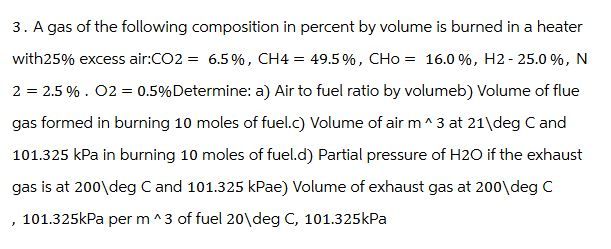 3. A gas of the following composition in percent by volume is burned in a heater
with259 excess airCO2 = 6.5%, CH4 = 49.5%, CHo = 16.0%, H2-25.09%, N
2=25%. 02 = 0.5%Determine: a) Air to fuel ratio by volumeb) Volume of flue
gas formed in burning 10 moles of fuel.c) Volume of air m ~ 3 at 21\deg C and
101.325 kPa in burning 10 moles of fuel.d) Partial pressure of H20 if the exhaust
gas is at 200\deg C and 101.325 kPae) Volume of exhaust gas at 200\deg C
, 101.325kPa per m #3 of fuel 20\deg C, 101.325kPa
This is AI generated Response.
Asked by: francis
Created at: 2026-02-18 06:07:42
Asked by: francis
Created at: 2026-02-18 06:07:42
Final Answer:
Rendered
Raw Text
Did you like this answer?
Let's break this problem into a step-by-step solution. We'll address each sub-question:
---
## **Given:**
- **Gas composition (by volume):**
- CO₂ = 6.5%
- CH₄ = 49.5%
- CO = 16.%
- H₂ = 25.%
- N₂ = 2.5%
- O₂ = .5%
- **Excess air:** 25%
- **Standard conditions:** 21°C, 101.325 kPa
---
## **Step 1: Write Combustion Reactions**
### **CH₄:**
\[
\text{CH}_4 + 2\text{O}_2 \rightarrow \text{CO}_2 + 2\text{H}_2\text{O}
\]
### **CO:**
\[
\text{CO} + .5\text{O}_2 \rightarrow \text{CO}_2
\]
### **H₂:**
\[
\text{H}_2 + .5\text{O}_2 \rightarrow \text{H}_2\text{O}
\]
---
## **Step 2: Assume a Basis**
Assume **100 moles** of fuel gas (so % = moles):
- CO₂: 6.5 mol
- CH₄: 49.5 mol
- CO: 16. mol
- H₂: 25. mol
- N₂: 2.5 mol
- O₂: .5 mol
---
## **Step 3: Calculate Theoretical Oxygen Requirement**
### **For CH₄:**
\[
49.5 \text{ mol} \times 2 = 99 \text{ mol O}_2
\]
### **For CO:**
\[
16. \text{ mol} \times .5 = 8. \text{ mol O}_2
\]
### **For H₂:**
\[
25. \text{ mol} \times .5 = 12.5 \text{ mol O}_2
\]
**Total theoretical O₂ needed:**
\[
99 + 8 + 12.5 = 119.5 \text{ mol}
\]
Subtract O₂ present in the fuel (.5 mol):
\[
119.5 - .5 = 119. \text{ mol O}_2 \text{ (net required)}
\]
---
## **Step 4: Calculate Air Required**
- **O₂ in air** = 21% by volume
- **Air needed (theoretical, for 100 mol fuel):**
\[
\text{Air} = \frac{119.}{.21} = 566.67 \text{ mol air}
\]
- **With 25% excess air:**
\[
\text{Air supplied} = 566.67 \times 1.25 = 708.3 \text{ mol air}
\]
---
## **Step 5: Air to Fuel Ratio (by Volume)**
- Fuel gas: 100 mol
- Air supplied: 708.3 mol
**Air-to-fuel ratio (by volume):**
\[
\boxed{7.08:1}
\]
---
## **Step 6: Volume of Flue Gas from 10 Moles Fuel**
### **Calculate Flue Gas Components for 10 mol Fuel**
Scale everything by .1 (since basis above is 100 mol):
- Air supplied: 70.83 mol (for 10 mol fuel)
#### **Dry Products:**
- CO₂ from CH₄: 49.5 × .1 = 4.95 mol
- CO₂ from CO: 16. × .1 = 1.6 mol
- CO₂ in fuel: 6.5 × .1 = .65 mol
- **Total CO₂:** \(4.95 + 1.6 + .65 = 7.2\) mol
- N₂ from air: Air supplied × .79 = 70.83 × .79 = 55.96 mol
- N₂ in fuel: 2.5 × .1 = .25 mol
- **Total N₂:** \(55.96 + .25 = 56.21\) mol
#### **Excess O₂:**
- O₂ supplied: 70.83 × .21 = 14.87 mol
- O₂ consumed: 11.9 mol (see above, for 10 mol fuel)
- **Excess O₂:** 14.87 - 11.9 = 2.97 mol
#### **H₂O:**
- From CH₄: 2 × 4.95 = 9.90 mol
- From H₂: 2 × 2.5 = 5. mol
- **Total H₂O:** 9.90 + 5. = 14.90 mol
### **Total Flue Gas (wet):**
\[
\text{CO}_2: 7.2\ \text{mol} \\
\text{N}_2: 56.21\ \text{mol} \\
\text{O}_2: 2.97\ \text{mol} \\
\text{H}_2\text{O}: 14.90\ \text{mol} \\
\text{Total:} = 7.2 + 56.21 + 2.97 + 14.90 = \boxed{81.28\ \text{mol}}
\]
---
## **Step 7: Volume of Air (at 21°C and 101.325 kPa) for 10 mol Fuel**
- Air supplied for 10 mol fuel = 70.83 mol
- Use ideal gas law: \( V = \frac{nRT}{P} \)
- \(R = .08206\ \text{L·atm/(mol·K)}\)
- \(T = 21^\circ C = 294.15\ K\)
- \(P = 101.325\ \text{kPa} = 1\ \text{atm}\)
\[
V = nRT/P = 70.83 \times .08206 \times 294.15 / 1 = 1,710.38\ \text{L} = 1.71\ \text{m}^3
\]
---
## **Step 8: Partial Pressure of H₂O (at 200°C, 101.325 kPa)**
- Total moles (from above): 81.28 mol
- H₂O moles: 14.90 mol
\[
P_{\text{H}_2\text{O}} = \frac{14.90}{81.28} \times 101.325\ \text{kPa} = 18.57\ \text{kPa}
\]
---
## **Step 9: Volume of Exhaust Gas at 200°C, 101.325 kPa per 1 m³ Fuel at 20°C, 101.325 kPa**
### **Calculate moles of fuel per 1 m³ at 20°C, 101.325 kPa**
- \( T = 20^\circ C = 293.15 K \)
- \( P = 101.325 kPa \)
- \( V = 1 m^3 = 100 L \)
\[
n_{\text{fuel}} = \frac{PV}{RT} = \frac{101.325 \times 100}{8.314 \times 293.15} = 41.55\ \text{mol}
\]
### **Moles of exhaust gas:**
\[
81.28\ \text{mol (flue) per 10 mol fuel} \implies 8.128\ \text{mol per 1 mol fuel}
\]
\[
\text{Total moles} = 41.55 \times 8.128 = 337.76\ \text{mol}
\]
### **Volume at 200°C (473.15 K), 101.325 kPa**
\[
V = \frac{nRT}{P} = \frac{337.76 \times 8.314 \times 473.15}{101.325} = 13,106.7\ \text{L} = 13.1\ \text{m}^3
\]
---
## **Summary of Answers**
### **a) Air to fuel ratio by volume:**
\[
\boxed{7.08:1}
\]
### **b) Volume of flue gas formed from 10 mol of fuel:**
\[
\boxed{81.28\ \text{mol (wet)}}
\]
### **c) Volume of air (at 21°C, 101.325 kPa) for 10 mol of fuel:**
\[
\boxed{1.71\ \text{m}^3}
\]
### **d) Partial pressure of H₂O in exhaust gas at 200°C, 101.325 kPa:**
\[
\boxed{18.57\ \text{kPa}}
\]
### **e) Volume of exhaust gas at 200°C, 101.325 kPa per 1 m³ fuel at 20°C, 101.325 kPa:**
\[
\boxed{13.1\ \text{m}^3}
\]
---
If you want to see the calculations for a specific part in more depth, let me know!
📢 Instructions:
- Ask anything relatd to above question only.
- For new Question goto :