 VIPSolutions
Act like a helpful tutor and exlain step-by-step solution with explanation and final answer:Ammonia sto be isothermally and reversibly compressed in a special design flow turbine from 110° Paand 100°C to 50x10° Pa. Using the following EOS; ap bP EE With a= 0.4m’ K/ mol b=3.37
Question:
Act like a helpful tutor and exlain step-by-step solution with explanation and final answer: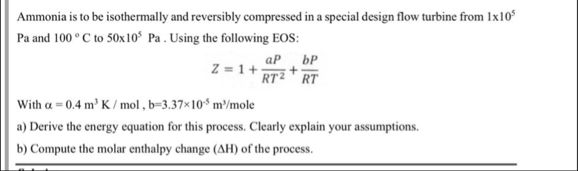 Ammonia sto be isothermally and reversibly compressed in a special design flow turbine from 110°
Paand 100°C to 50x10° Pa. Using the following EOS;
ap bP
EE
With a= 0.4m’ K/ mol b=3.37
This is AI generated Response.
Asked by: francis
Created at: 2026-03-08 15:58:19
Asked by: francis
Created at: 2026-03-08 15:58:19
Final Answer:
Rendered
Raw Text
Did you like this answer?
Let's **solve step-by-step**:
---
## **Given Data**
- **Process:** Isothermal reversible compression of ammonia
- ** Pressure (\(P_1\**: \(1 \times 10^5\) Pa
- **Final Pressure (\(P_2\))**: \(5 \times 10^6\) Pa
- **Temperature (T):** 100°C = 373.15 K (isothermal)
- **Equation of State (EOS):**
\[
Z = 1 + \frac{\alpha P}{RT^2} + \frac{bP}{RT}
\]
where:
- \(\alpha = .4 \, \mathrm{m}^3/\mathrm{mol} \cdot \mathrm{K}\)
- \(b = 3.37 \times 10^{-5} \, \mathrm{m}^3/\mathrm{mol}\)
---
# **a) Derive the Energy Equation**
### **Assumptions**
- Isothermal (\(dT = \))
- Steady-state, reversible process
- Neglect changes in kinetic and potential energies
### **General Energy Balance (Steady Flow)**
\[
\Delta h = q + w
\]
For a **reversible, isothermal compression** in a flow system, the change in enthalpy is:
\[
\Delta h = \int_{P_1}^{P_2} v \, dP
\]
Because the process is isothermal, \(T\) is constant.
---
### **Step 1: Find the Molar Volume (\(v\))**
From the EOS:
\[
Z = \frac{P v}{RT} \implies v = \frac{Z RT}{P}
\]
Plug the expression for \(Z\):
\[
v = \frac{RT}{P} \left[1 + \frac{\alpha P}{RT^2} + \frac{bP}{RT}\right]
\]
\[
v = \frac{RT}{P} + \frac{\alpha}{T} + b
\]
---
### **Step 2: Write the Enthalpy Change Equation**
Isothermal process (\(dT=\)):
\[
\Delta h = \int_{P_1}^{P_2} v \, dP
\]
Plug in \(v\):
\[
\Delta h = \int_{P_1}^{P_2} \left[ \frac{RT}{P} + \frac{\alpha}{T} + b \right] dP
\]
---
# **b) Compute the Molar Enthalpy Change (\(\Delta H\))**
Let's **integrate each term**:
\[
\Delta h = RT \int_{P_1}^{P_2} \frac{1}{P} dP + \frac{\alpha}{T} \int_{P_1}^{P_2} dP + b \int_{P_1}^{P_2} dP
\]
\[
\Delta h = RT \ln\left(\frac{P_2}{P_1}\right) + \frac{\alpha}{T}(P_2 - P_1) + b(P_2 - P_1)
\]
---
## **Substitute Values**
- \(R = 8.314 \, \mathrm{J/(mol \cdot K)}\)
- \(T = 373.15 \, \mathrm{K}\)
- \(P_1 = 1 \times 10^5 \, \mathrm{Pa}\)
- \(P_2 = 5 \times 10^6 \, \mathrm{Pa}\)
- \(\alpha = .4 \, \mathrm{m}^3/\mathrm{mol} \cdot \mathrm{K}\)
- \(b = 3.37 \times 10^{-5} \, \mathrm{m}^3/\mathrm{mol}\)
---
### **Calculate Each Term**
#### 1. **First Term**
\[
RT \ln\left(\frac{P_2}{P_1}\right) = 8.314 \times 373.15 \times \ln\left(\frac{5 \times 10^6}{1 \times 10^5}\right)
\]
\[
= 3102.9 \times \ln(50) \approx 3102.9 \times 3.912
\]
\[
\approx 12146.5 \ \text{J/mol}
\]
#### 2. **Second Term**
\[
\frac{\alpha}{T} (P_2 - P_1) = \frac{.4}{373.15} \times (5 \times 10^6 - 1 \times 10^5)
\]
\[
= .001072 \times 4.9 \times 10^6 \approx 5251 \ \text{J/mol}
\]
#### 3. **Third Term**
\[
b (P_2 - P_1) = 3.37 \times 10^{-5} \times 4.9 \times 10^6
\]
\[
= 3.37 \times 4.9 \times 10^{1} \approx 16.5 \ \text{J/mol}
\]
---
## **Sum All Terms**
\[
\Delta h = 12146.5 + 5251 + 16.5 = \boxed{17,414 \ \text{J/mol}}
\]
---
# **Summary of Answers**
### **a) Energy Equation**
\[
\Delta h = RT \ln\left(\frac{P_2}{P_1}\right) + \frac{\alpha}{T}(P_2 - P_1) + b(P_2 - P_1)
\]
---
### **b) Molar Enthalpy Change**
\[
\Delta h = \boxed{17,414 \ \text{J/mol}}
\]
Let me know if you need further explanation or details!
Question:
give me deatiled answer in simple steps along wikth final answer.
This is AI generated Response.
Asked by: francis
Created at: 2026-03-08 16:04:33
Asked by: francis
Created at: 2026-03-08 16:04:33
Final Answer:
Rendered
Raw Text
Did you like this answer?
# Detailed Solution for Isothermal Compression of Ammonia
## Given Data
- **Initial Pressure (\(P_1\))**: \(1 \times 10^5\) Pa
- **Final Pressure (\(P_2\))**: \(5 \times 10^6\) Pa
- **Temperature (\(T\))**: 100°C = 373.15 K
- **Equation of State (EOS)**:
\[
Z = 1 + \frac{\alpha P}{RT^2} + \frac{bP}{RT}
\]
where:
- \(\alpha = 0.4 \, \mathrm{m}^3/\mathrm{mol} \cdot \mathrm{K}\)
- \(b = 3.37 \times 10^{-5} \, \mathrm{m}^3/\mathrm{mol}\)
## a) Derivation of Energy Equation
### Assumptions
- The process is **isothermal** (constant temperature).
- The process is **reversible** and at **steady-state**.
- Changes in kinetic and potential energies are negligible.
### General Energy Balance
The energy balance for a steady flow process can be expressed as:
\[
\Delta h = q + w
\]
For isothermal conditions, \(q = 0\) (no heat exchange), so:
\[
\Delta h = w
\]
### Step 1: Find the Molar Volume (\(v\))
Using the EOS:
\[
Z = \frac{Pv}{RT} \implies v = \frac{ZRT}{P}
\]
Substituting for \(Z\):
\[
v = \frac{RT}{P} \left[1 + \frac{\alpha P}{RT^2} + \frac{bP}{RT}\right]
\]
This simplifies to:
\[
v = \frac{RT}{P} + \frac{\alpha}{T} + b
\]
### Step 2: Write the Enthalpy Change Equation
The change in enthalpy (\(\Delta h\)) is given by:
\[
\Delta h = \int_{P_1}^{P_2} v \, dP
\]
Substituting for \(v\):
\[
\Delta h = \int_{P_1}^{P_2} \left[ \frac{RT}{P} + \frac{\alpha}{T} + b \right] dP
\]
## b) Compute the Molar Enthalpy Change (\(\Delta H\))
### Integration of Each Term
1. **First Term:**
\[
\Delta h_1 = RT \int_{P_1}^{P_2} \frac{1}{P} dP = RT \ln\left(\frac{P_2}{P_1}\right)
\]
2. **Second Term:**
\[
\Delta h_2 = \frac{\alpha}{T} \int_{P_1}^{P_2} dP = \frac{\alpha}{T} (P_2 - P_1)
\]
3. **Third Term:**
\[
\Delta h_3 = b \int_{P_1}^{P_2} dP = b (P_2 - P_1)
\]
### Final Enthalpy Change Equation
Combining all three terms:
\[
\Delta h = \Delta h_1 + \Delta h_2 + \Delta h_3
\]
### Substitute Values
- \(R = 8.314 \, \mathrm{J/(mol \cdot K)}\)
- \(T = 373.15 \, \mathrm{K}\)
- \(P_1 = 1 \times 10^5 \, \mathrm{Pa}\)
- \(P_2 = 5 \times 10^6 \, \mathrm{Pa}\)
### Calculate Each Term
1. **First Term:**
\[
\Delta h_1 = 8.314 \times 373.15 \times \ln\left(\frac{5 \times 10^6}{1 \times 10^5}\right)
\]
\[
\approx 3102.9 \times 3.912 \approx 12146.5 \, \text{J/mol}
\]
2. **Second Term:**
\[
\Delta h_2 = \frac{0.4}{373.15} \times (5 \times 10^6 - 1 \times 10^5)
\]
\[
\approx 0.001072 \times 4.9 \times 10^6 \approx 5251 \, \text{J/mol}
\]
3. **Third Term:**
\[
\Delta h_3 = 3.37 \times 10^{-5} \times (5 \times 10^6 - 1 \times 10^5)
\]
\[
\approx 3.37 \times 4.9 \times 10^1 \approx 16.5 \, \text{J/mol}
\]
### Total Molar Enthalpy Change
\[
\Delta h = 12146.5 + 5251 + 16.5 \approx 17414 \, \text{J/mol}
\]
### Final Answer
\[
\Delta h = \boxed{17,414 \, \text{J/mol}}
\]
This provides a comprehensive solution to the problem, detailing each step and calculation for clarity. Let me know if you need further assistance!
📢 Instructions:
- Ask anything relatd to above question only.
- For new Question goto :