 VIPSolutions
Act like a helpful tutor and exlain step-by-step solution with explanation and final answer:1. An industrial chemical synthesis continuously utilizes a perfectly mixed hydrodynamic flow vessel operating under strict non-isothermal thermal parameters to successfully process a complex first-order exothermic liquid phase molecular transformation. The liquid reactant feed stream enters the processing boundary precisely at ambient standard thermal conditions. Determine the exact steady-state operating volumetric throughput capacity required to successfully achieve a critical ninety-five percent fractional conversion threshold, given the specific predetermined pre-exponential kinetic frequency factor, the experimentally derived thermal activation barrier, and the absolute physical interior spatial volume of the reaction containment vessel. ky = 4.5 x 10⁵s 1, E, = 85000 Jmol, V = 15m", T = 350 K. 2. A spherical heterogeneous highly porous catalyst architecture facilitates a simultaneous intrapellet isothermal molecular diffusion and internal first-order catalytic transformation. The surface macroscopic boundary conditions dictate a completely constant external reactant concentration environment. Formulate the comprehensive mathematical description characterizing the internal molecular reactant concentration gradient utilizing the fundamental microscopic spherical shell balance methodology. a) Derive the fundamental second-order ordinary differential equation governing the steady-state transport processes within the spherical domain. &c 2dC kk rar C0 b) Establish the requisite symmetry and external boundary constraints required for analytical integration. dc = =0,C(R)=C, c) Derive the exact explicit algebraic formulation representing the spatial concentration profile from the center to the exterior surface. Clr) = 0, BOF) sinh(¢)
Question:
Act like a helpful tutor and exlain step-by-step solution with explanation and final answer: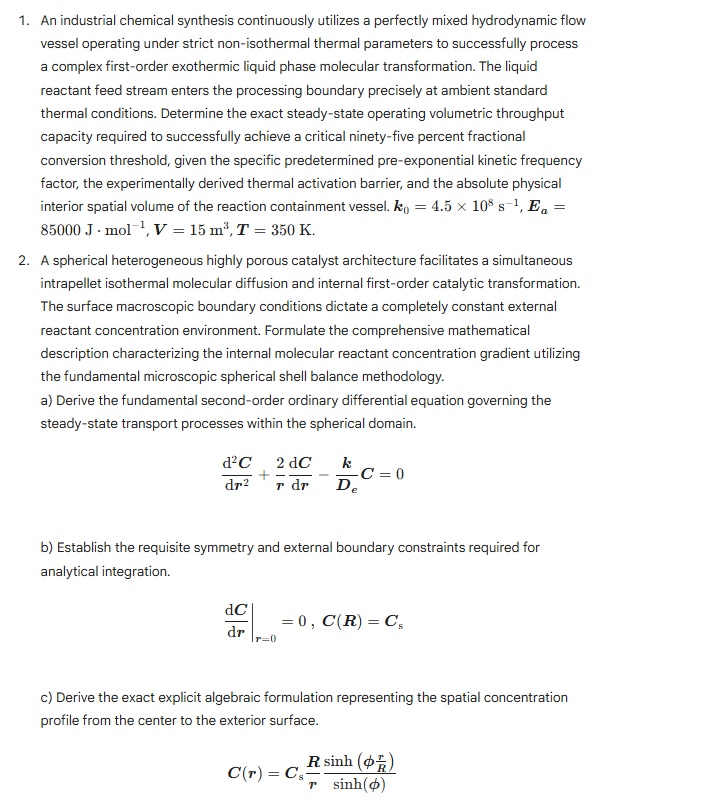 1. An industrial chemical synthesis continuously utilizes a perfectly mixed hydrodynamic flow
vessel operating under strict non-isothermal thermal parameters to successfully process
a complex first-order exothermic liquid phase molecular transformation. The liquid
reactant feed stream enters the processing boundary precisely at ambient standard
thermal conditions. Determine the exact steady-state operating volumetric throughput
capacity required to successfully achieve a critical ninety-five percent fractional
conversion threshold, given the specific predetermined pre-exponential kinetic frequency
factor, the experimentally derived thermal activation barrier, and the absolute physical
interior spatial volume of the reaction containment vessel. ky = 4.5 x 10⁵s 1, E, =
85000 Jmol, V = 15m", T = 350 K.
2. A spherical heterogeneous highly porous catalyst architecture facilitates a simultaneous
intrapellet isothermal molecular diffusion and internal first-order catalytic transformation.
The surface macroscopic boundary conditions dictate a completely constant external
reactant concentration environment. Formulate the comprehensive mathematical
description characterizing the internal molecular reactant concentration gradient utilizing
the fundamental microscopic spherical shell balance methodology.
a) Derive the fundamental second-order ordinary differential equation governing the
steady-state transport processes within the spherical domain.
&c 2dC kk
rar C0
b) Establish the requisite symmetry and external boundary constraints required for
analytical integration.
dc
= =0,C(R)=C,
c) Derive the exact explicit algebraic formulation representing the spatial concentration
profile from the center to the exterior surface.
Clr) = 0, BOF)
sinh(¢)
Asked by: Francis
Created at: 2026-03-05 09:19:35
Final Answer:
📢 Instructions:
- Ask anything relatd to above question only.
- For new Question goto :