 VIPSolutions
Act like a helpful tutor and exlain step-by-step solution with explanation and final answer: (Give me answer without using bulletr-points0PI. Assuming constant volume and physical properties in a perfectly mixed non-isothermal CSTR where an irreversible exothermic reaction A — B occurs, the dynamic energy balance and companent continuity equations govern the temporal evolution of reactor temperature and concentration. Considering the cooling jacket dynamics are negligible and the heat transfer coefficient remains constant, an analytical reconstruction of the linearized state-space model becomes strictly necessary to evaluate process stability. FyCas fg r T. = «30 iP Ca [ Teo F. oo am F Ta Te 4 Bir ei Teo R= Ay ~AHew |p U « Derivation of the unsteady-state non-linear differential equations describing the rate of change of reactor temperature and reactant concentration is required. « Linearization of the governing equations around a specified steady-state operating point must be performed to obtain the Jacobian matrix. « Determination of the open-loop transfer functions relating the reactor temperature to the cooling medium flow rate and the inlet temperature is essential. « Analysis of the characteristic equation to establish the conditions for localized stability using the Routh-Hurwitz criterion demands execution. P2. Given a cylindrical tank with a non-linear outlet flow resistance and a first-order valve dynamic, the closed-I response under proportional-integral-derivative control requires precise mathematical formulation. Assuming the inlet flow s the manipulated variable and the liquid level is the controlled variable, a complete evaluation of the system's dynamic behavior kK, i) Pr Py Fa ov | h h f| R Fou A « Development of the overall closed-loop transfer function relating the liquid level to a setpoint change is necessary, incorporating the dynamics of the process, valve, and controller. + Establishment of the condition for the elimination of offset for a step change in setpoint is required. « Derivation of the expression for the decay ratio and natural period of oscillation for the closed-loop system must be carried out. * Evaluation of the closed-loop transfer function relating the liquid level to a disturbance in the outlet flow resistance demands establishment. + Determination of the steady-state error for a step disturbance in the outlet resistance is essential. « Analysis of the effect of the integral time constant on the speed of response and stability is required. « Determination of the range of controller gain values for which the closed-loop system remains stable using the direct substitution method must be performed. « Application of the Cohen-Coon tuning method to determine initial controller settings based on an open-loop step test reaction curve demands execution.
Question:
Act like a helpful tutor and exlain step-by-step solution with explanation and final answer:
(Give me answer without using bulletr-points0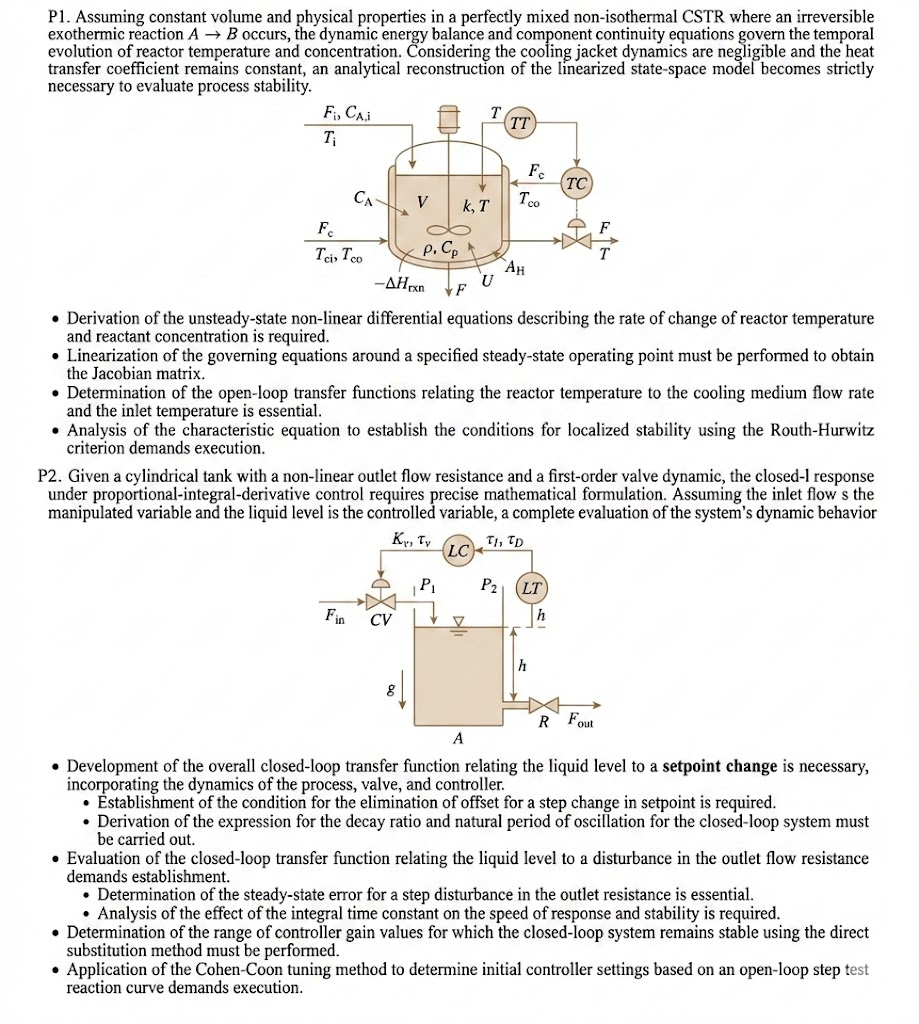 PI. Assuming constant volume and physical properties in a perfectly mixed non-isothermal CSTR where an irreversible
exothermic reaction A — B occurs, the dynamic energy balance and companent continuity equations govern the temporal
evolution of reactor temperature and concentration. Considering the cooling jacket dynamics are negligible and the heat
transfer coefficient remains constant, an analytical reconstruction of the linearized state-space model becomes strictly
necessary to evaluate process stability.
FyCas fg r
T. =
«30 iP
Ca [ Teo
F. oo am F
Ta Te 4 Bir
ei Teo R= Ay
~AHew |p U
« Derivation of the unsteady-state non-linear differential equations describing the rate of change of reactor temperature
and reactant concentration is required.
« Linearization of the governing equations around a specified steady-state operating point must be performed to obtain
the Jacobian matrix.
« Determination of the open-loop transfer functions relating the reactor temperature to the cooling medium flow rate
and the inlet temperature is essential.
« Analysis of the characteristic equation to establish the conditions for localized stability using the Routh-Hurwitz
criterion demands execution.
P2. Given a cylindrical tank with a non-linear outlet flow resistance and a first-order valve dynamic, the closed-I response
under proportional-integral-derivative control requires precise mathematical formulation. Assuming the inlet flow s the
manipulated variable and the liquid level is the controlled variable, a complete evaluation of the system's dynamic behavior
kK, i)
Pr Py
Fa ov | h
h
f|
R Fou
A
« Development of the overall closed-loop transfer function relating the liquid level to a setpoint change is necessary,
incorporating the dynamics of the process, valve, and controller.
+ Establishment of the condition for the elimination of offset for a step change in setpoint is required.
« Derivation of the expression for the decay ratio and natural period of oscillation for the closed-loop system must
be carried out.
* Evaluation of the closed-loop transfer function relating the liquid level to a disturbance in the outlet flow resistance
demands establishment.
+ Determination of the steady-state error for a step disturbance in the outlet resistance is essential.
« Analysis of the effect of the integral time constant on the speed of response and stability is required.
« Determination of the range of controller gain values for which the closed-loop system remains stable using the direct
substitution method must be performed.
« Application of the Cohen-Coon tuning method to determine initial controller settings based on an open-loop step test
reaction curve demands execution.
Asked by: Francis
Created at: 2026-03-04 07:56:37
Final Answer:
📢 Instructions:
- Ask anything relatd to above question only.
- For new Question goto :