 VIPSolutions
Act like a helpful tutor and exlain step-by-step solution with explanation and final answer.Problem 2 (35 points) A continuous mixer mixes NaOH with H>0 to produce an aqueous solution of NaOH. Determine the composition and flow rate of the product if the flow rate of NaOH is 100kg/hr, and the ratio of the flow rate of the H20 to the product solution is 0.9. Proceed as follows: 1- Choose a basis 2- Draw a flowchart 3- Place the information of the problem on the streams and label the unknowns. 4- Carry out degree-of-freedom analysis 5- Set up equations and solve them.
Question:
Act like a helpful tutor and exlain step-by-step solution with explanation and final answer.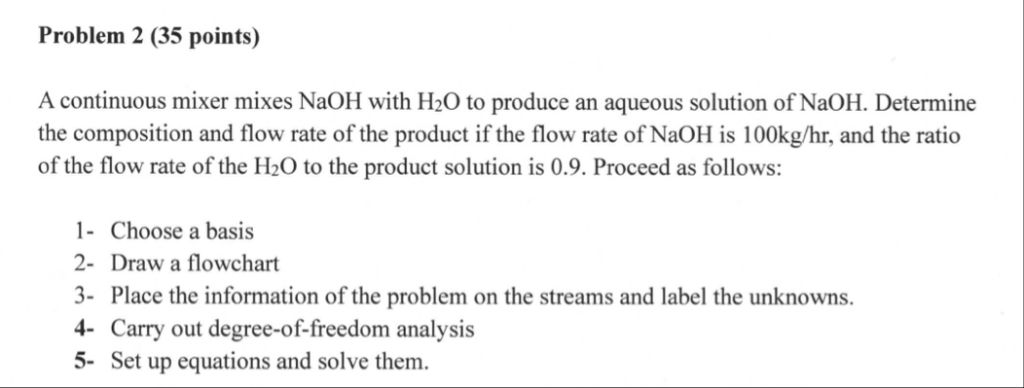 Problem 2 (35 points)
A continuous mixer mixes NaOH with H>0 to produce an aqueous solution of NaOH. Determine
the composition and flow rate of the product if the flow rate of NaOH is 100kg/hr, and the ratio
of the flow rate of the H20 to the product solution is 0.9. Proceed as follows:
1- Choose a basis
2- Draw a flowchart
3- Place the information of the problem on the streams and label the unknowns.
4- Carry out degree-of-freedom analysis
5- Set up equations and solve them.
This is AI generated Response.
Asked by: Francis
Created at: 2026-03-03 09:43:50
Asked by: Francis
Created at: 2026-03-03 09:43:50
Final Answer:
Rendered
Raw Text
Did you like this answer?
Let's solve the problem step by step as instructed:
---
## **Step 1: Choose a Basis**
Let's use the flow rate of NaOH as the basis, as given:
- **Basis:** 100 kg NaOH/hr
---
## **Step 2: Draw a Flowchart**
```
+---------+ +----------------------+
NaOH--| | | |---> Product (NaOH + H₂O)
| Mixer |----->| NaOH (100 kg/hr) |
H₂O---| | | H₂O (unknown, y) |
+---------+ +----------------------+
```
- Input streams: NaOH (100 kg/hr), H₂O (let's call it **y** kg/hr)
- Output stream: Product (NaOH + H₂O, total = **z** kg/hr)
---
## **Step 3: Place Information and Label Unknowns**
Given:
- Flow rate of NaOH = 100 kg/hr
- Flow rate of H₂O = **y** kg/hr (unknown)
- Product flow rate = **z** kg/hr (unknown)
- Ratio of H₂O to product flow rate = .9
---
## **Step 4: Degree-of-Freedom Analysis**
Let's count unknowns and equations:
- Unknowns: y (H₂O in), z (product out)
- Equations:
1. Total mass balance
2. Ratio relation
Number of equations = number of unknowns → **system is solvable**
---
## **Step 5: Set Up Equations and Solve**
**Equation 1: Mass Balance**
\[
\text{Total input} = \text{Total output}
\]
\[
100 + y = z
\]
**Equation 2: Ratio of H₂O to Product**
\[
\frac{\text{H}_2\text{O (in product)}}{\text{Product}} = .9
\]
Since all H₂O in goes to product,
\[
\frac{y}{z} = .9
\]
\[
y = .9z
\]
**Now substitute Equation 2 into Equation 1:**
\[
100 + y = z \implies 100 + .9z = z
\]
\[
100 = z - .9z
\]
\[
100 = .1z
\]
\[
z = \frac{100}{.1} = 100 \text{ kg/hr}
\]
**Now solve for y:**
\[
y = .9z = .9 \times 100 = 900 \text{ kg/hr}
\]
---
## **Final Answers**
### **a) Flow Rate of Product**
\[
\boxed{100\ \text{kg/hr}}
\]
### **b) Composition of Product**
- NaOH in product: \( 100\ \text{kg/hr} \)
- H₂O in product: \( 900\ \text{kg/hr} \)
#### **Mass fractions:**
- NaOH: \( \frac{100}{100} = .10 \) (**10 wt%**)
- H₂O: \( \frac{900}{100} = .90 \) (**90 wt%**)
### **Summary Table**
| Component | Flow rate (kg/hr) | Mass fraction |
|-----------|-------------------|--------------|
| NaOH | 100 | .10 |
| H₂O | 900 | .90 |
| **Total** | 100 | 1.00 |
---
## **Boxed Final Answers**
- **Product flow rate:** \(\boxed{100\ \text{kg/hr}}\)
- **Product composition:**
- \(\boxed{10\%}\) NaOH by mass
- \(\boxed{90\%}\) H₂O by mass
Let me know if you need further clarifications or a diagram!
📢 Instructions:
- Ask anything relatd to above question only.
- For new Question goto :