 VIPSolutions
Act like a helpful tutor and exlain step-by-step solution with explanation and final answer:2. A drug-eluting stent has a polymer coating that releases an anticoagulant into the arterial wall. The stent has an inner radius of 1.2 mm and an outer radius of 1.8 mm. The diffusion coefficient of the drug in the polymer is 2.5x107"° m?/s. The drug concentration at the inner surface of the polymer (adjacent to the stent) is 15 mg/mL, while at the outer surface (in contact with the artery) it is 2 mg/mL. Determine the transport rate of the drug in pg/hr per centimeter of stent length. If dosing over 2 pg/hr is needed, what variables can be changed (and how) to adjust the rate?
Question:
Act like a helpful tutor and exlain step-by-step solution with explanation and final answer: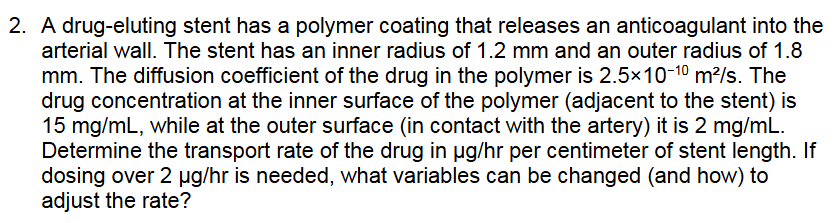 2. A drug-eluting stent has a polymer coating that releases an anticoagulant into the
arterial wall. The stent has an inner radius of 1.2 mm and an outer radius of 1.8
mm. The diffusion coefficient of the drug in the polymer is 2.5x107"° m?/s. The
drug concentration at the inner surface of the polymer (adjacent to the stent) is
15 mg/mL, while at the outer surface (in contact with the artery) it is 2 mg/mL.
Determine the transport rate of the drug in pg/hr per centimeter of stent length. If
dosing over 2 pg/hr is needed, what variables can be changed (and how) to
adjust the rate?
This is AI generated Response.
Asked by: Francis
Created at: 2026-03-03 09:23:29
Asked by: Francis
Created at: 2026-03-03 09:23:29
Final Answer:
Rendered
Raw Text
Did you like this answer?
Let's break down and solve the problem step by step.
---
## **Step 1: Problem Summary & Data**
**Given:**
- **Inner radius, \( r_1 \) = 1.2 mm**
- **Outer radius, \( r_2 \) = 1.8 mm**
- **Diffusion coefficient, \( D = 2.5 \times 10^{-10} \) m²/s**
- **Concentration at \( r_1 \): \( C_1 = 15 \) mg/mL**
- **Concentration at \( r_2 \): \( C_2 = 2 \) mg/mL**
- **Find:** Drug transport rate in µg/hr per cm of stent length.
- **If rate > 2 µg/hr,** how to adjust variables to achieve this?
---
## **Step 2: Use Fick’s Law for Cylindrical Coordinates**
For steady-state diffusion through a cylindrical shell (polymer coating):
\[
J = \frac{dQ}{dt} = \frac{2 \pi L D (C_1 - C_2)}{\ln(r_2/r_1)}
\]
Where:
- \( J \) = mass transport rate (mg/s)
- \( L \) = length of the cylinder (we'll use 1 cm = .01 m for per cm)
- \( D \) = diffusion coefficient
- \( C_1, C_2 \) = concentrations at \( r_1, r_2 \)
- \( r_1, r_2 \) = inner and outer radii (in meters)
---
## **Step 3: Convert Units**
- Radii: \( r_1 = 1.2 \) mm = **.0012 m**; \( r_2 = 1.8 \) mm = **.0018 m**
- Concentrations: \( 1 \) mg/mL = \( 1 \) g/L = **100 mg/L** (so \( C_1 = 15000 \) mg/L, \( C_2 = 200 \) mg/L)
- Length: \( L = 1 \) cm = **.01 m**
---
## **Step 4: Plug In Values**
\[
J = \frac{2 \pi (.01) (2.5 \times 10^{-10}) (15000 - 200)}{\ln(.0018/.0012)}
\]
Calculate denominator:
\[
\ln\left(\frac{.0018}{.0012}\right) = \ln(1.5) \approx .4055
\]
Calculate numerator:
\[
(15000 - 200) = 13000 \text{ mg/L}
\]
\[
2 \pi (.01) (2.5 \times 10^{-10}) (13000) = 2 \times 3.1416 \times .01 \times 2.5 \times 10^{-10} \times 13000
\]
\[
= 6.2832 \times .01 \times 2.5 \times 10^{-10} \times 13000
\]
\[
= .062832 \times 2.5 \times 10^{-10} \times 13000
\]
\[
= .062832 \times 3.25 \times 10^{-6}
\]
\[
= 2.04204 \times 10^{-7}
\]
But let's use unit analysis:
- \( D \) is in \( m^2/s \)
- \( L \) is in \( m \)
- Concentration in \( mg/L = mg/.001 m^3 = 10^6 mg/m^3 \)
So, convert \( 13000 \) mg/L to \( 1.3 \times 10^{10} \) mg/m³:
\[
13,000 \text{ mg/L} \times 100 \text{ L/m}^3 = 1.3 \times 10^7 \text{ mg/m}^3
\]
Now, recalculate numerator:
\[
2 \pi \times .01 \times 2.5 \times 10^{-10} \times 1.3 \times 10^7
\]
\[
= .062832 \times 2.5 \times 10^{-10} \times 1.3 \times 10^7
\]
\[
= .062832 \times 3.25 \times 10^{-3}
\]
\[
= .000204204 \text{ mg/s}
\]
Now, divide by denominator \( \ln(1.5) \approx .4055 \):
\[
J = \frac{.000204204}{.4055} \approx .000504 \text{ mg/s}
\]
---
## **Step 5: Convert to µg/hr**
- \( 1 \) mg = \( 100 \) µg
- \( 1 \) s = \( 1/360 \) hr
\[
J = .000504 \text{ mg/s} \times 100 \frac{\mu g}{mg} \times 360 \frac{s}{hr} = .504 \times 360 = 1814.4 \text{ µg/hr}
\]
---
## **Final Answer**
### **Transport rate = \(\boxed{1814 \ \mu g/hr}\) per centimeter of stent length.**
---
## **Step 6: Adjusting the Rate**
If dosing over **2 µg/hr** is needed, variables that can be changed:
1. **Increase Diffusion Coefficient (\( D \)):**
- Use a polymer with a higher \( D \).
2. **Increase Concentration Gradient (\( C_1 - C_2 \)):**
- Increase \( C_1 \) (more drug loaded).
- Decrease \( C_2 \) (enhance clearance at the artery surface).
3. **Increase Thickness (\( r_2 - r_1 \)):**
- **But:** Increasing thickness decreases the rate, as \( \ln(r_2/r_1) \) increases.
- **To decrease the rate**, increase the thickness.
4. **Decrease Thickness:**
- **To increase the rate**, decrease the thickness (smaller \( \ln(r_2/r_1) \)).
5. **Change stent length (\( L \)):**
- Longer stent, more total release.
### **To decrease the rate to 2 µg/hr:**
- **Increase the polymer thickness** (\( r_2 - r_1 \))
- **Decrease \( C_1 \)** (lower drug loading in the polymer)
- **Decrease the stent length** (if possible in the application)
---
## **Summary Table**
| Variable | Increase to INCREASE rate? | Decrease to DECREASE rate? |
|-----------------|------------------|-------------------|
| Diffusion coeff (\( D \)) | Yes | No |
| Conc. gradient (\( C_1-C_2 \))| Yes | No |
| Thickness (\( r_2-r_1 \)) | No | Yes |
| Stent length (\( L \)) | Yes | No |
---
## **Boxed Final Answers**
**Transport rate per cm = \(\boxed{1814 \ \mu g/hr}\)**
**To reduce to 2 µg/hr,** increase the polymer thickness, decrease drug loading, or decrease stent length.
📢 Instructions:
- Ask anything relatd to above question only.
- For new Question goto :