 VIPSolutions
Act like a helpful tutor and exlain step-by-step solution with explanation and final answer:For simple-shear flow, the shear rate can be written as y=Vv+0vv" Write down all components of the shear-rate tensor. Determine the magnitude of shear rate for this case. —_—V y LL.
Question:
Act like a helpful tutor and exlain step-by-step solution with explanation and final answer: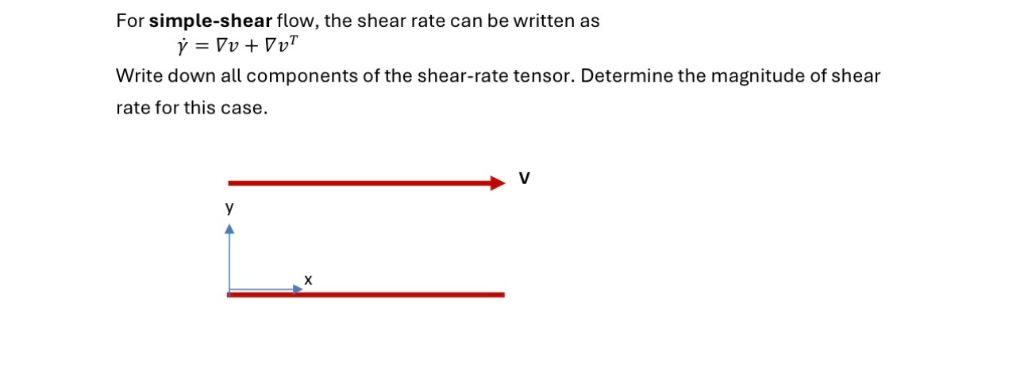 For simple-shear flow, the shear rate can be written as
y=Vv+0vv"
Write down all components of the shear-rate tensor. Determine the magnitude of shear
rate for this case.
—_—V
y
LL.
This is AI generated Response.
Asked by: Francis
Created at: 2026-03-02 01:59:20
Asked by: Francis
Created at: 2026-03-02 01:59:20
Final Answer:
Rendered
Raw Text
Did you like this answer?
# Solution: Shear Rate Tensor for Simple Shear Flow
Let's break down the problem and solve it step by step.
---
## 1. **Understanding the Velocity Field**
For simple shear flow:
- The velocity is in the x-direction and varies linearly with y:
\[
\mathbf{v} = (v_x, v_y) = (v(y), )
\]
- Typically, \(v(y) = \dot{\gamma} y\), where \(\dot{\gamma}\) is the shear rate.
---
## 2. **Shear Rate Tensor Definition**
The shear rate tensor (also called the rate-of-deformation tensor) is:
\[
\dot{\gamma} = \nabla \mathbf{v} + (\nabla \mathbf{v})^T
\]
Let's write out the velocity gradient tensor:
\[
\nabla \mathbf{v} =
\begin{bmatrix}
\frac{\partial v_x}{\partial x} & \frac{\partial v_x}{\partial y} \\
\frac{\partial v_y}{\partial x} & \frac{\partial v_y}{\partial y}
\end{bmatrix}
\]
Plug in the values:
- \(v_x = v(y)\), so \(\frac{\partial v_x}{\partial x} = \), \(\frac{\partial v_x}{\partial y} = \dot{\gamma}\)
- \(v_y = \), so all derivatives are .
So,
\[
\nabla \mathbf{v} =
\begin{bmatrix}
& \dot{\gamma} \\
&
\end{bmatrix}
\]
The transpose is:
\[
(\nabla \mathbf{v})^T =
\begin{bmatrix}
& \\
\dot{\gamma} &
\end{bmatrix}
\]
---
## 3. **Sum to Get the Shear Rate Tensor**
Add the two matrices:
\[
\dot{\gamma}_{ij} = \nabla \mathbf{v} + (\nabla \mathbf{v})^T =
\begin{bmatrix}
& \dot{\gamma} \\
&
\end{bmatrix}
+
\begin{bmatrix}
& \\
\dot{\gamma} &
\end{bmatrix}
=
\begin{bmatrix}
& \dot{\gamma} \\
\dot{\gamma} &
\end{bmatrix}
\]
---
## 4. **Magnitude of Shear Rate**
The magnitude of the shear rate for simple shear flow is just \(\dot{\gamma}\) (the off-diagonal elements in the tensor).
---
## 5. **Final Answers**
### **Shear-rate tensor:**
\[
\boxed{
\dot{\gamma}_{ij} =
\begin{bmatrix}
& \dot{\gamma} \\
\dot{\gamma} &
\end{bmatrix}
}
\]
### **Magnitude of shear rate:**
\[
\boxed{
|\dot{\gamma}| = \dot{\gamma}
}
\]
**Summary table:**
| Component | Value |
|-----------------------|--------------|
| \(\dot{\gamma}_{xx}\) | |
| \(\dot{\gamma}_{xy}\) | \(\dot{\gamma}\) |
| \(\dot{\gamma}_{yx}\) | \(\dot{\gamma}\) |
| \(\dot{\gamma}_{yy}\) | |
Question:
give me complete answer without blanks.
This is AI generated Response.
Asked by: Francis
Created at: 2026-03-02 02:52:56
Asked by: Francis
Created at: 2026-03-02 02:52:56
Final Answer:
Rendered
Raw Text
Did you like this answer?
# Complete Answer: Shear Rate Tensor for Simple Shear Flow
Let's provide a comprehensive solution for the shear rate tensor in simple shear flow.
---
## 1. **Understanding the Velocity Field**
For simple shear flow, the velocity is defined as:
\[
\mathbf{v}(y) = (v_x, v_y) = (\dot{\gamma} y, 0)
\]
where \(\dot{\gamma}\) is the shear rate.
---
## 2. **Shear Rate Tensor Definition**
The shear rate tensor (or rate-of-deformation tensor) is given by:
\[
\dot{\gamma} = \nabla \mathbf{v} + (\nabla \mathbf{v})^T
\]
### Velocity Gradient Tensor
The velocity gradient tensor is:
\[
\nabla \mathbf{v} =
\begin{bmatrix}
\frac{\partial v_x}{\partial x} & \frac{\partial v_x}{\partial y} \\
\frac{\partial v_y}{\partial x} & \frac{\partial v_y}{\partial y}
\end{bmatrix}
\]
### Applying Derivatives
Given \(v_x = \dot{\gamma} y\) and \(v_y = 0\):
- \(\frac{\partial v_x}{\partial x} = 0\)
- \(\frac{\partial v_x}{\partial y} = \dot{\gamma}\)
- \(\frac{\partial v_y}{\partial x} = 0\)
- \(\frac{\partial v_y}{\partial y} = 0\)
Thus, the velocity gradient tensor becomes:
\[
\nabla \mathbf{v} =
\begin{bmatrix}
0 & \dot{\gamma} \\
0 & 0
\end{bmatrix}
\]
### Transpose of the Velocity Gradient Tensor
The transpose is:
\[
(\nabla \mathbf{v})^T =
\begin{bmatrix}
0 & 0 \\
\dot{\gamma} & 0
\end{bmatrix}
\]
---
## 3. **Sum to Get the Shear Rate Tensor**
Adding the two matrices gives us:
\[
\dot{\gamma}_{ij} = \nabla \mathbf{v} + (\nabla \mathbf{v})^T =
\begin{bmatrix}
0 & \dot{\gamma} \\
0 & 0
\end{bmatrix}
+
\begin{bmatrix}
0 & 0 \\
\dot{\gamma} & 0
\end{bmatrix}
=
\begin{bmatrix}
0 & \dot{\gamma} \\
\dot{\gamma} & 0
\end{bmatrix}
\]
---
## 4. **Magnitude of Shear Rate**
The magnitude of the shear rate for simple shear flow is determined by the off-diagonal components:
\[
|\dot{\gamma}| = \dot{\gamma}
\]
---
## 5. **Final Answers**
### **Shear-rate tensor:**
\[
\boxed{
\dot{\gamma}_{ij} =
\begin{bmatrix}
0 & \dot{\gamma} \\
\dot{\gamma} & 0
\end{bmatrix}
}
\]
### **Magnitude of shear rate:**
\[
\boxed{
|\dot{\gamma}| = \dot{\gamma}
}
\]
**Summary Table of Components:**
| Component | Value |
|-----------------------|--------------|
| \(\dot{\gamma}_{xx}\) | 0 |
| \(\dot{\gamma}_{xy}\) | \(\dot{\gamma}\) |
| \(\dot{\gamma}_{yx}\) | \(\dot{\gamma}\) |
| \(\dot{\gamma}_{yy}\) | 0 |
📢 Instructions:
- Ask anything relatd to above question only.
- For new Question goto :