Question:
Act like a helpful tutor and exlain step-by-step solution with explanation and final answer:
Did you like this answer?
👍 0
👎 0
Let's tackle each part **step by step** with clear explanations.
---
# **Given Data Recap**
- **Reaction:** \( A \rightarrow B \)
- **CSTR with cooling jacket**
- **Rate law:** \( -r_A = k C_A \)
- **Arrhenius:** \( k = 10^ \exp(-20000/T) \) min\(^{-1}\)
- **Feed:** \( C_{A} = 2 \) mol/L, \( T_ = 300 \) K, \( F = 100 \) L/min
- **Reactor volume:** \( V = 500 \) L
- **Heat of reaction:** \( \Delta H_R = -50,000 \) J/mol
- **Heat capacity:** \( pC_p = 400 \) J/L·K
- **Heat removal:** \( Q = UA(T - T_C) \), \( UA = 2 \times 10^5 \) J/min·K, \( T_C = 290 \) K
---
## **(a) Develop Mass and Energy Balance Equations**
### **1. Mass Balance (A) in CSTR**
\[
\text{In} - \text{Out} + \text{Generation} =
\]
\[
F C_{A} - F C_A - V r_A =
\]
\[
100 \times 2 - 100 \times C_A - 500 \times (-k C_A) =
\]
\[
200 - 100 C_A + 500 k C_A =
\]
\[
200 = C_A (100 + 500k)
\]
\[
C_A = \frac{200}{100 + 500k}
\]
### **2. Energy Balance**
\[
\text{In} - \text{Out} + \text{Generation} = \text{Removal}
\]
- **In:** \( F pC_p T_ \)
- **Out:** \( F pC_p T \)
- **Generation:** \( -\Delta H_R \cdot V r_A \)
- **Removal:** \( UA (T - T_C) \)
\[
F pC_p T_ - F pC_p T + (-\Delta H_R) V r_A = UA (T - T_C)
\]
\[
100 \cdot 400 \cdot 300 - 100 \cdot 400 \cdot T + 50,000 \cdot 500 \cdot k C_A = 2 \times 10^5 (T - 290)
\]
Divide both sides by 100 for convenience:
\[
400,000 \cdot 300 - 400,000 T + 25,000,000 k C_A = 200,000 (T - 290)
\]
Or, rearrange to isolate terms:
\[
40,000,000 - 400,000 T + 25,000,000 k C_A = 200,000 T - 58,000,000
\]
\[
40,000,000 + 58,000,000 + 25,000,000 k C_A = 200,000 T + 400,000 T
\]
\[
98,000,000 + 25,000,000 k C_A = 600,000 T
\]
\[
T = \frac{98,000,000 + 25,000,000 k C_A}{600,000}
\]
---
## **(b) Multiple Steady States: Heat Generation and Removal**
### **Heat Generation Rate (\( Q_{gen} \))**
\[
Q_{gen} = -\Delta H_R V r_A = 50,000 \times 500 \times k C_A
\]
### **Heat Removal Rate (\( Q_{rem} \))**
\[
Q_{rem} = UA (T - T_C) = 2 \times 10^5 (T - 290)
\]
**Plot** both as a function of \( T \):
1. \( Q_{gen} \) depends on \( k(T) \) and \( C_A(T) \).
2. \( Q_{rem} \) is a straight line.
**Multiple steady states**: Where curves intersect more than once.
---
## **(c) Steady-State Temperatures and Concentrations**
1. **For \( T \) from \( 300 \) to \( 450 \) K:**
- Compute \( k(T) = \exp(-20000/T) \)
- Compute \( C_A = \frac{200}{100 + 500k} \)
- Compute \( Q_{gen}(T) = 50,000 \times 500 \times k C_A \)
- Find \( T \) where \( Q_{gen}(T) = Q_{rem}(T) \)
2. **Numerically solve** for intersections (for actual values, use Excel or Python).
---
## **(d) Stability of Steady States**
- **Stable:** If increase in \( T \) leads to \( Q_{rem} > Q_{gen} \) (system cools down)
- **Unstable:** If increase in \( T \) leads to \( Q_{gen} > Q_{rem} \) (system heats up)
On your plot:
- **Stable:** Slope of \( Q_{rem} \) > Slope of \( Q_{gen} \) at intersection
- **Unstable:** Slope of \( Q_{gen} \) > Slope of \( Q_{rem} \) at intersection
---
## **(e) Exit Temperature and Pressure**
- **Exit temperature:** The steady-state temperature \( T \) found above.
- **Pressure:** If constant, not specified. If not, use vapor pressure or ideal gas law if data is available.
---
# **Summary Table of Key Equations**
| Quantity | Equation |
|-------------------------|----------|
| \( k \) | \( k = \exp(-20000/T) \) min\(^{-1}\) |
| \( C_A \) | \( C_A = \frac{200}{100 + 500k} \) |
| Heat generation (\( Q_{gen} \)) | \( 50,000 \times 500 \times k C_A \) |
| Heat removal (\( Q_{rem} \)) | \( 2 \times 10^5 (T - 290) \) |
---
### **If you want to see the plots or numerical solution, let me know!**
---
## **Final Answers:**
- **(a)**: Mass and energy balances provided above.
- **(b)**: Multiple steady states possible if \( Q_{gen} \) and \( Q_{rem} \) intersect more than once.
- **(c)**: Solve numerically for \( T \) (use equations above for each \( T \)), then \( C_A \).
- **(d)**: Stability depends on the slopes at intersection points.
- **(e)**: Exit temperature = steady-state \( T \). Exit pressure: Not given (assume constant or ideal gas law if needed).
---
**Let me know if you want a step-by-step numerical example or plot!**
 VIPSolutions
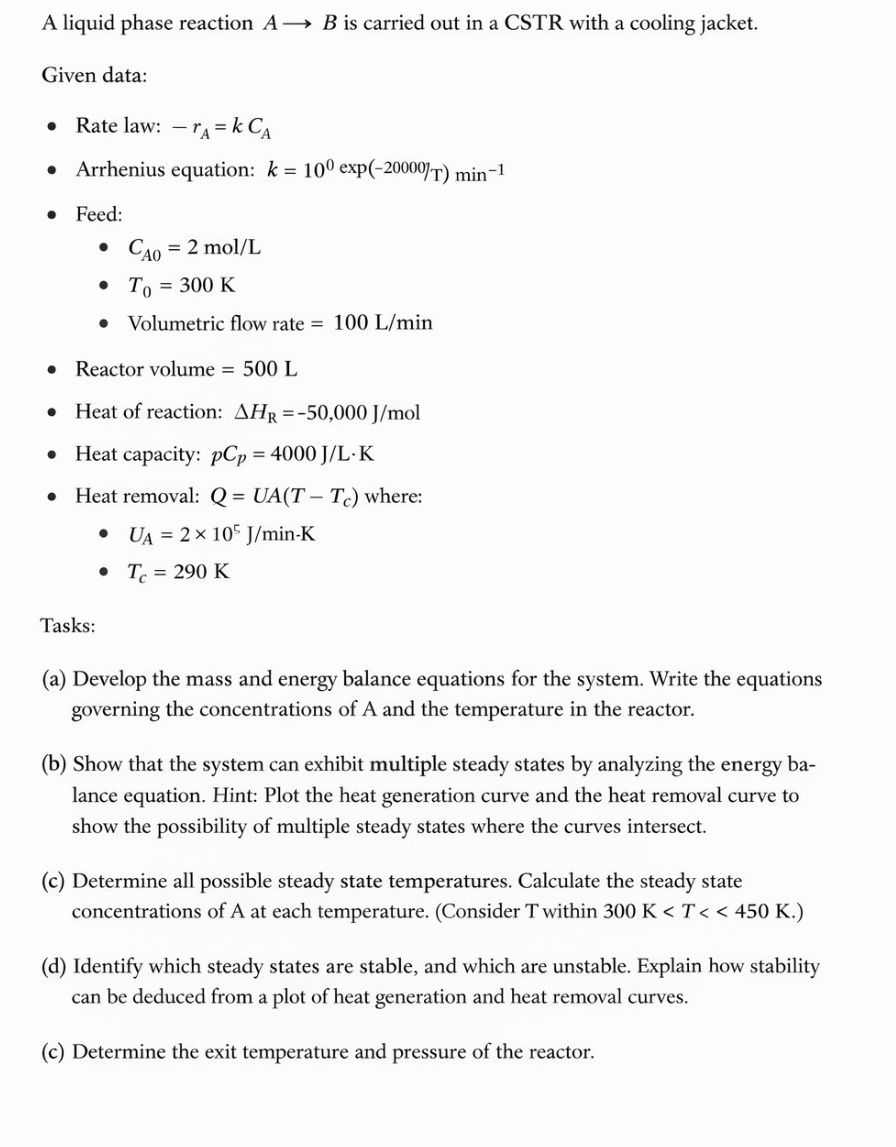 A liquid phase reaction A— B is carried out in a CSTR with a cooling jacket.
Given data:
e Ratelaw: —r,=kC,
® Arrhenius equation: k = 10° exp(-20000/r) pin -1
e Feed:
® Cyp=2mol/L
o Ty=300K
© Volumetric flow rate = 100 L/min
® Reactor volume = 500 L
© Heat of reaction: AHg =-50,000 J/mol
e Heat capacity: pCp =4000J/L-K
o Heat removal: Q = UA(T — T,) where:
® Uj =2x10°J/min-K
e T,=200K
Tasks:
(a) Develop the mass and energy balance equations for the system. Write the equations
governing the concentrations of A and the temperature in the reactor.
(b) Show that the system can exhibit multiple steady states by analyzing the energy ba-
lance equation. Hint: Plot the heat generation curve and the heat removal curve to
show the possibility of multiple steady states where the curves intersect.
(c) Determine all possible steady state temperatures. Calculate the steady state
concentrations of A at each temperature. (Consider T within 300 K < T < < 450 K.)
(d) Identify which steady states are stable, and which are unstable. Explain how stability
can be deduced from a plot of heat generation and heat removal curves.
(c) Determine the exit temperature and pressure of the reactor.