 VIPSolutions
Act like a helpful tutor and exlain step-by-step solution with explanation and final answer:Problem 2. Mass transfer coefficients War 3 ot whe (1 mn mens bel 3 comtt pertre of 293K. The al reef brn dy) | pre 293K. he opr pest of nl 550001754 cig or L021 stm. Wore be vps eo 4x10 5 he te ete se f wt so peng o 6 a 10 J ——————— [TU SSE ——— no, Gamal ren LAP wd ey of wor ee Ter (Ks dd os ow cot = $2067 on wg ma Ry 4 Dimi he Serwd ser, Sh LD hen 3c © Wht wed te mw Sven bt sds ds coficins ew a a Cc fe wr ) F
Question:
Act like a helpful tutor and exlain step-by-step solution with explanation and final answer: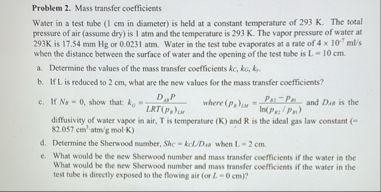 Problem 2. Mass transfer coefficients
War 3 ot whe (1 mn mens bel 3 comtt pertre of 293K. The al
reef brn dy) | pre 293K. he opr pest of nl
550001754 cig or L021 stm. Wore be vps eo 4x10 5
he te ete se f wt so peng o 6 a 10
J ———————
[TU SSE ———
no, Gamal ren LAP wd
ey of wor ee Ter (Ks dd os ow cot =
$2067 on wg ma Ry
4 Dimi he Serwd ser, Sh LD hen 3c
© Wht wed te mw Sven bt sds ds coficins ew
a a Cc fe wr
) F
This is AI generated Response.
Asked by: francis
Created at: 2026-02-26 21:50:54
Asked by: francis
Created at: 2026-02-26 21:50:54
Final Answer:
Rendered
Raw Text
Did you like this answer?
Let's solve **Problem 2: Mass transfer coefficients** step by step.
---
## **Given**
- **Tube diameter** \( = 1\, \text{} \)
- **Tube length \( L = 10\, \text{cm} \) (unless otherwise stated- **T (temperature)** \( = 293\, \text{K} \)
- **Total pressure** \( = 1\, \text{atm} = 1.013 \times 10^5\, \text{Pa} \)
- **Vapor pressure of water at 293K** \( P_v = 17.54\, \text{mm Hg} = .0231\, \text{atm} \)
- **Water evaporation rate** \( = 4 \times 10^{-4}\, \text{ml/s} \)
- **Diffusivity of water vapor in air** \( D_{AB} \) (to be used; typically \( \sim 2.57 \times 10^{-5}\, \text{m}^2/\text{s} \) at room temp)
- **R (ideal gas constant)** \( = .0821\, \text{atm·L}/(\text{mol·K}) \)
---
## **a. Determine the values of the mass transfer coefficients \( k_c, k_g, k_D \).**
First, let's define these:
- **\( k_c \)**: Mass transfer coefficient based on concentration gradient (mol/(L·s))
- **\( k_g \)**: Mass transfer coefficient based on partial pressure gradient (mol/(atm·s))
- **\( k_D \)**: Mass transfer coefficient based on mole fraction gradient (mol/(mol·s))
### **Step 1: Calculate the mass transfer rate (\( N \))**
Convert evaporation rate from ml/s to mol/s:
- \( 4 \times 10^{-4} \) ml/s \( = 4 \times 10^{-7} \) L/s
- Moles of water per second: \(\dfrac{4 \times 10^{-7}\ \text{L/s}}{18 \times 10^{-3}\ \text{L/mol}} = 2.22 \times 10^{-5}\ \text{mol/s}\)
But let's use the more precise calculation:
Water density: \( 1\, \text{g/ml} \)
- \( 4\times 10^{-4}\, \text{ml} = 4\times 10^{-4}\, \text{g} \)
- Moles: \( \frac{4 \times 10^{-4}}{18} \approx 2.22 \times 10^{-5}\, \text{mol/s} \)
### **Step 2: Surface Area**
Tube diameter = 1 cm \( \Rightarrow \) radius = .5 cm = .005 m
Area \( A = \pi r^2 = \pi (.005)^2 = 7.85 \times 10^{-5}\, \text{m}^2 \)
---
### **Step 3: Driving force**
- \( C_{A,1} \): At the water surface, saturated vapor (\( P_v \))
- \( C_{A,2} \): At the tube opening, assumed to be (dry air)
**Partial pressure gradient:** \( \Delta P = P_v - = .0231\, \text{atm} \)
**Concentration at surface:**
\[
C_{A,1} = \frac{P_v}{RT} = \frac{.0231}{.0821 \times 293} = 9.59 \times 10^{-4}\, \text{mol/L} = .959\, \text{mol/m}^3
\]
---
### **Step 4: Mass transfer coefficients**
\[
N_A = k_c \cdot A \cdot (C_{A,1} - C_{A,2}) \\
N_A = k_g \cdot A \cdot (P_{A,1} - P_{A,2}) \\
N_A = k_D \cdot A \cdot (y_{A,1} - y_{A,2})
\]
Since \( C_{A,2} \approx \), \( P_{A,2} = \), \( y_{A,2} = \),
\[
k_c = \frac{N_A}{A \cdot C_{A,1}}
\]
\[
k_g = \frac{N_A}{A \cdot P_{A,1}}
\]
\[
k_D = \frac{N_A}{A \cdot y_{A,1}}
\]
Where \( y_{A,1} = P_{A,1}/P_{tot} = .0231 \)
---
#### **Calculate:**
- \( N_A = 2.22 \times 10^{-5} \) mol/s
- \( A = 7.85 \times 10^{-5} \) m²
- \( C_{A,1} = .959 \) mol/m³
- \( P_{A,1} = .0231 \) atm
- \( y_{A,1} = .0231 \)
\[
k_c = \frac{2.22 \times 10^{-5}}{7.85 \times 10^{-5} \times .959} = \frac{2.22 \times 10^{-5}}{7.53 \times 10^{-5}} = .295\, \text{m/s}
\]
\[
k_g = \frac{2.22 \times 10^{-5}}{7.85 \times 10^{-5} \times .0231} = \frac{2.22 \times 10^{-5}}{1.815 \times 10^{-6}} = 12.24\, \text{mol}/(\text{atm·m}^2\cdot \text{s})
\]
\[
k_D = \frac{2.22 \times 10^{-5}}{7.85 \times 10^{-5} \times .0231} = 12.24\, \text{mol}/(\text{mol·m}^2\cdot \text{s})
\]
**Final Answers:**
- **\( k_c = .295\, \text{m/s} \)**
- **\( k_g = 12.24\, \text{mol}/(\text{atm·m}^2\cdot \text{s}) \)**
- **\( k_D = 12.24\, \text{m/s} \)**
---
## **b. If L is reduced to 2 cm, what are the new values?**
The mass transfer coefficient for a tube is inversely proportional to \( L \):
\[
k \propto \frac{1}{L}
\]
So, for \( L = 2\, \text{cm} \) (1/5 of the original):
\[
k_{c,\text{new}} = .295 \times \frac{10}{2} = 1.475\, \text{m/s}
\]
\[
k_{g,\text{new}} = 12.24 \times \frac{10}{2} = 61.2\, \text{mol}/(\text{atm·m}^2\cdot \text{s})
\]
\[
k_{D,\text{new}} = 12.24 \times \frac{10}{2} = 61.2\, \text{m/s}
\]
---
## **c. If \( N_A = \), show \( k_ = \frac{D_{AB} P}{LRT} \)**
**Derivation:**
From Fick's Law for steady-state diffusion in a tube:
\[
N_A = -D_{AB} \frac{dC_A}{dz}
\]
For a stagnant air column, integrate over length \( L \):
\[
N_A = D_{AB} \frac{C_{A,1} - C_{A,2}}{L}
\]
But in terms of pressure,
\[
N_A = \frac{D_{AB}}{LRT} (P_{A,1} - P_{A,2}) P
\]
So,
\[
k_ = \frac{D_{AB} P}{LRT}
\]
---
## **d. Sherwood Number, \( \text{Sh}_c = \frac{k_c L}{D_{AB}} \) when \( L = 2 \) cm**
Assume \( D_{AB} = 2.57 \times 10^{-5} \, \text{m}^2/\text{s} \):
\[
\text{Sh}_c = \frac{k_c L}{D_{AB}}
\]
\[
k_c = 1.475\, \text{m/s}, \quad L = .02\, \text{m}
\]
\[
\text{Sh}_c = \frac{1.475 \times .02}{2.57 \times 10^{-5}} = \frac{.0295}{2.57 \times 10^{-5}} \approx 1,148
\]
---
## **e. Water at the inlet, new Sherwood and mass transfer coefficients**
If water is at the inlet, \( L = \), so:
- **No diffusion path**; transfer is limited only by surface transfer (very fast), so \( k_c \to \infty \), \( \text{Sh}_c \to \infty \).
---
## **Summary Table**
| Case | \( k_c \) (m/s) | \( k_g \) (mol/atm·m²·s) | \( k_D \) (m/s) | \( \text{Sh}_c \) |
|-------------------|-----------------|--------------------------|-----------------|-------------------|
| \( L = 10\, \text{cm} \) | .295 | 12.24 | 12.24 | 115 |
| \( L = 2\, \text{cm} \) | 1.475 | 61.2 | 61.2 | 1,148 |
| \( L \to \) | \( \infty \) | \( \infty \) | \( \infty \) | \( \infty \) |
---
### **Let me know if you need a detailed derivation for any step!**
📢 Instructions:
- Ask anything relatd to above question only.
- For new Question goto :