 VIPSolutions
Act like a helpful tutor and exlain \step-by-step solution with explanation and final answer:Problem 1. Considering the deformation gradient F mapping an infinitesimal material line segment dX in the reference configuration to dx in the current configuration, a rigorous formulation of the Green- Lagrange strain tensor E is necessary. Assuming hyperelastic material behavior with a strain energy density function, the thermodynamic conjugate pairing requires establishment. This framework facilitates the analytical reconstruction of the non-linear strain-displacement relations » Obtain the expression for the right Cauchy-Green deformation tensor C in terms of the deformation gradient F. > Deduce the relationship between the Green-Lagrange strain tensor E and the displacement gradient Vu, neglecting higher-order terms. » Analyze the polar decomposition of F into the rotation tensor R and the right stretch tensor U. » Derive the expression for the rate of deformation tensor D and the spin tensor W from the spatial velocity gradient I. Problem 2. Under large deformation conditions for a body with volume V and surface A in the reference state, the relationship between the second Piola-Kirchhoff stress tensor § and the Cauchy stress tensor & must be established. This involves a precise derivation utilizing Nanson's formula for area transformation and the balance of linear momentum in both material and spatial frames. ¢ N n P< | be Sh da y 4 dX Q E 1% » Derive the relation linking the Cauchy stress o and the first Piola-Kirchhoff stress P through the definition of traction vectors. » Formulate the constitutive equation for the second Piola-Kirchhoff stress § from the strain energy density function ¥(C). » Deduce the push-forward operation converting the material tensor S to the spatial Kirchhoff stress 7 » Obtain the expression for the material tangent modulus C and its push-forward spatial counterpart C. Problem 3. Given the requirement for material frame-indifference in the constitutive response, an analysis of the objective rates of stress tensors becomes imperative for a complete formulation. The principle of virtual work in the reference configuration provides the fundamental basis for deriving the equilibrium equations. A consistent linearization of the weak form is requisite for numerical implementation. » Derive the Jaumann rate of the Cauchy stress tensor av and prove its objectivity under rigid body rotation. » Formulate the balance of linear momentum in the reference configuration in terms of the first Piola- Kirchhoff stress P and body forces. » Deduce the symmetry of the Cauchy stress o from the balance of angular momentum in the spatial configuration. » Analyze the relationship between the Truesdell stress rate and the Lie derivative of the Kirchhoff stress 7.
Question:
Act like a helpful tutor and exlain \step-by-step solution with explanation and final answer: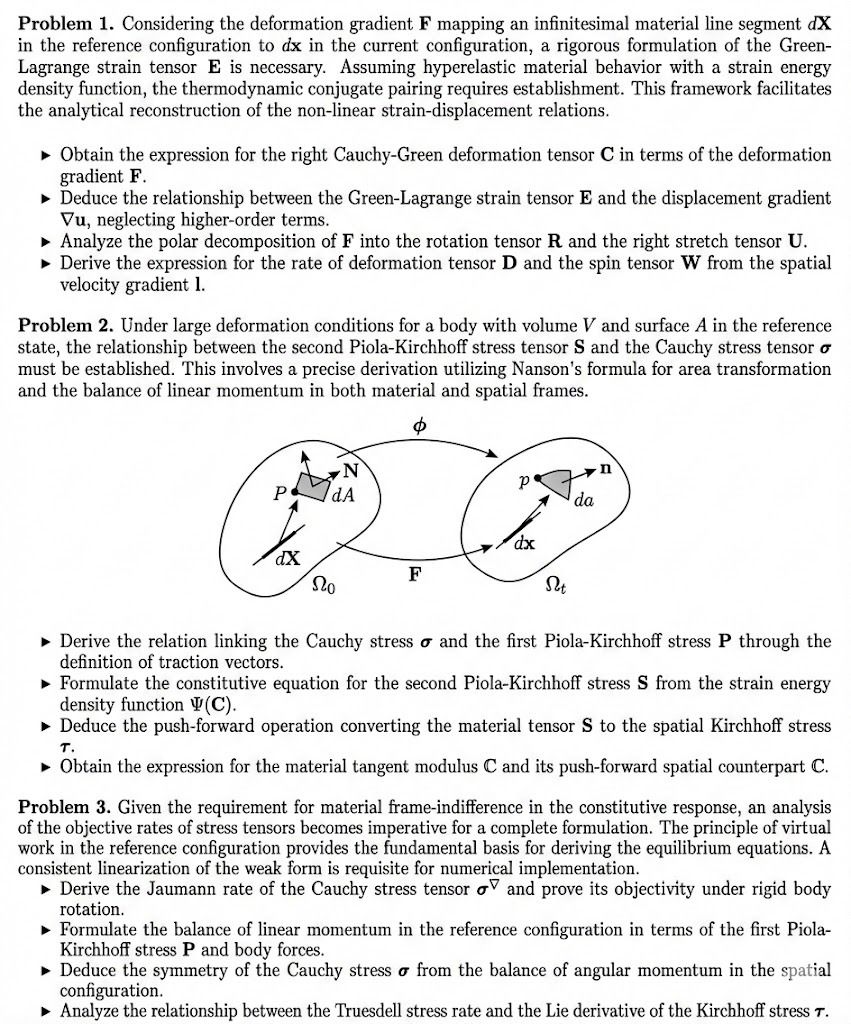 Problem 1. Considering the deformation gradient F mapping an infinitesimal material line segment dX
in the reference configuration to dx in the current configuration, a rigorous formulation of the Green-
Lagrange strain tensor E is necessary. Assuming hyperelastic material behavior with a strain energy
density function, the thermodynamic conjugate pairing requires establishment. This framework facilitates
the analytical reconstruction of the non-linear strain-displacement relations
» Obtain the expression for the right Cauchy-Green deformation tensor C in terms of the deformation
gradient F.
> Deduce the relationship between the Green-Lagrange strain tensor E and the displacement gradient
Vu, neglecting higher-order terms.
» Analyze the polar decomposition of F into the rotation tensor R and the right stretch tensor U.
» Derive the expression for the rate of deformation tensor D and the spin tensor W from the spatial
velocity gradient I.
Problem 2. Under large deformation conditions for a body with volume V and surface A in the reference
state, the relationship between the second Piola-Kirchhoff stress tensor § and the Cauchy stress tensor &
must be established. This involves a precise derivation utilizing Nanson's formula for area transformation
and the balance of linear momentum in both material and spatial frames.
¢
N n
P< |
be Sh da
y 4
dX
Q E 1%
» Derive the relation linking the Cauchy stress o and the first Piola-Kirchhoff stress P through the
definition of traction vectors.
» Formulate the constitutive equation for the second Piola-Kirchhoff stress § from the strain energy
density function ¥(C).
» Deduce the push-forward operation converting the material tensor S to the spatial Kirchhoff stress
7
» Obtain the expression for the material tangent modulus C and its push-forward spatial counterpart C.
Problem 3. Given the requirement for material frame-indifference in the constitutive response, an analysis
of the objective rates of stress tensors becomes imperative for a complete formulation. The principle of virtual
work in the reference configuration provides the fundamental basis for deriving the equilibrium equations. A
consistent linearization of the weak form is requisite for numerical implementation.
» Derive the Jaumann rate of the Cauchy stress tensor av and prove its objectivity under rigid body
rotation.
» Formulate the balance of linear momentum in the reference configuration in terms of the first Piola-
Kirchhoff stress P and body forces.
» Deduce the symmetry of the Cauchy stress o from the balance of angular momentum in the spatial
configuration.
» Analyze the relationship between the Truesdell stress rate and the Lie derivative of the Kirchhoff stress 7.
Asked by: Francis
Created at: 2026-02-26 16:16:16
Final Answer:
📢 Instructions:
- Ask anything relatd to above question only.
- For new Question goto :