Act like a helpful tutor and exlain step-by-step solution with explanation and final answer:321 Electromotive force
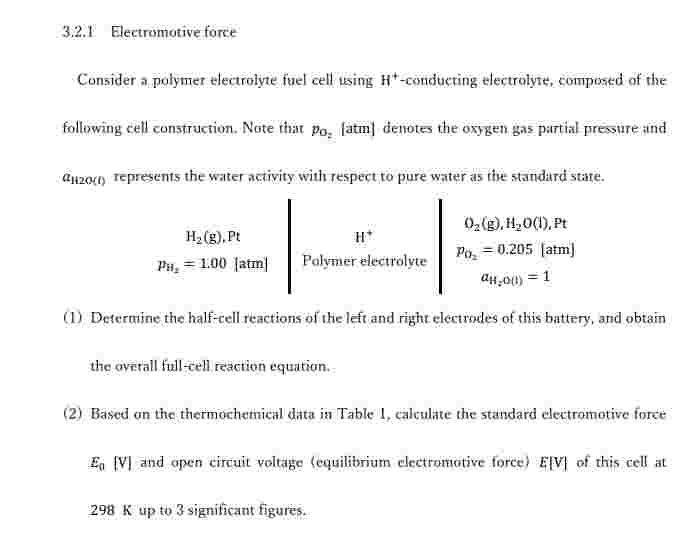
Consider 3 polymer electrolyte fuel cell using. #*-conducting electrolyte, compused of the
following cell construction. Note that po, fatm] denotes the oxygen gas partial pressure and
Gaon Tepresents the seater activity with respect to pre water ds the standird stare.
Hag), w OREO.
Puy =100 fam] | Polymer electrolye | 70: 0205 atm)
analy =1
(1) Determine the half=cell reactions of the efe and right electrodes of this battery, and obtain
the overall full-cel reaction equition.
(2) Based an the thetmochemical dita in Table 1, caleulite the standard clectromative force
Ey [V) and apen circuit voltage (equilibrium electromative force) EV] of this cell at
298 K up to 3 significant figures.
Question:
Act like a helpful tutor and exlain step-by-step solution with explanation and final answer:321 Electromotive force
Consider 3 polymer electrolyte fuel cell using. #*-conducting electrolyte, compused of the
following cell construction. Note that po, fatm] denotes the oxygen gas partial pressure and
Gaon Tepresents the seater activity with respect to pre water ds the standird stare.
Hag), w OREO.
Puy =100 fam] | Polymer electrolye | 70: 0205 atm)
analy =1
(1) Determine the half=cell reactions of the efe and right electrodes of this battery, and obtain
the overall full-cel reaction equition.
(2) Based an the thetmochemical dita in Table 1, caleulite the standard clectromative force
Ey [V) and apen circuit voltage (equilibrium electromative force) EV] of this cell at
298 K up to 3 significant figures.
This is AI generated Response.
Asked by: francis
Created at: 2026-02-26 15:32:00
Final Answer:
RenderedRaw Text
Did you like this answer?
Let's break down the problem step by step.
---
## **Step 1: Write the Half-Cell Reactions**
### **Anode (Left Electrode):**
- **Hydrogen oxidation:**
\(\text{H}_2(\text{g}) \rightarrow 2\text{H}^+ + 2e^-\)
*At Pt, \(p_{H_2} = 1.00 \text{ atm}\)*
### **Cathode (Right Electrode):**
- **Oxygen reduction:**
\(\frac{1}{2}\text{O}_2(\text{g}) + 2\text{H}^+ + 2e^- \rightarrow \text{H}_2\text{O}(\ell)\)
*At Pt, \(p_{O_2} = .205 \text{ atm},\ a_{H_2O(\ell)} = 1\)*
---
## **Step 2: Write the Overall Cell Reaction**
Add the two half-cell reactions (electrons will cancel):
\[
\text{H}_2(\text{g}) + \frac{1}{2}\text{O}_2(\text{g}) \rightarrow \text{H}_2\text{O}(\ell)
\]
---
## **Step 3: Standard Electromotive Force (\(E^\)) Calculation**
From standard electrode potentials (at 298 K, all gases at 1 atm, solutes at 1 M):
- \(E^_{\text{cathode}} (\text{O}_2/\text{H}_2\text{O}) = +1.229 \text{ V}\)
- \(E^_{\text{anode}} (\text{H}_2/\text{H}^+) = \text{ V}\)
\[
E^_{\text{cell}} = E^_{\text{cathode}} - E^_{\text{anode}} = 1.229\ \text{V} - \ \text{V} = \boxed{1.23\ \text{V}}
\]
---
## **Step 4: Nernst Equation for Non-Standard Conditions**
The cell operates at:
- \(p_{H_2} = 1.00 \text{ atm}\)
- \(p_{O_2} = .205 \text{ atm}\)
- \(a_{H_2O(\ell)} = 1\)
The Nernst equation for the cell is:
\[
E = E^_{\text{cell}} - \frac{.05916}{n} \log Q
\]
Where:
- \(n = 2\) (electrons transferred)
- \(Q = \frac{a_{H_2O}}{p_{H_2} \cdot (p_{O_2})^{1/2}}\)
Plug in values:
\[
Q = \frac{1}{1.00 \times (.205)^{1/2}}
\]
\[
(.205)^{1/2} \approx .453
\]
\[
Q = \frac{1}{1 \times .453} = 2.21
\]
---
\[
E = 1.229 - \frac{.05916}{2} \log(2.21)
\]
\[
\log(2.21) \approx .344
\]
\[
\frac{.05916}{2} = .02958
\]
\[
E = 1.229 - (.02958 \times .344)
\]
\[
E = 1.229 - .0102
\]
\[
E = \boxed{1.22\ \text{V}}
\]
---
## **Final Answers**
### **(1) Half-cell reactions and overall cell reaction:**
- **Anode:** \(\text{H}_2(\text{g}) \rightarrow 2\text{H}^+ + 2e^-\)
- **Cathode:** \(\frac{1}{2}\text{O}_2(\text{g}) + 2\text{H}^+ + 2e^- \rightarrow \text{H}_2\text{O}(\ell)\)
- **Overall:** \(\text{H}_2(\text{g}) + \frac{1}{2}\text{O}_2(\text{g}) \rightarrow \text{H}_2\text{O}(\ell)\)
### **(2) Standard EMF and cell voltage at given conditions:**
- **Standard EMF (\(E^\)):** \(\boxed{1.23\ \text{V}}\)
- **Open circuit voltage at given conditions:** \(\boxed{1.22\ \text{V}}\) (to 3 significant figures)
Let me know if you need more detail on any step!
VIPSolutions focuses on clear, step‑by‑step explanations so you can learn quickly. Whether you need an AI‑generated walkthrough or a short hint to get unstuck, each solution is organized for fast reading and easy review later.
Search similar questions, compare approaches, and bookmark the best answers for revision. Our goal is simple: quick, reliable study help that feels natural—not noisy.
 VIPSolutions
 321 Electromotive force
Consider 3 polymer electrolyte fuel cell using. #*-conducting electrolyte, compused of the
following cell construction. Note that po, fatm] denotes the oxygen gas partial pressure and
Gaon Tepresents the seater activity with respect to pre water ds the standird stare.
Hag), w OREO.
Puy =100 fam] | Polymer electrolye | 70: 0205 atm)
analy =1
(1) Determine the half=cell reactions of the efe and right electrodes of this battery, and obtain
the overall full-cel reaction equition.
(2) Based an the thetmochemical dita in Table 1, caleulite the standard clectromative force
Ey [V) and apen circuit voltage (equilibrium electromative force) EV] of this cell at
298 K up to 3 significant figures.