 VIPSolutions
Act like a helpful tutor and exlain step-by-step solution with explanation and final answer:1. Guanidine dissolved in aqueous solution is degraded to ammonia and urea by enzyme guanidinase on surfaces of nonporous polymeric beads. Conversion rate is controlled by transfer of guanidine to the surface of the beads through liquid film, and the conversion takes place on the surface of the beads. The following parameter values are measured: K»=0.2 mg/em?, V,,’=0.1 mg guanidine/cm? support surface-s, Sy = 1 mg/cm®. When the substrate concentration at the surface equals 1, 0.8, 0.6, 0.4, 0.2 or 0.1 mg/cm?, determine (a) observed reaction rate, (b) effectiveness factor, and (c) the mass transfer coefficient.
Question:
Act like a helpful tutor and exlain step-by-step solution with explanation and final answer: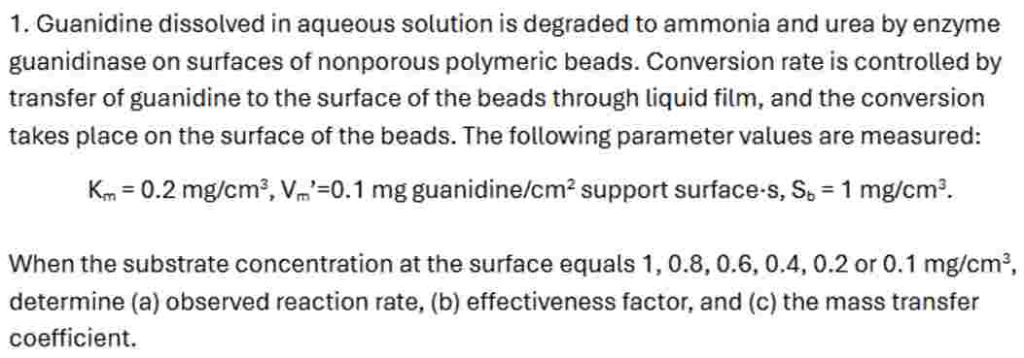 1. Guanidine dissolved in aqueous solution is degraded to ammonia and urea by enzyme
guanidinase on surfaces of nonporous polymeric beads. Conversion rate is controlled by
transfer of guanidine to the surface of the beads through liquid film, and the conversion
takes place on the surface of the beads. The following parameter values are measured:
K»=0.2 mg/em?, V,,’=0.1 mg guanidine/cm? support surface-s, Sy = 1 mg/cm®.
When the substrate concentration at the surface equals 1, 0.8, 0.6, 0.4, 0.2 or 0.1 mg/cm?,
determine (a) observed reaction rate, (b) effectiveness factor, and (c) the mass transfer
coefficient.
This is AI generated Response.
Asked by: francis
Created at: 2026-02-19 08:01:09
Asked by: francis
Created at: 2026-02-19 08:01:09
Final Answer:
Rendered
Raw Text
Did you like this answer?
Let's solve the problem step by step:
---
## **Given Data**
- **Michaelis constant:** \( K_m = .2 \) mg/cm³
- **Maximum rate:** \( V_m' = .1 \) mg guanidine/(cm²·s)
- **Bulk substrate concentration:** \( S_b = 1 \) mg/cm³
We are to find, for surface concentrations \( S_s = 1, .8, .6, .4, .2, .1 \) mg/cm³:
1. Observed reaction rate (\( r_{obs} \))
2. Effectiveness factor (\( \eta \))
3. Mass transfer coefficient (\( k_L \))
---
## **Step 1: Michaelis-Menten Kinetics**
The enzyme-catalyzed reaction at the surface is given by:
\[
r = \frac{V_m' S_s}{K_m + S_s}
\]
Where:
- \( r \): Reaction rate per unit surface area (mg/(cm²·s))
- \( S_s \): Substrate concentration at the surface
---
## **Step 2: Mass Transfer Rate**
Substrate is transported from the bulk to the surface via a liquid film:
\[
\text{Mass transfer rate} = k_L (S_b - S_s)
\]
At steady state, mass transfer rate = reaction rate:
\[
k_L (S_b - S_s) = \frac{V_m' S_s}{K_m + S_s}
\]
---
## **Step 3: Calculate Observed Reaction Rate (\( r_{obs} \))**
\[
r_{obs} = \text{mass transfer rate} = k_L (S_b - S_s)
\]
But we don't know \( k_L \) yet. Let's find \( k_L \) first.
---
## **Step 4: Calculate Mass Transfer Coefficient (\( k_L \))**
Rearrange the steady-state equation:
\[
k_L (S_b - S_s) = \frac{V_m' S_s}{K_m + S_s}
\]
\[
k_L = \frac{V_m' S_s}{(K_m + S_s)(S_b - S_s)}
\]
---
## **Step 5: Calculate Effectiveness Factor (\( \eta \))**
Effectiveness factor is the ratio of the observed rate to the rate if the surface concentration were equal to the bulk:
\[
\eta = \frac{r_{obs}}{r_{max}}
\]
where
\[
r_{max} = \frac{V_m' S_b}{K_m + S_b}
\]
and
\[
r_{obs} = \frac{V_m' S_s}{K_m + S_s}
\]
---
## **Step 6: Plug in Values for Each \( S_s \)**
Let's calculate for each \( S_s \):
### **Case 1: \( S_s = 1 \) mg/cm³**
#### a) **Observed Reaction Rate**
\[
r_{obs} = \frac{V_m' S_s}{K_m + S_s} = \frac{.1 \times 1}{.2 + 1} = \frac{.1}{1.2} = .0833 \text{ mg/(cm²·s)}
\]
#### b) **Effectiveness Factor**
\[
r_{max} = \frac{.1 \times 1}{.2 + 1} = .0833
\]
\[
\eta = \frac{.0833}{.0833} = 1.00
\]
#### c) **Mass Transfer Coefficient**
\[
k_L = \frac{.1 \times 1}{(.2 + 1)(1 - 1)}
\]
But \(S_b - S_s = \), so **\( k_L \) is undefined/infinite** (no mass transfer limitation).
---
### **Case 2: \( S_s = .8 \) mg/cm³**
#### a) **Observed Reaction Rate**
\[
r_{obs} = \frac{.1 \times .8}{.2 + .8} = \frac{.08}{1.} = .08 \text{ mg/(cm²·s)}
\]
#### b) **Effectiveness Factor**
\[
\eta = \frac{.08}{.0833} = .96
\]
#### c) **Mass Transfer Coefficient**
\[
k_L = \frac{.1 \times .8}{(.2 + .8)(1 - .8)} = \frac{.08}{1. \times .2} = \frac{.08}{.2} = .4 \text{ cm/s}
\]
---
### **Case 3: \( S_s = .6 \) mg/cm³**
#### a) \( r_{obs} = \frac{.1 \times .6}{.2 + .6} = \frac{.06}{.8} = .075 \) mg/(cm²·s)
#### b) \( \eta = \frac{.075}{.0833} = .90 \)
#### c) \( k_L = \frac{.1 \times .6}{(.2 + .6)(1 - .6)} = \frac{.06}{.8 \times .4} = \frac{.06}{.32} = .1875 \) cm/s
---
### **Case 4: \( S_s = .4 \) mg/cm³**
#### a) \( r_{obs} = \frac{.1 \times .4}{.2 + .4} = \frac{.04}{.6} = .0667 \) mg/(cm²·s)
#### b) \( \eta = \frac{.0667}{.0833} = .80 \)
#### c) \( k_L = \frac{.1 \times .4}{(.2 + .4)(1 - .4)} = \frac{.04}{.6 \times .6} = \frac{.04}{.36} = .111 \) cm/s
---
### **Case 5: \( S_s = .2 \) mg/cm³**
#### a) \( r_{obs} = \frac{.1 \times .2}{.2 + .2} = \frac{.02}{.4} = .05 \) mg/(cm²·s)
#### b) \( \eta = \frac{.05}{.0833} = .60 \)
#### c) \( k_L = \frac{.1 \times .2}{(.2 + .2)(1 - .2)} = \frac{.02}{.4 \times .8} = \frac{.02}{.32} = .0625 \) cm/s
---
### **Case 6: \( S_s = .1 \) mg/cm³**
#### a) \( r_{obs} = \frac{.1 \times .1}{.2 + .1} = \frac{.01}{.3} = .0333 \) mg/(cm²·s)
#### b) \( \eta = \frac{.0333}{.0833} = .40 \)
#### c) \( k_L = \frac{.1 \times .1}{(.2 + .1)(1 - .1)} = \frac{.01}{.3 \times .9} = \frac{.01}{.27} = .037 \) cm/s
---
## **Step 7: Summary Table**
| \( S_s \) (mg/cm³) | \( r_{obs} \) (mg/cm²·s) | \( \eta \) | \( k_L \) (cm/s) |
|--------------------|--------------------------|------------|---------------------|
| 1. | .0833 | 1.00 | ∞ (undefined) |
| .8 | .080 | .96 | .40 |
| .6 | .075 | .90 | .188 |
| .4 | .0667 | .80 | .111 |
| .2 | .050 | .60 | .0625 |
| .1 | .0333 | .40 | .037 |
---
## **Key Points**
- **Observed reaction rate** is calculated by Michaelis-Menten at the surface.
- **Effectiveness factor** shows how much the observed rate is reduced by mass transfer limitations.
- **Mass transfer coefficient** can be back-calculated from the steady-state equation.
Let me know if you need more details or a specific explanation for any step!
📢 Instructions:
- Ask anything relatd to above question only.
- For new Question goto :