 VIPSolutions
Act like a helpful tutor and exlain step-by-step solution with explanation and final answer:A gas of the following composition in percent by volume is burned in a heater with25% excess airCO2 = 6.5%, CH4 = 49.5%, C2H6 = 16.0%, H2 = 25.0%, N2=25%. O 2 = 0.5%Determine: a) Air to fuel ratio by volumeb) Volume of flue gas formed in burning 10 moles of fuel.c) Volume of air m * 3 at 21\deg C and 101.325 kPa in burning 10 moles of fuel.d) Partial pressure of H20 if the exhaust gas is at 200\deg C and 101.325 kPa €) Volume of exhaust gas at 200\deg C, 101.325kPa per m*3 of fuel 20\deg C. 101.325kPa
Question:
Act like a helpful tutor and exlain step-by-step solution with explanation and final answer: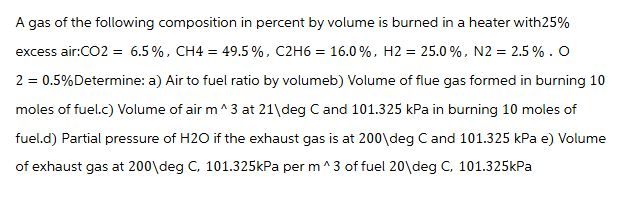 A gas of the following composition in percent by volume is burned in a heater with25%
excess airCO2 = 6.5%, CH4 = 49.5%, C2H6 = 16.0%, H2 = 25.0%, N2=25%. O
2 = 0.5%Determine: a) Air to fuel ratio by volumeb) Volume of flue gas formed in burning 10
moles of fuel.c) Volume of air m * 3 at 21\deg C and 101.325 kPa in burning 10 moles of
fuel.d) Partial pressure of H20 if the exhaust gas is at 200\deg C and 101.325 kPa €) Volume
of exhaust gas at 200\deg C, 101.325kPa per m*3 of fuel 20\deg C. 101.325kPa
This is AI generated Response.
Asked by: Francis
Created at: 2026-02-18 07:56:56
Asked by: Francis
Created at: 2026-02-18 07:56:56
Final Answer:
Rendered
Raw Text
Did you like this answer?
Let's solve the problem step by step.
---
## **Given Composition (by volume)**
- **CO₂:** 6.5%
- **CH₄:** 49.5%
- **C₂H₆:** 16.%
- **H₂:** 25.%
- **N₂:** 2.5%
- **O₂:** .5%
- **Excess air:** 25%
Assume 100 moles of fuel gas for simplicity.
---
### **Step 1: Write Combustion Reactions**
#### **Combustion Equations (per mole):**
1. **CH₄ + 2O₂ → CO₂ + 2H₂O**
2. **C₂H₆ + 3.5O₂ → 2CO₂ + 3H₂O**
3. **H₂ + .5O₂ → H₂O**
4. **CO₂, N₂, O₂:** Inert (except O₂, which adds to the requirement)
5. **N₂:** Passes through
---
### **Step 2: Calculate Theoretical Oxygen Requirement**
#### **Moles in 100 moles of fuel:**
- CH₄: 49.5 moles
- C₂H₆: 16. moles
- H₂: 25. moles
- CO₂: 6.5 moles
- N₂: 2.5 moles
- O₂: .5 moles
#### **O₂ required:**
- For CH₄: \(49.5 \times 2 = 99.\) moles O₂
- For C₂H₆: \(16. \times 3.5 = 56.\) moles O₂
- For H₂: \(25. \times .5 = 12.5\) moles O₂
**Total O₂ required:**
\(99. + 56. + 12.5 = 167.5\) moles O₂
#### **Subtract O₂ in fuel:**
O₂ in fuel = .5 moles
**Net O₂ required from air:**
\(167.5 - .5 = 167.\) moles O₂
#### **Theoretical Air Required:**
Air contains 21% O₂ by volume (mole).
\[
\text{Theoretical air (moles)} = \frac{167.}{.21} = 795.24 \text{ moles}
\]
#### **Actual Air (with 25% excess):**
\[
\text{Actual air} = 795.24 \times 1.25 = 994.05 \text{ moles}
\]
---
### **Step 3: Air to Fuel Ratio by Volume (a)**
\[
\text{Air to fuel ratio (by volume)} = \frac{994.05}{100} = 9.94 : 1
\]
---
### **Step 4: Volume of Flue Gas for 10 moles of Fuel (b)**
Let's use 10 moles of fuel. Scale all mole numbers by .1 (since calculations so far were done for 100 moles).
#### **Products from Combustion:**
- **CH₄:** 4.95 moles → 4.95 CO₂ + 9.90 H₂O
- **C₂H₆:** 1.6 moles → 3.2 CO₂ + 4.8 H₂O
- **H₂:** 2.5 moles → 2.5 H₂O
- **CO₂ (in fuel):** .65 moles (unchanged)
- **N₂ in fuel:** .25 moles (unchanged)
- **N₂ from air:**
Air supplied for 10 moles of fuel: \(994.05 \times .1 = 99.405\) moles air
N₂ in air: 79%
N₂ from air: \(99.405 \times .79 = 78.53\) moles
**Total N₂ in exhaust:** \(.25 + 78.53 = 78.78\) moles
#### **O₂ supplied:**
From air: \(99.405 \times .21 = 20.88\) moles
O₂ in fuel: .05 moles
Total O₂ supplied: 20.93 moles
O₂ consumed: \(9.90 + 5.6 + 1.25 = 16.75\) moles
O₂ remaining: \(20.93 - 16.75 = 4.18\) moles
#### **Sum of Products:**
- CO₂: \(4.95 + 3.2 + .65 = 8.8\)
- H₂O: \(9.90 + 4.8 + 2.5 = 17.2\)
- N₂: \(78.78\)
- O₂: \(4.18\)
**Total moles of flue gas:**
\(8.8 + 17.2 + 78.78 + 4.18 = 108.96\) moles
---
### **Step 5: Volume of Air at 21°C, 101.325 kPa for 10 moles of Fuel (c)**
**Air supplied for 10 moles fuel:**
\(994.05 \times .1 = 99.405\) moles
Use ideal gas law:
\[
V = \frac{nRT}{P}
\]
- \(n = 99.405\)
- \(R = 8.314 \, \text{J/mol·K}\)
- \(T = 273 + 21 = 294\, \text{K}\)
- \(P = 101325\, \text{Pa}\)
\[
V = \frac{99.405 \times 8.314 \times 294}{101325} = \frac{242,496}{101325} = 2.40 \, \text{m}^3
\]
---
### **Step 6: Partial Pressure of H₂O at 200°C, 101.325 kPa (d)**
- H₂O moles: 17.2
- Total exhaust moles: 108.96
\[
\text{Partial pressure of H}_2\text{O} = 101.325 \times \frac{17.2}{108.96} = 16.\, \text{kPa}
\]
---
### **Step 7: Volume of Exhaust Gas at 200°C, 101.325 kPa per m³ of Fuel (e)**
First, find how many moles in 1 m³ of fuel at standard conditions (assume 1 mole ≈ 22.414 L at STP, so 1 m³ has ~44.6 moles):
- For 44.6 moles of fuel, flue gas moles: \(44.6 \times \frac{108.96}{10} = 485.9\) moles
At 200°C (\(T = 473\) K), 101325 Pa:
\[
V = \frac{485.9 \times 8.314 \times 473}{101325} = \frac{1,907,363}{101325} = 18.83\, \text{m}^3
\]
---
## **Final Answers**
### **a) Air to fuel ratio by volume:**
\[
\boxed{9.94 : 1}
\]
### **b) Volume of flue gas from 10 moles of fuel:**
\[
\boxed{108.96 \text{ moles}}
\]
### **c) Volume of air at 21°C, 101.325 kPa for 10 moles of fuel:**
\[
\boxed{2.40 \text{ m}^3}
\]
### **d) Partial pressure of H₂O in exhaust at 200°C, 101.325 kPa:**
\[
\boxed{16. \text{ kPa}}
\]
### **e) Volume of exhaust gas at 200°C, 101.325 kPa per m³ of fuel at 20°C, 101.325 kPa:**
\[
\boxed{18.83 \text{ m}^3}
\]
---
Let me know if you need any clarification or a deeper explanation of any step!
📢 Instructions:
- Ask anything relatd to above question only.
- For new Question goto :