 VIPSolutions
Act like a helpful tutor and exlain step-by-step solution with explanation and final answer:Washing clothes is a necessary chore in fe, especially you don't wanto offend others. In the United States, chiornated bleach is often added during the wash cycle to whiten clothes. While bieach i an effective leaning agent, the chirine in the bleach aso ‘combines with organic matter i the wash water to form chloroform (CHCI3), a probable human carcinogen. During the wasn cycle, a typical washing machine fis ith 80 L of water. a. Ifyou assume that the washing machine operates fie batch reactor during the wash cycle (and that no chloroform escapes the washing machine once tis formed), what isthe inal chioroform concentration inthe water after one wash cycle (1 ug/L)? “The infil concentration of chirofor in the water at the beginning ofthe 30 -inute wash cycle is 10 ug/L and the first order reaction rate constant that describes the formation of chloroform inthe water i 0.167 min-1. b. Unless you ink the wash water, your most probable chloroform exposure pathway is via inhalation. Chloroform i a volate ‘compound that wil partition from the wash water nto the airspace in the washing machine. When you open Up the top of the. washing machine, chloroform will be released nto the sir Assume that 5 g/min of chloroform i released at a steady rate from your washing machine into the room once you open the top of the machine. Tne washing machine i located in a 12 m3 launcry oom which leaky, such hat the effective fresh air ventilation rate though the room is § m3/hour. Ifyou remain inthe launcy room folding clothes for one hour after you open the top of the washing machine, what s the concentration of chloroform in your breathing ar (in ug/m3) ? The temperature inthe room 5 30 °C and pressure is 1 atm. Assume that the ir in the room is wel mixed andi that no chloroform is present inthe ar entering the room.
Question:
Act like a helpful tutor and exlain step-by-step solution with explanation and final answer: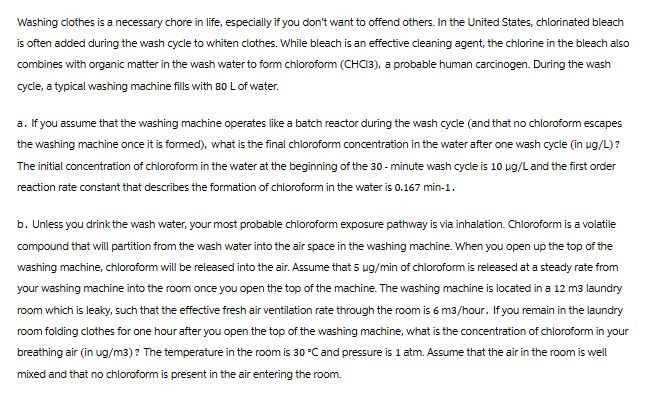 Washing clothes is a necessary chore in fe, especially you don't wanto offend others. In the United States, chiornated bleach
is often added during the wash cycle to whiten clothes. While bieach i an effective leaning agent, the chirine in the bleach aso
‘combines with organic matter i the wash water to form chloroform (CHCI3), a probable human carcinogen. During the wasn
cycle, a typical washing machine fis ith 80 L of water.
a. Ifyou assume that the washing machine operates fie batch reactor during the wash cycle (and that no chloroform escapes
the washing machine once tis formed), what isthe inal chioroform concentration inthe water after one wash cycle (1 ug/L)?
“The infil concentration of chirofor in the water at the beginning ofthe 30 -inute wash cycle is 10 ug/L and the first order
reaction rate constant that describes the formation of chloroform inthe water i 0.167 min-1.
b. Unless you ink the wash water, your most probable chloroform exposure pathway is via inhalation. Chloroform i a volate
‘compound that wil partition from the wash water nto the airspace in the washing machine. When you open Up the top of the.
washing machine, chloroform will be released nto the sir Assume that 5 g/min of chloroform i released at a steady rate from
your washing machine into the room once you open the top of the machine. Tne washing machine i located in a 12 m3 launcry
oom which leaky, such hat the effective fresh air ventilation rate though the room is § m3/hour. Ifyou remain inthe launcy
room folding clothes for one hour after you open the top of the washing machine, what s the concentration of chloroform in your
breathing ar (in ug/m3) ? The temperature inthe room 5 30 °C and pressure is 1 atm. Assume that the ir in the room is wel
mixed andi that no chloroform is present inthe ar entering the room.
Asked by: Francis
Created at: 2026-02-18 07:19:22
Final Answer:
📢 Instructions:
- Ask anything relatd to above question only.
- For new Question goto :