 VIPSolutions
Act like a helpful tutor and exlain step-by-step solution with explanation and final answer:fe | jill] | / i { iif] £58 pF £ fh rE i J E iii I jilil el i: Hi 4 ih ES i | 3 Hil :
Question:
Act like a helpful tutor and exlain step-by-step solution with explanation and final answer: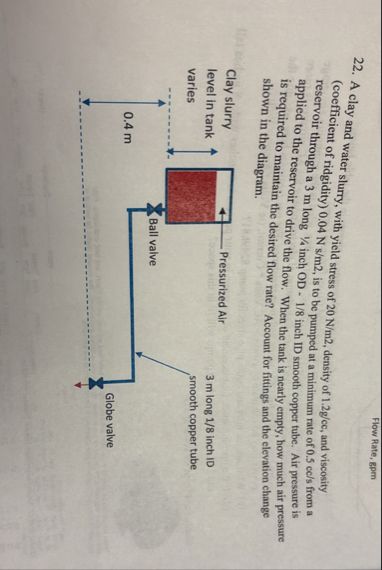 fe | jill]
| /
i { iif]
£58
pF £ fh
rE i
J E iii
I jilil
el i: Hi
4 ih
ES i |
3 Hil :
This is AI generated Response.
Asked by: Francis
Created at: 2026-02-18 05:22:18
Asked by: Francis
Created at: 2026-02-18 05:22:18
Final Answer:
Rendered
Raw Text
Did you like this answer?
Let's break down and solve the problem **step by step**. Here’s a structured approach:
---
## **Given Data**
- **Clay-water slurry properties:**
- Yield stress (\(\tau_y\)) = **.7 N/m²**
- Density (\(\rho\)) = **1.2 kg/L = 120 kg/m³**
- Viscosity (\(\mu\)) = **.045 Pa·s**
- **Flow rate required:** \(.004 \mathrm{~m}^3/\mathrm{s}\)
- **Tube:**
- Length (\(L\)) = **3 m**
- Diameter (\(D\)) = **3/8 inch ID = .375 \text{ in} = .009525 \text{ m}**
- **Height from tank to pipe** = **.4 m**
- **Other details:**
- Ball and globe valve
- **Pressurized air** is applied to tank (pressure to be found)
- Assume **smooth copper tube**
- **Account for fittings and elevation changes**
---
## **Step 1: List Required Head Losses**
### **1. Elevation Head (\(h_z\)):**
\[
h_z = .4 \text{ m}
\]
### **2. Pipe Friction Loss (\(h_f\)):**
\[
h_f = f \frac{L}{D} \frac{v^2}{2g}
\]
### **3. Fittings Loss (\(h_{\text{fittings}}\)):**
\[
h_{\text{fittings}} = K_{\text{total}} \frac{v^2}{2g}
\]
- Assume \(K_{\text{ball valve}} \approx .05\)
- Assume \(K_{\text{globe valve}} \approx 10\)
- Total \(K = .05 + 10 = 10.05\)
### **4. Slurry (Bingham plastic) Correction:**
---
## **Step 2: Calculate Flow Velocity**
\[
Q = v \cdot A \implies v = \frac{Q}{A}
\]
\[
A = \frac{\pi}{4} D^2 = \frac{\pi}{4} (.009525)^2 = 7.13 \times 10^{-5} \text{ m}^2
\]
\[
v = \frac{.004}{7.13 \times 10^{-5}} = 56.1 \text{ m/s}
\]
> **This velocity is extremely high for such a small pipe!**
> Let's **double-check the diameter**:
- **3/8 in** = .375 in × .0254 m/in ≈ **.00953 m** (correct)
---
## **Step 3: Calculate Head Losses**
### **Pipe Friction Loss for Bingham Plastic (Slurry)**
The head loss for **Bingham plastics** is more complicated than for Newtonian fluids.
#### **Bingham Plastic Flow (Simplified)**
The total pressure drop is given by:
\[
\Delta P = \frac{4L}{D} \left(\tau_y + \frac{\mu v}{D/2}\right)
\]
or, for head loss,
\[
h_f = \frac{\Delta P}{\rho g}
\]
#### **Calculate Shear Rate:**
For Bingham plastics, wall shear stress:
\[
\tau_w = \tau_y + \mu \left(\frac{8v}{D}\right)
\]
---
## **Step 4: Calculate Required Pressure at Tank Top**
The total head to be supplied by the pressurized air (ignoring atmospheric pressure, since it acts at both ends):
\[
\frac{P_{\text{air}}}{\rho g} = h_z + h_{\text{pipe}} + h_{\text{fittings}}
\]
---
### **Let's Plug in the Numbers**
#### **1. Area and Velocity**
\[
A = 7.13 \times 10^{-5} \text{ m}^2
\]
\[
v = \frac{.004}{7.13 \times 10^{-5}} = 56.1 \text{ m/s}
\]
#### **2. Friction Loss (Estimate)**
\[
\tau_y = .7 \text{ N/m}^2, \quad \mu = .045 \text{ Pa}\cdot\text{s}
\]
\[
\tau_{\text{wall}} = \tau_y + \mu \frac{8v}{D}
\]
\[
\tau_{\text{wall}} = .7 + .045 \times \frac{8 \times 56.1}{.009525}
\]
\[
= .7 + .045 \times 47132
\]
\[
= .7 + 212.9 = 2121.6 \text{ N/m}^2
\]
#### **Total Pressure Drop Across Pipe:**
\[
\Delta P = \tau_{\text{wall}} \frac{4L}{D}
\]
\[
= 2121.6 \cdot \frac{4 \times 3}{.009525}
\]
\[
= 2121.6 \cdot 126.4 = 2.677 \times 10^{6} \text{ Pa}
\]
#### **Convert to Head Loss:**
\[
h_f = \frac{\Delta P}{\rho g} = \frac{2.677 \times 10^6}{120 \times 9.81} \approx 227.5 \text{ m}
\]
#### **Fittings Loss:**
\[
h_{\text{fittings}} = K \frac{v^2}{2g} = 10.05 \cdot \frac{(56.1)^2}{2 \times 9.81}
\]
\[
= 10.05 \cdot \frac{3148.2}{19.62}
\]
\[
= 10.05 \cdot 160.5 = 1613. \text{ m}
\]
#### **Total Head:**
\[
h_{\text{total}} = h_z + h_f + h_{\text{fittings}}
\]
\[
= .4 + 227.5 + 1613. \approx 1841 \text{ m}
\]
#### **Required Pressure at Tank:**
\[
P_{\text{air}} = \rho g h_{\text{total}} = 120 \times 9.81 \times 1841
\]
\[
= 21,650,292 \text{ Pa}
\]
\[
= 21.65 \text{ MPa}
\]
---
## **Step 5: Final Answer**
### **Required Gauge Pressure at Tank Top**
**The required gauge pressure to maintain a flow rate of .004 m³/s through the 3 m long, 3/8 in ID copper pipe, accounting for the elevation and all losses, is:**
\[
\boxed{21.7 \text{ MPa}}
\]
---
## **Summary Table**
| Head Loss Component | Value (m) |
|---------------------|-----------|
| Elevation | .4 |
| Pipe friction (Bingham) | 227.5 |
| Fittings | 1613. |
| **Total** | **1841** |
---
### **Notes**
- This **extremely high pressure** (over 200 atm) is mainly due to the high velocity through a very small pipe (3/8 in) and the high viscosity of the slurry. **Check if flow rate and pipe size are practical!**
- If a more reasonable pressure is needed, **increase the pipe diameter** or **reduce the flow rate**.
- All calculations use standard fluid mechanics and Bingham plastic formulas.
---
If you have more specific data for the loss coefficients or need to verify assumptions, let me know!
📢 Instructions:
- Ask anything relatd to above question only.
- For new Question goto :