 VIPSolutions
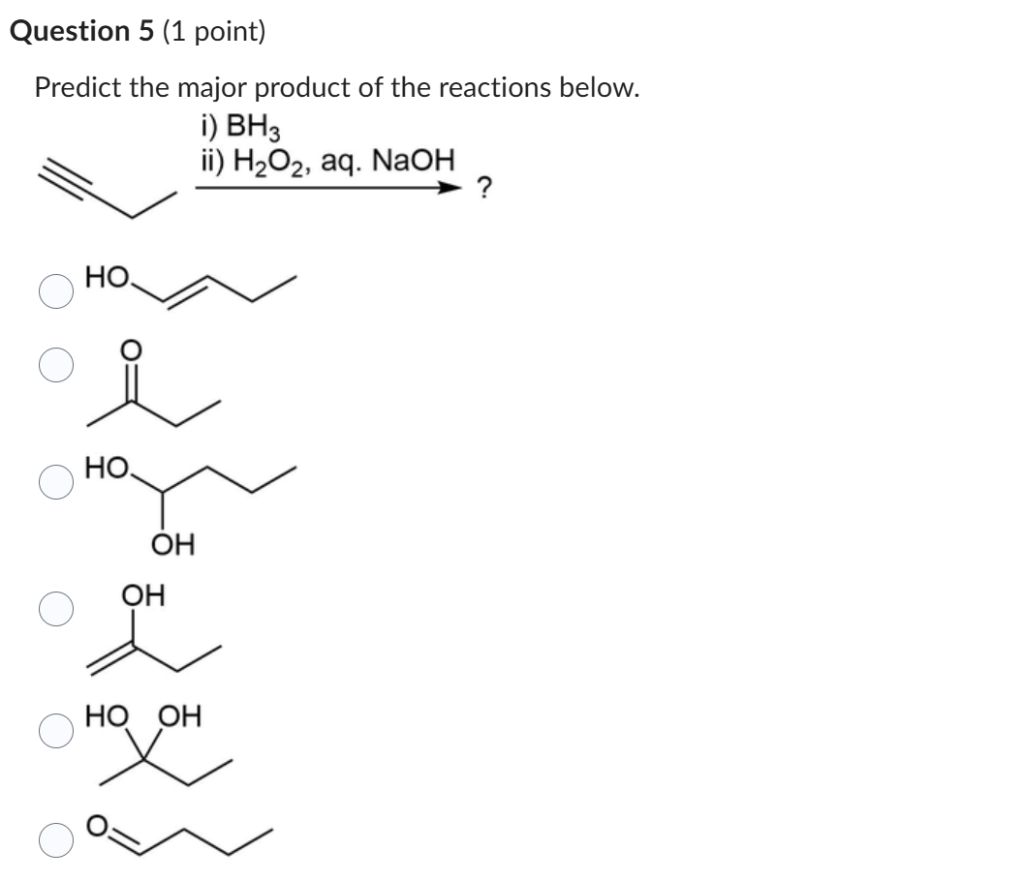
Act like a helpful tutor and exlain me : With diagramsQuestion 4 (1 point) Predict which of the suggested products is formed in the highest yield from the reactions below. OMe i) BH; ry ii) H,0,, aq. NaOH , O OH ome 0 OMe on 0 OMe ald Question 5 (1 point) Predict the major product of the reactions below. i) BHj OP ii) H,O,, aq. NaOH , ORO A a) ON OH OO ~~
Question:
Act like a helpful tutor and exlain me :
With diagrams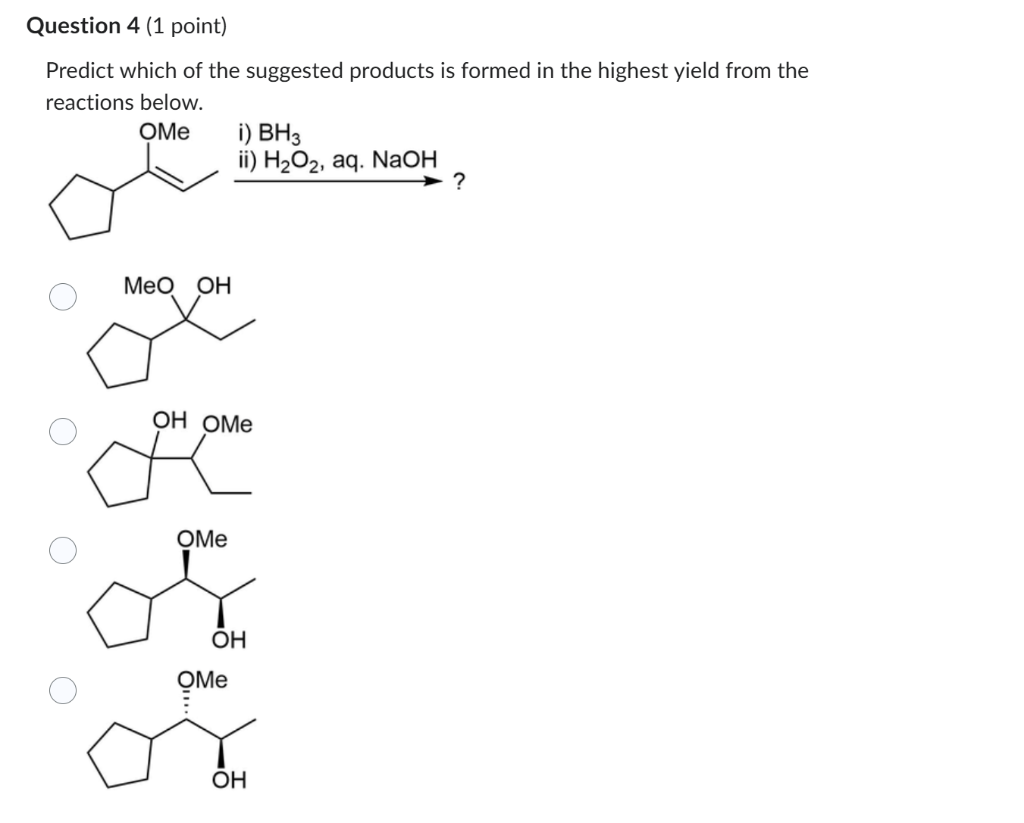
 Question 4 (1 point)
Predict which of the suggested products is formed in the highest yield from the
reactions below.
OMe i) BH;
ry ii) H,0,, aq. NaOH ,
O OH ome
0 OMe
on
0 OMe
ald
Question 5 (1 point)
Predict the major product of the reactions below.
i) BHj
OP ii) H,O,, aq. NaOH ,
ORO A
a) ON
OH
OO ~~
This is AI generated Response.
Asked by: Alok Kumar
Created at: 2026-01-26 03:39:12
Asked by: Alok Kumar
Created at: 2026-01-26 03:39:12
Final Answer:
Rendered
Raw Text
Did you like this answer?
Let's break down both questions step by step, focusing on the chemistry involved and using diagrams for clarity.
---
# **Hydroboration-Oxidation Reaction**
The given reagents for both questions are:
1. **BH₃** (Borane)
2. **H₂O₂, aq. NaOH** (Hydrogen peroxide in basic medium)
This combination is known as **hydroboration-oxidation**, which converts **alkenes or alkynes to alcohols** with **anti-Markovnikov** regioselectivity (the OH group attaches to the less substituted carbon).
---
## **Question 4 Explanation**
### **Starting Material**
- A cyclopentyl ring with an alkene and a methoxy (OMe) group as shown.
### **Step 1: Hydroboration**
- Borane adds **syn** (on the same side) across the double bond.
- **Boron** attaches to the **less substituted carbon** (anti-Markovnikov).
- **Hydrogen** attaches to the more substituted carbon.
**Diagram:**
```
OMe
|
Cyclopentane-CH=CH2
|
(double bond)
```
→ After hydroboration, boron at the less substituted end.
### **Step 2: Oxidation**
- The boron is replaced by an **OH group**.
### **Key Points**
- **Anti-Markovnikov:** OH ends up on the less substituted carbon.
- **Syn addition:** Both H and OH add to the same face of the double bond (can lead to stereochemistry).
### **Analyzing the Options**
- **First structure:** OH and OMe on the same carbon (not possible here).
- **Second structure:** OH and OMe on adjacent carbons, OH on the less substituted carbon (this matches anti-Markovnikov).
- **Third and fourth:** Show stereoisomers (enantiomers). Both are possible, but only one will be the "major" product unless the starting alkene is not chiral.
**Correct Answer:**
The product with the OH on the less substituted carbon, adjacent to the carbon with the OMe group, is the correct answer.
**So, the answer is the second option (from the top).**
---
## **Question 5 Explanation**
### **Starting Material**
- 1-Butyne (an alkyne).
### **Hydroboration-Oxidation with Alkynes**
- Converts terminal alkynes to **aldehydes** (anti-Markovnikov).
- The boron adds to the terminal carbon, and after oxidation, you get an aldehyde at the terminal position.
**Diagram:**
```
CH≡C-CH2-CH3
```
→ After hydroboration-oxidation:
```
O
||
CH3-CH2-CH2-CH
\
H
```
(Butanal)
### **Analyzing the Options**
- **First structure:** Alcohol on the terminal position, but no alkene (not correct).
- **Second structure:** Ketone at the second carbon (not correct for terminal alkyne).
- **Third structure:** Two OH groups (incorrect).
- **Fourth structure:** Dihydroxy compound (incorrect).
- **Fifth structure:** Aldehyde at terminal position (correct).
**Correct Answer:**
The last structure, butanal (aldehyde at the end), is correct.
---
## **Summary Table**
| Reaction Type | Reagents | Product Type | Regioselectivity |
|---------------------------|--------------------------|----------------------|----------------------|
| Hydroboration-Oxidation | BH₃, H₂O₂/NaOH | Alcohol (from alkene)| Anti-Markovnikov |
| Hydroboration-Oxidation | BH₃, H₂O₂/NaOH (alkyne) | Aldehyde (terminal) | Anti-Markovnikov |
---
## **Visual Summary**
### **Question 4 Key Step**

*OH ends up on the less substituted carbon (anti-Markovnikov).*
### **Question 5 Key Step**

*Terminal alkyne yields an aldehyde.*
---
If you need more details or have a specific option you want to discuss, let me know!
📢 Instructions:
- Ask anything relatd to above question only.
- For new Question goto :