 VIPSolutions
Act like a helpful tutor and exlain me :What is the present equivalent of a 20-year geometric cash-flow series increasing at 2% per year if the first year amount is $17,530 and the interest rate is 10% per year? What is the future (time 20) equivalent value of this series? & Click the icon to view the interest and annuity table for discrete compounding when i= 2% per year. 5) Click the icon to view the interest and annuity table for discrete compounding when i= 10% per year. et The present equivalent value of the geometric cash-flow series is s| |. (Round to the nearest dollar.)
Question:
Act like a helpful tutor and exlain me :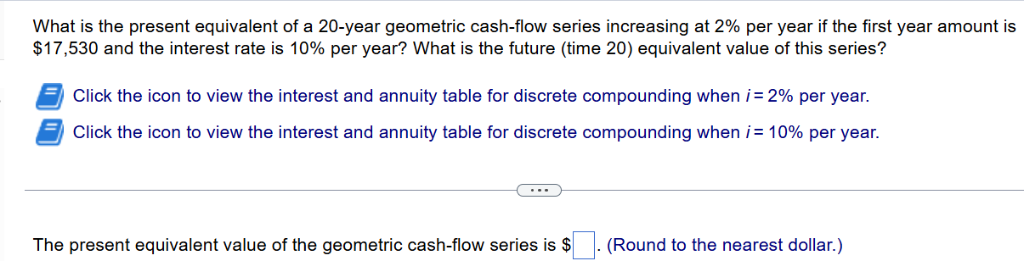 What is the present equivalent of a 20-year geometric cash-flow series increasing at 2% per year if the first year amount is
$17,530 and the interest rate is 10% per year? What is the future (time 20) equivalent value of this series?
& Click the icon to view the interest and annuity table for discrete compounding when i= 2% per year.
5) Click the icon to view the interest and annuity table for discrete compounding when i= 10% per year.
et
The present equivalent value of the geometric cash-flow series is s| |. (Round to the nearest dollar.)
This is AI generated Response.
Asked by: Alok Kumar
Created at: 2026-01-31 03:38:37
Asked by: Alok Kumar
Created at: 2026-01-31 03:38:37
Final Answer:
Rendered
Raw Text
Did you like this answer?
Let's break down the problem and solve it step by step:
---
## **Problem Recap**
You are given:
- **20-year geometric cash-flow series**
- **First year cash flow (\(A_1\))**: $17,530
- **Growth rate (\(g\))**: 2% per year
- **Interest rate (\(i\))**: 10% per year
- **Find**:
1. **Present Value (PV)** of this series
2. **Future Value (FV)** at year 20
---
## **Step 1: Present Value of a Geometric Gradient Series**
The general formula for the **present value** of a geometric gradient series is:
\[
PV = \frac{A_1}{i-g} \left[1 - \left(\frac{1+g}{1+i}\right)^n\right]
\]
Where:
- \(A_1\) = first cash flow
- \(i\) = interest rate per period
- \(g\) = growth rate per period
- \(n\) = number of periods
---
### **Plug in the Numbers**
- \(A_1 = 17,530\)
- \(i = .10\)
- \(g = .02\)
- \(n = 20\)
\[
PV = \frac{17,530}{.10 - .02} \left[1 - \left(\frac{1.02}{1.10}\right)^{20}\right]
\]
#### **Step-by-step Calculation**
1. **Calculate the denominator:**
\[
.10 - .02 = .08
\]
2. **Fraction inside the exponent:**
\[
\frac{1.02}{1.10} = .92727
\]
3. **Exponentiate:**
\[
(.92727)^{20} \approx .171
\]
4. **Subtract from 1:**
\[
1 - .171 = .829
\]
5. **Divide \(A_1\) by .08:**
\[
\frac{17,530}{.08} = 219,125
\]
6. **Multiply by .829:**
\[
219,125 \times .829 \approx 181,747
\]
---
### **Final Answer**
\[
\boxed{181,747}
\]
---
## **Step 2: Future Value at Year 20**
The future value (at year 20) of a geometric gradient series is:
\[
FV = PV \times (1+i)^n
\]
Or, you can use the direct formula:
\[
FV = \frac{A_1 \times (1+i)^n}{i-g} \left[1 - \left(\frac{1+g}{1+i}\right)^n\right]
\]
But since we already have the PV, let's use the first approach:
\[
FV = 181,747 \times (1.10)^{20}
\]
\[
(1.10)^{20} \approx 6.727
\]
\[
FV \approx 181,747 \times 6.727 \approx 1,222,429
\]
---
## **Summary Table**
| Value | Amount (rounded) |
|-------------------|------------------|
| Present Value (PV)| $181,747 |
| Future Value (FV) | $1,222,429 |
---
### **If you need the answer rounded to the nearest dollar, enter:**
\[
\boxed{181,747}
\]
Let me know if you want to see the full calculation for the future value or if you have more questions!
📢 Instructions:
- Ask anything relatd to above question only.
- For new Question goto :