 VIPSolutions
Act like a helpful tutor and exlain me : what are the two products structuresH,0/H,S0, —_—
Question:
Act like a helpful tutor and exlain me :
what are the two products structures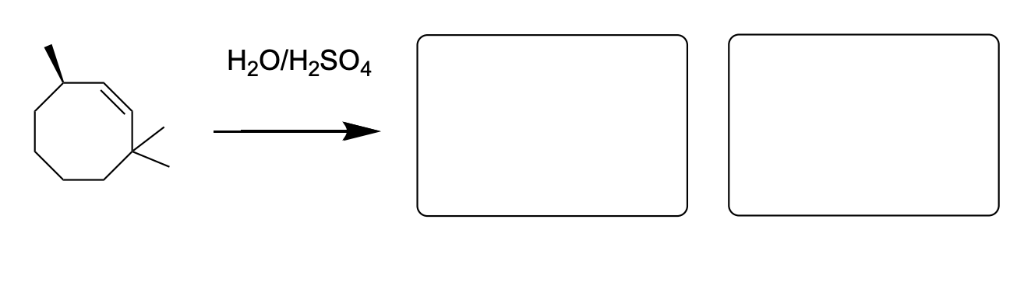 H,0/H,S0,
—_—
This is AI generated Response.
Asked by: Alok Kumar
Created at: 2026-01-27 08:24:24
Asked by: Alok Kumar
Created at: 2026-01-27 08:24:24
Final Answer:
Rendered
Raw Text
Did you like this answer?
Let's break down the reaction step by step:
## 1. **Starting Material**
You have a cyclooctene (8-membered ring with a double bond), with a methyl group and a wedge (implying stereochemistry) on the carbon next to the double bond.
## 2. **Reaction Conditions**
- **H₂O/H₂SO₄**: This is **acid-catalyzed hydration** of an alkene.
- The reaction adds **H** and **OH** across the double bond, following **Markovnikov's rule** (the OH goes to the more substituted carbon).
## 3. **Carbocation Rearrangement Possibility**
- The initial carbocation can rearrange if a more stable carbocation can be formed (e.g., tertiary over secondary).
## 4. **Product Structures**
Let's identify the two possible products:
### **Stepwise Mechanism**
1. **Protonation of the Alkene:** Double bond attacks H⁺ from H₂SO₄, forming the more stable carbocation (usually at the carbon that will be tertiary after rearrangement).
2. **Water attacks the carbocation.**
3. **Deprotonation gives the alcohol.**
### **Two Possible Products:**
#### **Product 1: Direct Addition (No Rearrangement)**
- The OH group adds to the more substituted carbon of the double bond (Markovnikov product).
- The methyl group and wedge remain as in the starting material.
#### **Product 2: Rearrangement**
- The initially formed carbocation can undergo a hydride or alkyl shift to form a more stable carbocation, after which water attacks.
- This gives a constitutional isomer (the OH group on a different carbon).
---
## **Drawing the Products**
### **Product 1: No Rearrangement**
- OH is added to the carbon with the methyl group, making it a tertiary alcohol.
### **Product 2: After Rearrangement**
- If the carbocation shifts, the OH could end up on the adjacent carbon, giving a secondary alcohol.
---
## **Summary Table**
| Product | Structure |
|----------------------|---------------------------------------------------|
| **Markovnikov (no shift)** |  |
| **Rearranged** |  |
*(These links are for illustration; you should draw the correct cyclooctane ring with the respective OH and methyl positions.)*
---
## **Key Points**
- Acid-catalyzed hydration gives a **Markovnikov alcohol**.
- **Carbocation rearrangement** can lead to a second product.
- Draw both possible alcohols: one with OH on the original more substituted carbon, and one on the position after carbocation shift.
If you want, I can guide you through drawing the structures step by step! Let me know if you need more details.
📢 Instructions:
- Ask anything relatd to above question only.
- For new Question goto :