 VIPSolutions
Act like a helpful tutor and exlain me : Water flows through the transition at A at 1 5 ft / s and has a pressure of 3 0 psi. The height between A and B is 1 2 feet. Answer the following questions. Determine the velocity of the fluid at B . ( ft / s ) Hint: You will need to use the continuity equation. Determine the pressure of the fluid at B . ( psi ) Hint: You will need to use Bernoulli's equation.3jn. 11 h sin —s fen
Question:
Act like a helpful tutor and exlain me :
Water flows through the transition at A at
1
5
ft
/
s and has a pressure of
3
0
psi. The height between A and B is
1
2
feet. Answer the following questions.
Determine the velocity of the fluid at B
.
(
ft
/
s
)
Hint: You will need to use the continuity equation.
Determine the pressure of the fluid at B
.
(
psi
)
Hint: You will need to use Bernoulli's equation.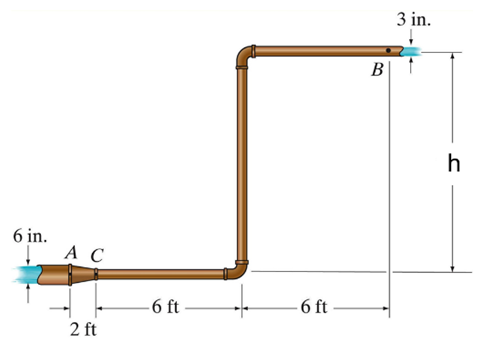 3jn.
11
h
sin
—s fen
This is AI generated Response.
Asked by: manish kumar
Created at: 2025-09-10 07:40:45
Asked by: manish kumar
Created at: 2025-09-10 07:40:45
Final Answer:
Rendered
Raw Text
Did you like this answer?
# Step-by-Step Solution
Let's break it down using the **continuity equation** and **Bernoulli's equation**, as guided by the hints.
---
## **Given Data**
- **At A:**
- Velocity, \( v_A = 15 \) ft/s
- Pressure, \( P_A = 30 \) psi
- Diameter at A, \( d_A = 6 \) in \( = 0.5 \) ft
- **At B:**
- Height above A: \( h = 12 \) ft
- Diameter at B, \( d_B = 3 \) in \( = 0.25 \) ft
---
## **1. Find the Velocity at B (Continuity Equation)**
The **continuity equation** for incompressible fluids states:
\[
A_A v_A = A_B v_B
\]
Where \( A \) is the cross-sectional area.
### **Calculate Areas:**
- \( A_A = \pi (d_A/2)^2 = \pi (0.25)^2 = 0.196 \) ft²
- \( A_B = \pi (d_B/2)^2 = \pi (0.125)^2 = 0.0491 \) ft²
### **Apply Continuity:**
\[
A_A v_A = A_B v_B
\]
\[
0.196 \times 15 = 0.0491 \times v_B
\]
\[
2.94 = 0.0491 \times v_B
\]
\[
v_B = \frac{2.94}{0.0491} \approx 59.9 \text{ ft/s}
\]
---
## **2. Find the Pressure at B (Bernoulli's Equation)**
The **Bernoulli equation** (ignoring friction) between A and B:
\[
\frac{P_A}{\gamma} + z_A + \frac{v_A^2}{2g} = \frac{P_B}{\gamma} + z_B + \frac{v_B^2}{2g}
\]
- \( \gamma \): Specific weight of water (\( 62.4 \) lb/ft³)
- \( g \): Acceleration due to gravity (\( 32.2 \) ft/s²)
- Heights: \( z_B = z_A + 12 \) ft
### **Plug in values:**
Let’s set \( z_A = 0 \), so \( z_B = 12 \) ft.
\[
\frac{P_A}{62.4} + 0 + \frac{15^2}{2 \times 32.2} = \frac{P_B}{62.4} + 12 + \frac{59.9^2}{2 \times 32.2}
\]
#### **Calculate each term:**
- \( \frac{P_A}{62.4} = \frac{30 \times 144}{62.4} = \frac{4320}{62.4} = 69.23 \) ft (since 1 psi = 144 lb/ft²)
- \( \frac{15^2}{2 \times 32.2} = \frac{225}{64.4} = 3.50 \) ft
- \( \frac{59.9^2}{2 \times 32.2} = \frac{3588}{64.4} = 55.73 \) ft
#### **Set up equation:**
\[
69.23 + 0 + 3.50 = \frac{P_B}{62.4} + 12 + 55.73
\]
\[
72.73 = \frac{P_B}{62.4} + 67.73
\]
\[
72.73 - 67.73 = \frac{P_B}{62.4}
\]
\[
5.00 = \frac{P_B}{62.4}
\]
\[
P_B = 5.00 \times 62.4 = 312 \text{ lb/ft}^2
\]
Convert to psi:
\[
P_B = \frac{312}{144} = 2.17 \text{ psi}
\]
---
## **Final Answers**
### **1. Velocity at B**
\[
\boxed{59.9\ \text{ft/s}}
\]
### **2. Pressure at B**
\[
\boxed{2.17\ \text{psi}}
\]
---
## **Summary Table**
| Location | Velocity (ft/s) | Pressure (psi) |
|----------|-----------------|---------------|
| A | 15 | 30 |
| B | 59.9 | 2.17 |
---
**Let me know if you want to see the step-by-step math in more detail or have questions about the equations!**
📢 Instructions:
- Ask anything relatd to above question only.
- For new Question goto :