 VIPSolutions
Act like a helpful tutor and exlain me :va Let the equilibrium condition for national income be SN+TM=1N+Go (5, T,1'>0 S+T'>1) where 5, Y, T, 1, and G stand for saving, national income, taxes, investment, and gov- ernment expenditure, respectively. All derivatives are continuous. (@) Interpret the economic meanings of the derivatives 5, T', and Is (b) Check whether the conditions of the implici-function theorem are satisfied. If so, write the equilibrium identity. id (dy /dGa) and discuss its economic implications.
Question:
Act like a helpful tutor and exlain me :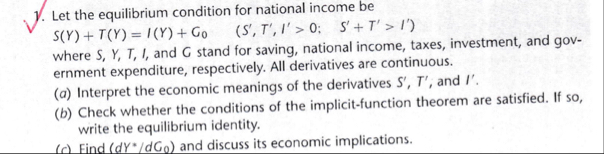 va Let the equilibrium condition for national income be
SN+TM=1N+Go (5, T,1'>0 S+T'>1)
where 5, Y, T, 1, and G stand for saving, national income, taxes, investment, and gov-
ernment expenditure, respectively. All derivatives are continuous.
(@) Interpret the economic meanings of the derivatives 5, T', and Is
(b) Check whether the conditions of the implici-function theorem are satisfied. If so,
write the equilibrium identity.
id (dy /dGa) and discuss its economic implications.
This is AI generated Response.
Asked by: Alok Kumar
Created at: 2026-03-02 03:01:56
Asked by: Alok Kumar
Created at: 2026-03-02 03:01:56
Final Answer:
Rendered
Raw Text
Did you like this answer?
Let's go step by step through the problem:
---
# **Equilibrium Condition for National Income**
The equilibrium condition is:
\[
S(Y) + T(Y) = I(Y) + G_
\]
where:
- \( S(Y) \) = Saving as a function of national income (\( Y \))
- \( T(Y) \) = Taxes as a function of \( Y \)
- \( I(Y) \) = Investment as a function of \( Y \)
- \( G_ \) = Exogenous (fixed) government expenditure
With conditions:
- \( S', T', I' > \): The derivatives of saving, taxes, and investment with respect to income are all positive.
- \( S' + T' > I' \): The sum of marginal propensities to save and tax is greater than the marginal propensity to invest.
---
## **(a) Economic Meaning of the Derivatives \( S' \), \( T' \), and \( I' \)**
- **\( S'(Y) \):**
The marginal propensity to save (MPS). It measures how much saving increases when national income increases by one unit.
**Economic meaning:** For every extra dollar earned, \( S'(Y) \) dollars are saved.
- **\( T'(Y) \):**
The marginal tax rate. It measures how much tax revenue increases when national income increases by one unit.
**Economic meaning:** For every extra dollar earned, \( T'(Y) \) dollars go to taxes.
- **\( I'(Y) \):**
The marginal propensity to invest out of income. It measures how much investment increases when national income increases by one unit.
**Economic meaning:** For every extra dollar earned, \( I'(Y) \) dollars are invested.
---
## **(b) Conditions of the Implicit Function Theorem**
The implicit function theorem allows us to solve for \( Y \) as a function of \( G_ \) if certain conditions are met.
Given the equilibrium:
\[
F(Y, G_) = S(Y) + T(Y) - I(Y) - G_ =
\]
The key condition is that \( F_Y(Y, G_) \neq \):
\[
F_Y = S'(Y) + T'(Y) - I'(Y)
\]
From the question: \( S' + T' > I' \Rightarrow F_Y > \), so the condition is satisfied.
**Equilibrium identity (solving for \( Y \)):**
\[
Y^* = f(G_) \quad \text{such that} \quad S(Y^*) + T(Y^*) = I(Y^*) + G_
\]
---
## **(c) Find \( \frac{dY^*}{dG_} \) and Discuss Its Economic Implications**
Differentiate the equilibrium condition implicitly with respect to \( G_ \):
\[
\frac{d}{dG_} [S(Y^*) + T(Y^*) - I(Y^*) - G_] =
\]
Chain rule gives:
\[
(S' + T' - I') \frac{dY^*}{dG_} - 1 =
\]
\[
\Rightarrow \frac{dY^*}{dG_} = \frac{1}{S' + T' - I'}
\]
### **Economic Implication:**
- **\( \frac{dY^*}{dG_} \):** This measures the change in equilibrium national income when government spending increases by 1 unit—**the government expenditure multiplier**.
- Since \( S' + T' > I' \), the denominator is positive, so an increase in \( G_ \) increases \( Y^* \).
- **Economic interpretation:** The multiplier is smaller when people save and pay taxes more (higher \( S' \) and \( T' \)), or when investment is less responsive to income (lower \( I' \)).
---
## **Summary Table**
| Derivative | Economic Meaning |
|------------|-----------------------------------|
| \( S'(Y) \) | Marginal propensity to save |
| \( T'(Y) \) | Marginal tax rate |
| \( I'(Y) \) | Marginal propensity to invest |
**Multiplier:** \( \frac{dY^*}{dG_} = \frac{1}{S' + T' - I'} \)
---
**Let me know if you need further clarification on any part!**
📢 Instructions:
- Ask anything relatd to above question only.
- For new Question goto :