 VIPSolutions
Act like a helpful tutor and exlain me :Uo=2m/s — — = v=80x10° ms } — 1 x PeSm— L=15m ——» Engine oil with a kinematic viscosity of v = 8.0 x 10° m?s flows over a flat plate of length L=1.5 m with a free stream velocity of Us, = 2 m/s. The flow is steady and laminar. Assume the Blasius solution is applicable. 1. Calculate the Reynolds number at the end of the plate (x =L). 2. Determine the boundary layer thickness § at the trailing edge. 3. Compute the local wall shear stress 1, at x = L. 4. Estimate the total friction drag Fp on one side of the plate per unit width.
Question:
Act like a helpful tutor and exlain me :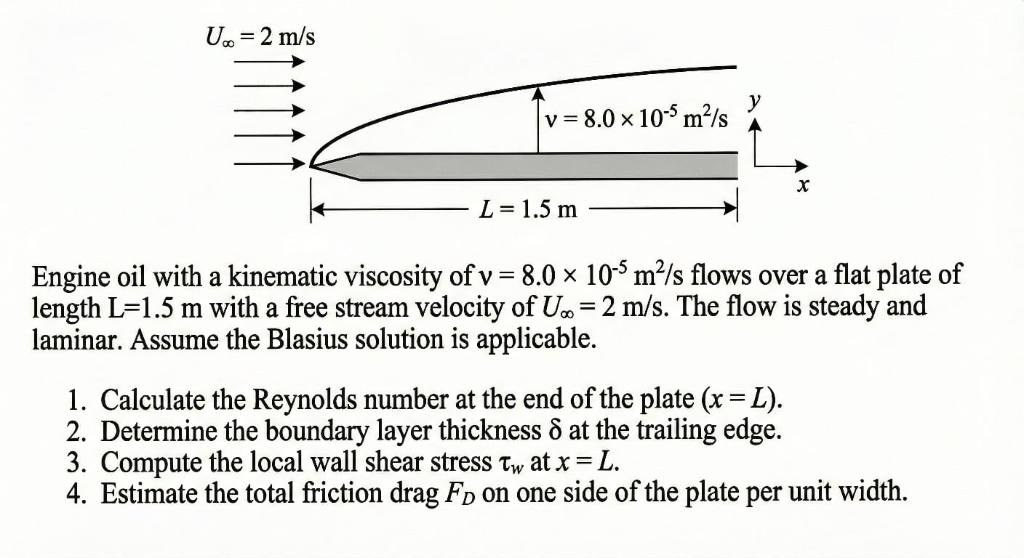 Uo=2m/s
—
—
= v=80x10° ms }
— 1
x
PeSm— L=15m ——»
Engine oil with a kinematic viscosity of v = 8.0 x 10° m?s flows over a flat plate of
length L=1.5 m with a free stream velocity of Us, = 2 m/s. The flow is steady and
laminar. Assume the Blasius solution is applicable.
1. Calculate the Reynolds number at the end of the plate (x =L).
2. Determine the boundary layer thickness § at the trailing edge.
3. Compute the local wall shear stress 1, at x = L.
4. Estimate the total friction drag Fp on one side of the plate per unit width.
This is AI generated Response.
Asked by: Alok Kumar
Created at: 2026-01-27 06:06:49
Asked by: Alok Kumar
Created at: 2026-01-27 06:06:49
Final Answer:
Rendered
Raw Text
Did you like this answer?
Let's work through each step using the given data and the Blasius solution for laminar boundary layers:
---
## **Given Data**
- **Kinematic viscosity,** \( \nu = 8. \times 10^{-5} \) m²/s
- **Plate length,** \( L = 1.5 \) m
- **Free stream velocity,** \( U_\infty = 2 \) m/s
---
## **1. Reynolds Number at the End of the Plate (\( x = L \))**
The Reynolds number is calculated as:
\[
Re_L = \frac{U_\infty L}{\nu}
\]
**Plug in the values:**
\[
Re_L = \frac{2 \times 1.5}{8. \times 10^{-5}}
= \frac{3.}{8. \times 10^{-5}}
= 3.75 \times 10^4
\]
---
## **2. Boundary Layer Thickness (\( \delta \)) at the Trailing Edge**
For a laminar flow over a flat plate (Blasius solution):
\[
\delta = \frac{5.x}{\sqrt{Re_x}}
\]
At \( x = L \):
\[
\delta_L = \frac{5.L}{\sqrt{Re_L}}
\]
**Plug in the values:**
\[
\delta_L = \frac{5. \times 1.5}{\sqrt{3.75 \times 10^4}}
= \frac{7.5}{193.6}
\approx .0388~\text{m} = 38.8~\text{mm}
\]
---
## **3. Local Wall Shear Stress (\( \tau_w \)) at \( x = L \)**
Blasius solution for wall shear stress:
\[
\tau_w = .332 \rho U_\infty^2 \sqrt{\frac{\nu}{U_\infty L}}
\]
**Note:** Density (\( \rho \)) of engine oil is not given, so keep it as \( \rho \) or assume a typical value if needed.
\[
\tau_w = .332 \rho (2)^2 \sqrt{\frac{8. \times 10^{-5}}{2 \times 1.5}}
\]
Calculate the square root:
\[
\frac{8. \times 10^{-5}}{3.} = 2.667 \times 10^{-5}
\]
\[
\sqrt{2.667 \times 10^{-5}} = 5.16 \times 10^{-3}
\]
Plug values into the equation:
\[
\tau_w = .332 \rho \times 4 \times 5.16 \times 10^{-3}
= .332 \times 4 \times 5.16 \times 10^{-3} \rho
= 1.328 \times 5.16 \times 10^{-3} \rho
= 6.85 \times 10^{-3} \rho~(\text{N/m}^2)
\]
---
## **4. Total Friction Drag (\( F_D \)) on One Side per Unit Width**
Total drag per unit width (Blasius):
\[
F_D = C_f \times \frac{1}{2} \rho U_\infty^2 \times L
\]
Where the average skin friction coefficient for a laminar plate:
\[
C_f = \frac{1.328}{\sqrt{Re_L}}
\]
Calculate \( C_f \):
\[
C_f = \frac{1.328}{\sqrt{3.75 \times 10^4}}
= \frac{1.328}{193.6}
= .00686
\]
Now, plug values into drag equation:
\[
F_D = .00686 \times \frac{1}{2} \rho (2)^2 \times 1.5
\]
\[
= .00686 \times .5 \times 4 \times 1.5 \rho
= .00686 \times 3 \rho
= .0206 \rho~\text{N/m}
\]
---
## **Summary Table**
| Step | Formula | Result (in terms of \( \rho \)) |
|------|---------|-------------------------------|
| 1. Reynolds number | \( Re_L = \frac{U_\infty L}{\nu} \) | \( 3.75 \times 10^4 \) |
| 2. Boundary layer thickness | \( \delta_L = \frac{5L}{\sqrt{Re_L}} \) | \( .0388 \) m (38.8 mm) |
| 3. Wall shear stress | \( \tau_w = .332 \rho U_\infty^2 \sqrt{\frac{\nu}{U_\infty L}} \) | \( 6.85 \times 10^{-3} \rho \) N/m² |
| 4. Total friction drag | \( F_D = C_f \frac{1}{2} \rho U_\infty^2 L \) | \( .0206 \rho \) N/m |
---
### **Let me know if you need further clarification or if you want to plug in a typical value for oil density!**
Question:
without tabular form pls
This is AI generated Response.
Asked by: Alok Kumar
Created at: 2026-01-27 06:07:50
Asked by: Alok Kumar
Created at: 2026-01-27 06:07:50
Final Answer:
Rendered
Raw Text
Did you like this answer?
# Fluid Mechanics Analysis of Engine Oil Flow
Let's analyze the flow of engine oil over a flat plate using the Blasius solution for laminar boundary layers.
## Given Data
- **Kinematic viscosity,** \( \nu = 8.0 \times 10^{-5} \) m²/s
- **Plate length,** \( L = 1.5 \) m
- **Free stream velocity,** \( U_\infty = 2 \) m/s
---
## 1. Reynolds Number at the End of the Plate (\( x = L \))
The Reynolds number is calculated using the formula:
\[
Re_L = \frac{U_\infty L}{\nu}
\]
Substituting the given values:
\[
Re_L = \frac{2 \times 1.5}{8.0 \times 10^{-5}} = \frac{3}{8.0 \times 10^{-5}} = 3.75 \times 10^4
\]
---
## 2. Boundary Layer Thickness (\( \delta \)) at the Trailing Edge
For laminar flow, the boundary layer thickness at the end of the plate is given by:
\[
\delta = \frac{5L}{\sqrt{Re_L}}
\]
Calculating \( \delta_L \):
\[
\delta_L = \frac{5 \times 1.5}{\sqrt{3.75 \times 10^4}} = \frac{7.5}{193.6} \approx 0.0388 \text{ m} \text{ (or 38.8 mm)}
\]
---
## 3. Local Wall Shear Stress (\( \tau_w \)) at \( x = L \)
The wall shear stress is computed as:
\[
\tau_w = 0.332 \rho U_\infty^2 \sqrt{\frac{\nu}{U_\infty L}}
\]
Calculating:
\[
\tau_w = 0.332 \rho (2)^2 \sqrt{\frac{8.0 \times 10^{-5}}{2 \times 1.5}}
\]
Calculate the square root:
\[
\frac{8.0 \times 10^{-5}}{3} = 2.667 \times 10^{-5} \quad \Rightarrow \quad \sqrt{2.667 \times 10^{-5}} = 5.16 \times 10^{-3}
\]
Substituting back:
\[
\tau_w = 0.332 \rho \times 4 \times 5.16 \times 10^{-3} = 6.85 \times 10^{-3} \rho \text{ (N/m²)}
\]
---
## 4. Total Friction Drag (\( F_D \)) on One Side per Unit Width
The total drag per unit width can be estimated using:
\[
F_D = C_f \times \frac{1}{2} \rho U_\infty^2 \times L
\]
Where the average skin friction coefficient for laminar flow is:
\[
C_f = \frac{1.328}{\sqrt{Re_L}}
\]
Calculating \( C_f \):
\[
C_f = \frac{1.328}{\sqrt{3.75 \times 10^4}} = \frac{1.328}{193.6} \approx 0.00686
\]
Substituting back into the drag equation:
\[
F_D = 0.00686 \times \frac{1}{2} \rho (2)^2 \times 1.5
\]
\[
= 0.00686 \times 0.5 \times 4 \times 1.5 \rho = 0.0206 \rho \text{ (N/m)}
\]
---
## Summary of Results
1. **Reynolds Number:** \( 3.75 \times 10^4 \)
2. **Boundary Layer Thickness:** \( 0.0388 \) m (or 38.8 mm)
3. **Local Wall Shear Stress:** \( 6.85 \times 10^{-3} \rho \) N/m²
4. **Total Friction Drag:** \( 0.0206 \rho \) N/m
---
Feel free to ask if you have questions or need further assistance!
📢 Instructions:
- Ask anything relatd to above question only.
- For new Question goto :