 VIPSolutions
Act like a helpful tutor and exlain me : These are synthesis questions. You need to show how the starting material can be converted into the product ( s ) shown. You may use any reactions we have learned. show all the reagents you need. Show each molecule synthesized along the way and be sure to pay attention to the regiochemistry and stereochemistry preferences for each reaction. ( 1 2 pts ) All of the carbon atoms of the products must come from the starting materials for this one! Please show all work handwritten. ( 1 2 pts ) All of the carbon atoms of the products must come from the starting materials for this one!(12 pts) All of the carbon atoms of the products must come from the starting materials for this one! ? a
Question:
Act like a helpful tutor and exlain me :
These are synthesis questions. You need to show how the starting material can be converted into the product
(
s
)
shown. You may use any reactions we have learned. show all the reagents you need. Show each molecule synthesized along the way and be sure to pay attention to the regiochemistry and stereochemistry preferences for each reaction.
(
1
2
pts
)
All of the carbon atoms of the products must come from the starting materials for this one! Please show all work handwritten.
(
1
2
pts
)
All of the carbon atoms of the products must come from the starting materials for this one!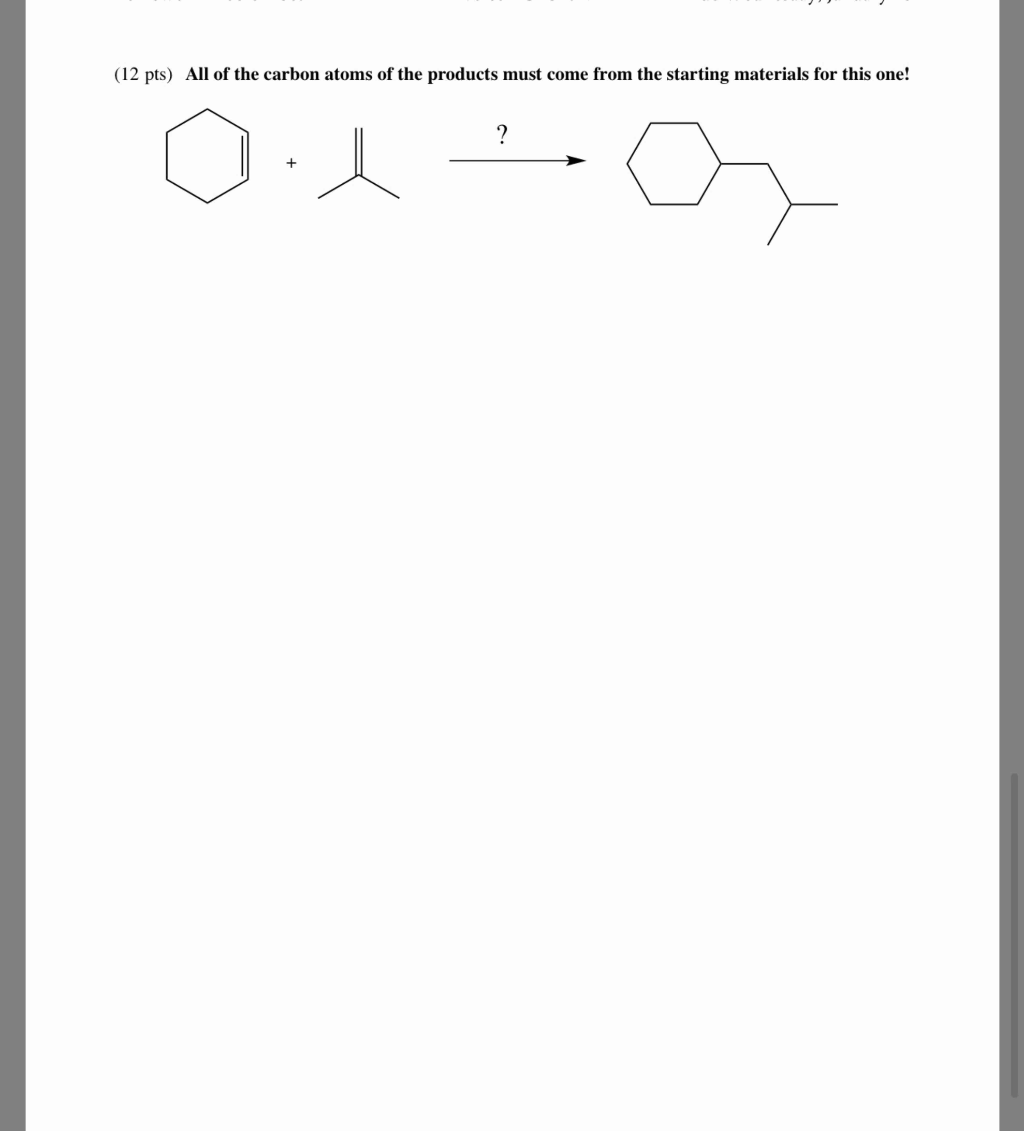 (12 pts) All of the carbon atoms of the products must come from the starting materials for this one!
?
a
This is AI generated Response.
Asked by: Alok Kumar
Created at: 2026-01-29 06:43:47
Asked by: Alok Kumar
Created at: 2026-01-29 06:43:47
Final Answer:
Rendered
Raw Text
Did you like this answer?
# Synthesis Explanation
## Problem Recap
**Starting materials:**
- Cyclohexene (a 6-membered ring with one double bond)
- Isobutene (2-methylpropene, (CH₂=C(CH₃)₂))
**Product:**
- Cyclohexane ring with a sec-butyl group (–CH(CH₃)CH₂CH₃) attached
## Analysis
### 1. **Recognize the Reaction Type**
This transformation requires joining cyclohexene and isobutene such that the isobutyl group is added to the cyclohexane ring. This is a classic **alkylation** reaction.
### 2. **Key Principle**
- All carbons in the product must come from the starting materials.
- The product shows the isobutyl group (from isobutene) attached to the cyclohexane ring.
### 3. **Possible Reactions**
The most straightforward route is **alkylation via carbocation formation**:
- Generate a carbocation from isobutene
- Add it to cyclohexene
But cyclohexene is not nucleophilic enough for direct alkylation. Instead, convert cyclohexene to a nucleophile (e.g., via **hydroboration-oxidation to cyclohexanol, then dehydration to cyclohexene, then further to a cyclohexyl halide or Grignard**).
But, **Friedel–Crafts alkylation** is not possible directly on cyclohexene, but we can use an **acid-catalyzed alkylation** or a **radical addition** (Markovnikov addition of isobutene to cyclohexene).
### 4. **Stepwise Synthesis**
#### **Step 1: Electrophilic Addition of Isobutene to Cyclohexene (Carbocation Mechanism)**
**a. Generate tert-butyl carbocation from isobutene:**
- Use acid (H⁺) to protonate isobutene, forming a tertiary carbocation.
**b. Electrophilic addition to cyclohexene:**
- The double bond of cyclohexene attacks the carbocation, forming a new C–C bond at the more substituted position (Markovnikov addition).
#### **Step 2: Hydrogenation (if needed)**
- If the product still contains a double bond, hydrogenate using H₂/Pd-C to get cyclohexane.
---
## **Detailed Mechanism**
### **Step 1: Carbocation Formation**
- Isobutene + H⁺ → tert-butyl carbocation
### **Step 2: Alkylation**
- Cyclohexene double bond attacks the carbocation at the more substituted position.
- This gives a cyclohexyl ring with a sec-butyl substituent (after rearrangement, if necessary).
### **Step 3: Hydrogenation**
- If any double bond remains, use H₂/Pd-C to fully saturate.
---
## **Reagents Needed**
1. **Acid (H₂SO₄ or H₃PO₄)** to generate carbocation from isobutene
2. **H₂ / Pd-C** for hydrogenation
---
## **Summary of Steps**
1. **Mix cyclohexene and isobutene with strong acid:**
- The isobutene is protonated to give a carbocation.
- Cyclohexene’s double bond attacks the carbocation, forming a new C–C bond.
2. **Hydrogenate if necessary (H₂, Pd-C):**
- Reduces any remaining double bond, giving a fully saturated product.
---
## **Handwritten Work Example (Structure Flow)**
```plaintext
Cyclohexene Isobutene
⬇ ⬇
[H⁺] → Carbocation
⬇
Double bond of cyclohexene attacks carbocation
⬇
Cyclohexyl-sec-butyl intermediate (may still have a double bond)
⬇
[H₂, Pd-C]
⬇
Final Product: sec-butyl cyclohexane
```
---
## **Tips**
- Pay attention to **Markovnikov selectivity** (the more stable carbocation will form).
- All carbons in the product are accounted for from the starting materials.
---
**If you need a fully handwritten version, you should draw each step as described above, showing the movement of electrons and the intermediate structures.** Let me know if you want a stepwise drawing or further breakdown!
📢 Instructions:
- Ask anything relatd to above question only.
- For new Question goto :