 VIPSolutions
Act like a helpful tutor and exlain me :The spring that is part of segment DB shown in the figure has an unstretched length of 1.7 m. Note that segment DB is longer than the spring length. Determine the stiffness k of the spring (in N/m) to hold the 59 kg crate in the position shown. Express your answer in degrees to three significant figures. F 2m - 3m + EB E— D | A N I< ri
Question:
Act like a helpful tutor and exlain me :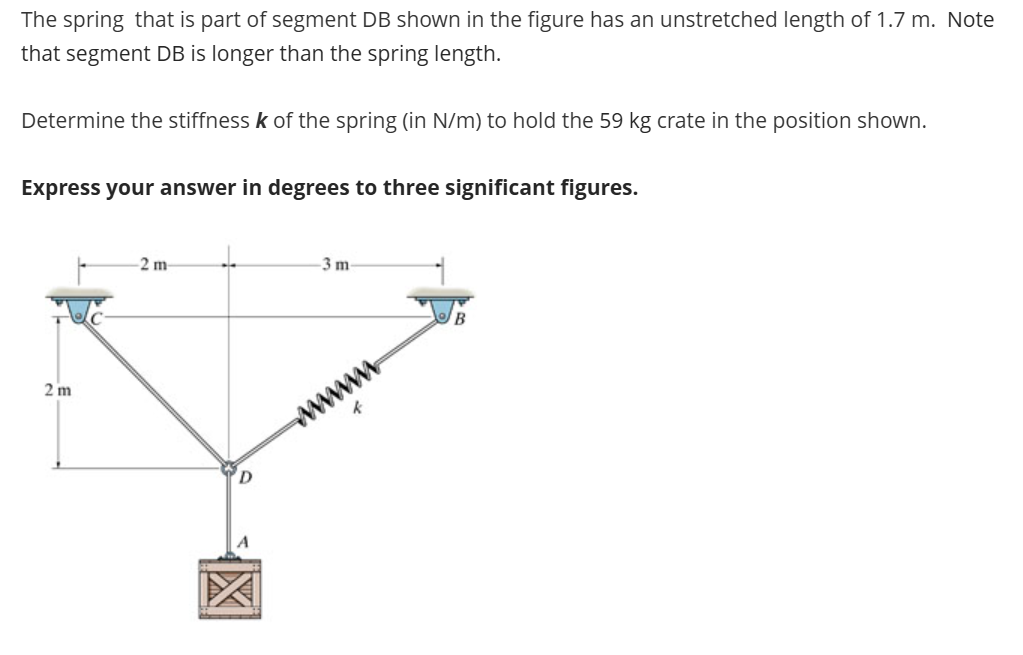 The spring that is part of segment DB shown in the figure has an unstretched length of 1.7 m. Note
that segment DB is longer than the spring length.
Determine the stiffness k of the spring (in N/m) to hold the 59 kg crate in the position shown.
Express your answer in degrees to three significant figures.
F 2m - 3m +
EB E—
D
| A
N
I<
ri
This is AI generated Response.
Asked by: manish kumar
Created at: 2025-09-18 10:26:12
Asked by: manish kumar
Created at: 2025-09-18 10:26:12
Final Answer:
Rendered
Raw Text
Did you like this answer?
Let's break down the problem step by step:
## **Step 1: Understand the Problem**
- There is a crate of mass \( m = 59 \) kg hanging from point \( D \).
- The spring (with stiffness \( k \)) connects from \( D \) to \( B \).
- The spring has an **unstretched length** of \( 1.7 \) m, but the actual segment \( DB \) is longer.
- We are to find the **stiffness \( k \) of the spring** so that the crate is held in the position shown.
---
## **Step 2: Find the Geometry**
Let's find the coordinates of points \( D \) and \( B \):
- Point \( D \) is vertically below \( C \), so its coordinates: \( (0, 0) \).
- The crate is hanging directly below \( D \), so we focus on \( D \) for forces.
- Point \( B \): From the top view, \( B \) is 3 meters to the right of the vertical line through \( D \), and 2 meters up.
- So, \( B = (3, 2) \).
**Length \( DB \):**
\[
DB = \sqrt{(3 - 0)^2 + (2 - 0)^2} = \sqrt{9 + 4} = \sqrt{13} = 3.606 \text{ m}
\]
---
## **Step 3: Spring Stretch**
- **Unstretched length** of spring: \( L_0 = 1.7 \) m
- **Stretched length** (actual \( DB \)): \( L = 3.606 \) m
- **Extension** (\( x \)):
\[
x = L - L_0 = 3.606 - 1.7 = 1.906 \text{ m}
\]
---
## **Step 4: Free Body Diagram and Equilibrium**
The crate is in equilibrium, so the **vertical forces** must balance the weight:
- The forces acting at \( D \) are:
- Tension in \( DC \) (let's call it \( T_{DC} \)), acting along \( DC \)
- Spring force \( F_s \) along \( DB \)
- Weight \( W = mg \) acting downward
Sum of vertical forces at \( D \) must be zero.
---
## **Step 5: Find the Angle of Spring**
We need the vertical component of the spring force.
- **Direction vector of \( DB \):** \( (3, 2) \)
- **Magnitude:** \( 3.606 \)
- **Unit vector along \( DB \):** \( \frac{(3, 2)}{3.606} = (0.832, 0.555) \)
- **Vertical component is the \( y \)-component:** \( 0.555 \) times the total spring force.
---
## **Step 6: Write the Force Balance Equation**
Let \( F_s \) be the spring force.
Vertically, components must add up to weight:
\[
\text{Upward force from spring} = F_s \cdot \sin(\theta)
\]
Where \( \theta \) is the angle between \( DB \) and the horizontal.
But from the unit vector, vertical component is \( 0.555 \):
\[
F_s \cdot 0.555 = mg
\]
\[
F_s = \frac{mg}{0.555}
\]
But \( F_s = kx \):
\[
kx = \frac{mg}{0.555}
\]
\[
k = \frac{mg}{0.555 \times x}
\]
Recall \( x = 1.906 \) m, \( m = 59 \) kg, \( g = 9.81 \) m/s\(^2\):
---
## **Step 7: Plug in the Numbers**
\[
k = \frac{59 \times 9.81}{0.555 \times 1.906}
\]
\[
k = \frac{578.79}{1.0588}
\]
\[
k = 546.7 \, \text{N/m}
\]
**To three significant figures:**
\[
\boxed{547 \, \text{N/m}}
\]
---
## **Summary Table:**
| Quantity | Value |
|-------------------|---------------|
| \( DB \) length | 3.606 m |
| Extension \( x \) | 1.906 m |
| \( mg \) | 578.79 N |
| Vertical fraction | 0.555 |
| \( k \) | 547 N/m |
---
### **Final Answer**
\[
\boxed{
k = 547 \ \text{N/m}
}
\]
Let me know if you'd like a breakdown of the forces or vector calculations!
📢 Instructions:
- Ask anything relatd to above question only.
- For new Question goto :