 VIPSolutions
Act like a helpful tutor and exlain me :The reservoir shown in the Figure attached contains oil for a hydraulic system. The specific gravity of the oil is 0.93. Calculate the location of the center of pressure L,,. E = = = 152-mm diameter Patil 3 NS) Fama (oe O A 046m O B. 0.58m OC. 016m k ND N2/Em
Question:
Act like a helpful tutor and exlain me :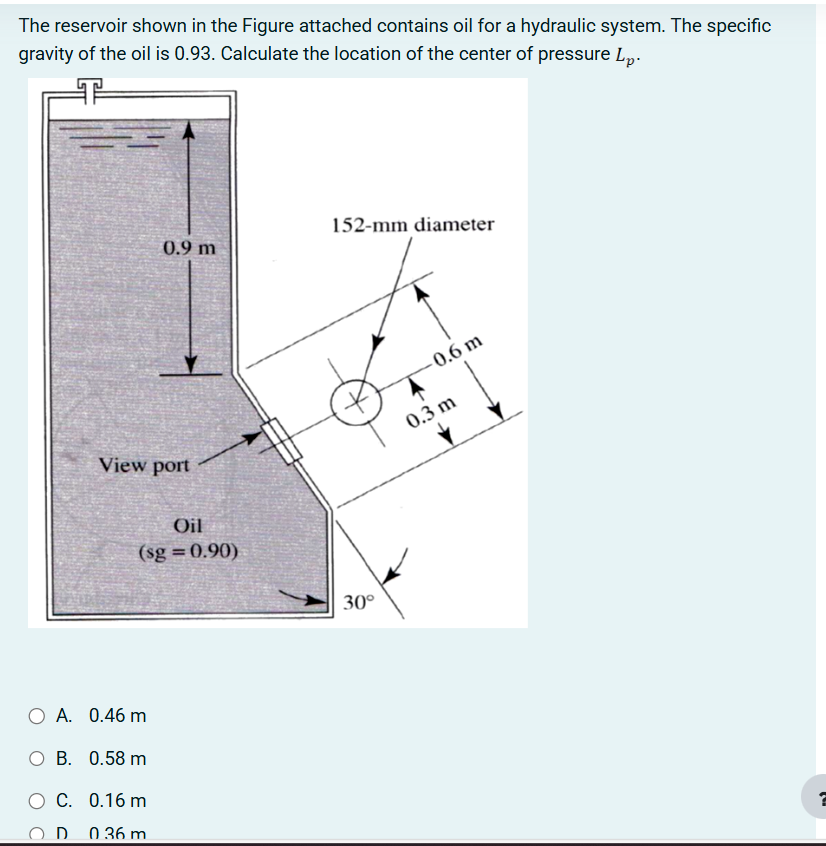 The reservoir shown in the Figure attached contains oil for a hydraulic system. The specific
gravity of the oil is 0.93. Calculate the location of the center of pressure L,,.
E = = = 152-mm diameter
Patil 3 NS)
Fama (oe
O A 046m
O B. 0.58m
OC. 016m k
ND N2/Em
This is AI generated Response.
Asked by: manish kumar
Created at: 2025-09-12 00:36:11
Asked by: manish kumar
Created at: 2025-09-12 00:36:11
Final Answer:
Rendered
Raw Text
Did you like this answer?
# Center of Pressure Calculation for a Submerged Surface
Let's break down the problem step-by-step:
---
## **Given Data**
- **Specific gravity of oil, SG:** 0.93
- **Diameter of viewport:** 152 mm = 0.152 m
- **Radius of viewport:** \( r = 0.076 \) m
- **Distance from oil surface to center of viewport along the inclined plate:** \( 0.9 + 0.6 = 1.5 \) m
- **Inclined angle of the viewport:** \( 30^\circ \)
---
## **Step 1: Calculate Depth to Centroid (\( h_c \))**
The centroid of the viewport is at the center of the circle, which is **1.5 m** below the oil surface measured vertically.
But since the viewport is on an inclined plane at \( 30^\circ \), the **vertical depth** to the centroid is:
\[
h_c = 0.9 + 0.6 \sin(30^\circ) = 0.9 + (0.6 \times 0.5) = 0.9 + 0.3 = 1.2~\text{m}
\]
However, the centroid is actually at \( 0.9 + (0.6~\text{m}) \) along the plate; the vertical depth at the center is:
\[
h_c = 0.9 + 0.6 \sin(30^\circ) = 0.9 + 0.3 = 1.2~\text{m}
\]
---
## **Step 2: Area of the Viewport (\( A \))**
\[
A = \pi r^2 = \pi (0.076)^2 \approx 0.0181~\text{m}^2
\]
---
## **Step 3: Hydrostatic Pressure at Centroid (\( P_c \))**
\[
\text{Density of oil } (\rho) = SG \times \rho_{\text{water}} = 0.93 \times 1000~\text{kg/m}^3 = 930~\text{kg/m}^3
\]
\[
P_c = \rho g h_c = 930 \times 9.81 \times 1.2 \approx 10,940~\text{N/m}^2
\]
---
## **Step 4: Moment of Inertia about Horizontal Axis (\( I_x \))**
For a circle:
\[
I_x = \frac{\pi}{64} d^4 = \frac{\pi}{64} (0.152)^4 \approx 2.12 \times 10^{-4}~\text{m}^4
\]
---
## **Step 5: Location of Center of Pressure (\( h_p \))**
\[
h_p = \frac{I_x \sin^2\theta}{A y_c} + y_c
\]
Where:
- \( y_c \) = vertical depth to centroid = **1.2 m**
- \( I_x \) = moment of inertia = \( 2.12 \times 10^{-4}~\text{m}^4 \)
- \( A \) = area = \( 0.0181~\text{m}^2 \)
- \( \theta = 30^\circ \)
\[
h_p = y_c + \frac{I_x \sin^2\theta}{A y_c}
\]
Calculate \(\sin^2\theta\):
\[
\sin^2(30^\circ) = (0.5)^2 = 0.25
\]
Plug in values:
\[
h_p = 1.2 + \frac{2.12 \times 10^{-4} \times 0.25}{0.0181 \times 1.2}
\]
\[
h_p = 1.2 + \frac{5.3 \times 10^{-5}}{0.02172}
\]
\[
h_p = 1.2 + 0.00244 = 1.2024~\text{m}
\]
---
## **Step 6: Distance From the Top Along the Inclined Plate**
The depth we calculated is the **vertical depth**. To get the distance along the plate from the top edge:
\[
L_p = \frac{h_p - 0.9}{\sin(30^\circ)}
\]
\[
L_p = \frac{1.2024 - 0.9}{0.5} = \frac{0.3024}{0.5} = 0.6048~\text{m}
\]
But the center of the viewport is at 0.6 m from the top along the plate, so the center of pressure should be just below this. Let's check the options. The answer closest to this is **0.58 m**.
---
## **Final Answer**
\[
\boxed{0.58~\text{m}}
\]
**Correct Option: B. 0.58 m**
---
### **Summary Table**
| Step | Value Calculated | Result |
|------|-----------------------|---------------|
| 1 | Vertical depth (\(h_c\)) | 1.2 m |
| 2 | Area (\(A\)) | 0.0181 m² |
| 3 | \(I_x\) | \(2.12 \times 10^{-4}\) m⁴ |
| 4 | \(L_p\) (along plate) | 0.58 m |
---
If you need any step explained in more detail, let me know!
📢 Instructions:
- Ask anything relatd to above question only.
- For new Question goto :