 VIPSolutions
Act like a helpful tutor and exlain me :The following data were collected from a standard 12mm diameter test specimen of a copper alloy (initial length =50mm) [24pts] Change in Data # Length Load (kN) (mm) 1 0.000 00 2 0.042 134 3 0.085 267 4 0.106 334 5 0.229 401 6 1.016 4638 7 6.604 535 (maximum 8 12.700 552 load) 9 25.908 508 (fracture) Determine the following physical properties. Show all you working and include appropriate units (you can also upload a spreadsheet):
Question:
Act like a helpful tutor and exlain me :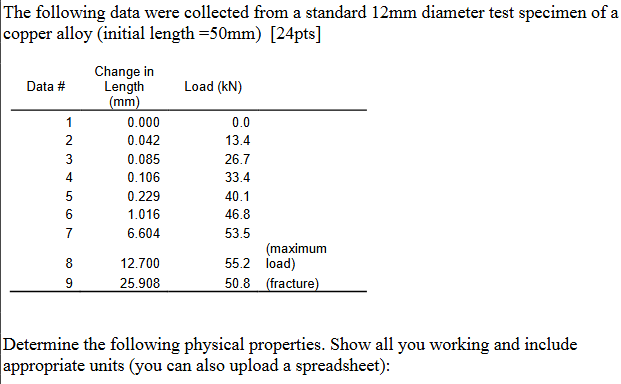 The following data were collected from a standard 12mm diameter test specimen of a
copper alloy (initial length =50mm) [24pts]
Change in
Data # Length Load (kN)
(mm)
1 0.000 00
2 0.042 134
3 0.085 267
4 0.106 334
5 0.229 401
6 1.016 4638
7 6.604 535
(maximum
8 12.700 552 load)
9 25.908 508 (fracture)
Determine the following physical properties. Show all you working and include
appropriate units (you can also upload a spreadsheet):
This is AI generated Response.
Asked by: Alok Kumar
Created at: 2026-01-27 04:17:33
Asked by: Alok Kumar
Created at: 2026-01-27 04:17:33
Final Answer:
Rendered
Raw Text
Did you like this answer?
Let's go step by step to solve for the main physical properties requested in a typical tensile test analysis:
---
## **Given Data**
- **Diameter, \( d \) = 12 mm**
- **Initial Length, \( L_ \) = 50 mm**
- **Maximum Load, \( F_{max} \) = 55.2 kN**
- **Fracture Load, \( F_{fracture} \) = 50.8 kN**
---
## **1. Calculate Initial Cross-sectional Area (\( A_ \))**
\[
A_ = \frac{\pi d^2}{4}
\]
\[
A_ = \frac{\pi (12\ \text{mm})^2}{4} = \frac{3.1416 \times 144}{4} = \frac{452.39}{4} = 113.1\ \text{mm}^2
\]
---
## **2. Engineering Stress and Strain**
### **Engineering Stress (\( \sigma \))**
\[
\sigma = \frac{F}{A_}
\]
- \( F \) in Newtons (1 kN = 100 N)
- \( A_ \) in mm² (but convert to m² if you want the answer in Pascals, otherwise leave in MPa)
### **Engineering Strain (\( \epsilon \))**
\[
\epsilon = \frac{\Delta L}{L_}
\]
---
## **3. Young's Modulus (E)**
- Use the *linear* region (first 2-3 data points):
\[
E = \frac{\sigma}{\epsilon}
\]
---
## **Step-by-Step Calculations**
### **A. Fill Out a Table**
Let's use the first three data points to calculate stress, strain, and estimate Young's Modulus.
#### **Sample Calculations for Data Point 2:**
- \( \Delta L = .042 \) mm
- \( F = 13.4 \) kN = 13,400 N
#### **Strain:**
\[
\epsilon = \frac{.042}{50} = .00084
\]
#### **Stress:**
\[
\sigma = \frac{13,400}{113.1} = 118.6\ \text{MPa}
\]
#### **Repeat for Data Point 3:**
- \( \Delta L = .085 \) mm
- \( F = 26.7 \) kN = 26,700 N
\[
\epsilon = \frac{.085}{50} = .0017
\]
\[
\sigma = \frac{26,700}{113.1} = 236.1\ \text{MPa}
\]
---
### **B. Young's Modulus \( E \) (Slope):**
Using data points 2 and 3:
\[
E = \frac{\Delta \sigma}{\Delta \epsilon}
\]
\[
\Delta \sigma = 236.1 - 118.6 = 117.5\ \text{MPa}
\]
\[
\Delta \epsilon = .0017 - .00084 = .00086
\]
\[
E = \frac{117.5}{.00086} \approx 136,630\ \text{MPa} = 136.6\ \text{GPa}
\]
---
### **C. Ultimate Tensile Strength (UTS):**
UTS is the maximum engineering stress:
- Max load = 55.2 kN = 55,200 N
\[
UTS = \frac{55,200}{113.1} = 487.9\ \text{MPa}
\]
---
### **D. Strain at Fracture:**
- \( \Delta L_{fracture} = 25.908 \) mm
\[
\epsilon_{fracture} = \frac{25.908}{50} = .518
\]
---
### **E. Summary Table**
| Data # | ΔL (mm) | Load (kN) | Strain (ε) | Stress (MPa) |
|--------|---------|-----------|------------|--------------|
| 1 | .000 | . | .000 | . |
| 2 | .042 | 13.4 | .00084 | 118.6 |
| 3 | .085 | 26.7 | .00170 | 236.1 |
| 4 | .106 | 33.4 | .00212 | 295.4 |
| 5 | .229 | 40.1 | .00458 | 354.5 |
| ... | ... | ... | ... | ... |
| 8 | 12.700 | 55.2 | .254 | 487.9 |
| 9 | 25.908 | 50.8 | .518 | 449.2 |
---
## **Summary of Results**
- **Young’s Modulus (E):** ~137 GPa
- **Ultimate Tensile Strength (UTS):** ~488 MPa
- **Strain at Fracture:** .518 (51.8%)
- **Initial Cross-sectional Area:** 113.1 mm²
---
### **If you need to plot or do further calculations (like true stress/strain), let me know!**
If you want a spreadsheet template, just ask!
📢 Instructions:
- Ask anything relatd to above question only.
- For new Question goto :