VIPSolutions logo ✨ VIPSolutions

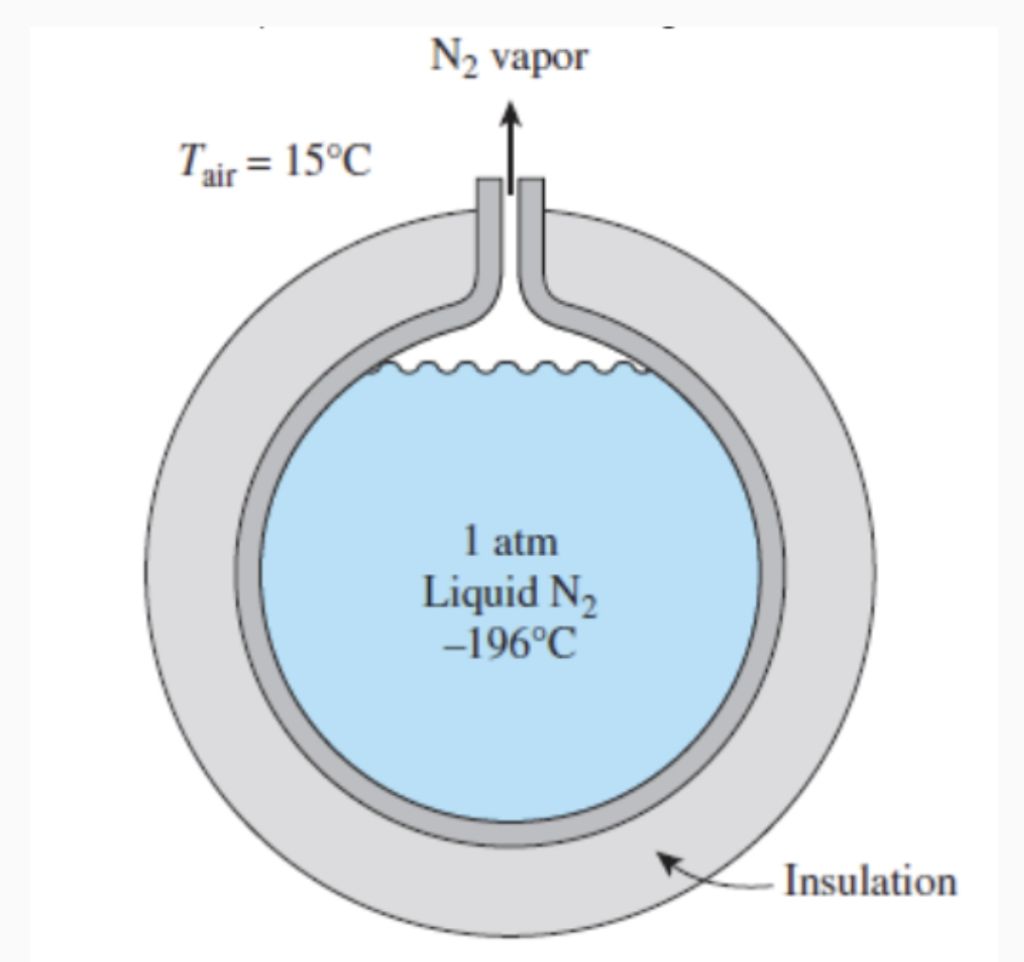
Act like a helpful tutor and exlain me : The boiling point of nitrogen at sea level ( 1 atm pressure ) at atmospheric pressure is - 1 9 6 ° C . Therefore, nitrogen is commonly used in low - temperature scientific studies. The temperature of liquid nitrogen in a tank open to the atmosphere will remain constant at - 1 9 6 ° C until it is consumed. Any heat transfer to the tank will result in the evaporation of some liquid nitrogen, which has a heat of vaporization of 1 9 8 kJ / kg and a density of 8 1 0 kg / m ^ 3 at 1 atm. Consider a spherical tank 3 m in diameter that is initially filled with liquid nitrogen at 1 atm and - 1 9 6 ° C . The tank is exposed to ambient air at 1 5 ° C , with a combined convective and radiant heat transfer coefficient of 3 5 W / m ^ 2 . K . The temperature of the thin shell of the spherical tank should be nearly the same as the temperature of the nitrogen inside. Determine the evaporation rate of liquid nitrogen in the tank as a result of heat transfer from the ambient air if the tank is: a ) Uninsulated. b ) Insulated with 5 cm of insulating fiberglass ( k = 0 . 0 3 5 W / m . K )N, vapor i Ty = 15°C | 1 atm Liquid N, -196°C Insulation
Question:

Act like a helpful tutor and exlain me : The boiling point of nitrogen at sea level ( 1 atm pressure ) at atmospheric pressure is - 1 9 6 ° C . Therefore, nitrogen is commonly used in low - temperature scientific studies. The temperature of liquid nitrogen in a tank open to the atmosphere will remain constant at - 1 9 6 ° C until it is consumed. Any heat transfer to the tank will result in the evaporation of some liquid nitrogen, which has a heat of vaporization of 1 9 8 kJ / kg and a density of 8 1 0 kg / m ^ 3 at 1 atm. Consider a spherical tank 3 m in diameter that is initially filled with liquid nitrogen at 1 atm and - 1 9 6 ° C . The tank is exposed to ambient air at 1 5 ° C , with a combined convective and radiant heat transfer coefficient of 3 5 W / m ^ 2 . K . The temperature of the thin shell of the spherical tank should be nearly the same as the temperature of the nitrogen inside. Determine the evaporation rate of liquid nitrogen in the tank as a result of heat transfer from the ambient air if the tank is: a ) Uninsulated. b ) Insulated with 5 cm of insulating fiberglass ( k = 0 . 0 3 5 W / m . K )Uploaded ImageN, vapor i Ty = 15°C | 1 atm Liquid N, -196°C Insulation

This is AI generated Response.
Asked by: manish kumar
Created at: 2025-09-08 18:58:36

Final Answer:

Rendered Raw Text
Did you like this answer?
Absolutely! Let’s break this down step by step: ## **Given Data** - **Boiling point of nitrogen**: \( -196^\circ C \) (at 1 atm) - **Heat of vaporization (\(h_{fg}\))**: \( 198 \) kJ/kg \( = 198,000 \) J/kg - **Density (\(\rho\))**: \( 810 \) kg/m³ - **Tank shape**: Sphere, **diameter** \( d = 3 \) m \(\rightarrow r = 1.5\) m - **Ambient temperature (\(T_{air}\))**: \( 15^\circ C \) - **Nitrogen temperature (\(T_{N_2}\))**: \( -196^\circ C \) - **Combined heat transfer coefficient (\(h\))**: \( 35 \) W/m²·K - **Insulation thickness**: \( 5 \) cm \( = 0.05 \) m (for part b) - **Thermal conductivity of insulation (\(k\))**: \( 0.035 \) W/m·K --- ## **Step 1: Calculate the Temperature Difference** \[ \Delta T = T_{air} - T_{N_2} = 15 - (-196) = 211^\circ C = 211\,K \] --- ## **Step 2: Find the Surface Area of the Sphere** \[ A = 4\pi r^2 = 4\pi (1.5)^2 = 28.27\, m^2 \] --- ## **Step 3: Calculate Heat Transfer Rate (\(\dot{Q}\))** ### **a) Uninsulated Tank** The heat transfer is only through convection/radiation: \[ \dot{Q} = hA\Delta T \] \[ \dot{Q} = 35 \times 28.27 \times 211 \approx 208,349\,W = 208.3\,kW \] --- ### **b) Insulated Tank** First, find the total thermal resistance: #### **(i) Convective resistance (outside):** \[ R_{conv} = \frac{1}{hA} \] #### **(ii) Conductive resistance (through spherical insulation):** For a spherical shell: \[ R_{cond} = \frac{r_2 - r_1}{4\pi k r_1 r_2} \] - \( r_1 = 1.5\,m \) (inner radius) - \( r_2 = r_1 + 0.05 = 1.55\, m \) \[ R_{cond} = \frac{1.55 - 1.5}{4\pi \times 0.035 \times 1.5 \times 1.55} = \frac{0.05}{4\pi \times 0.035 \times 2.325} \] Calculate denominator: - \( 4\pi \times 0.035 \times 2.325 \approx 1.022 \) So, \[ R_{cond} = \frac{0.05}{1.022} \approx 0.0489\, K/W \] #### **(iii) Convective resistance:** \[ R_{conv} = \frac{1}{hA} = \frac{1}{35 \times 30.2} \approx 0.000941\, K/W \] Where \(A = 4\pi r_2^2 = 4\pi (1.55)^2 \approx 30.2\,m^2\) #### **Total resistance:** \[ R_{total} = R_{cond} + R_{conv} = 0.0489 + 0.000941 = 0.04984\,K/W \] #### **Heat transfer rate:** \[ \dot{Q} = \frac{\Delta T}{R_{total}} = \frac{211}{0.04984} \approx 4,235\,W = 4.24\,kW \] --- ## **Step 4: Evaporation Rate Calculation** \[ \dot{m} = \frac{\dot{Q}}{h_{fg}} \] ### **a) Uninsulated:** \[ \dot{m}_{uninsulated} = \frac{208,349}{198,000} \approx 1.053\, kg/s \] ### **b) Insulated:** \[ \dot{m}_{insulated} = \frac{4,235}{198,000} \approx 0.0214\, kg/s \] --- ## **Summary Table** | Case | Heat Transfer (\(\dot{Q}\)) | Evaporation Rate (\(\dot{m}\)) | |----------------|----------------------------|------------------------------| | Uninsulated | 208.3 kW | 1.053 kg/s | | Insulated (5cm)| 4.24 kW | 0.0214 kg/s | --- ## **Key Takeaways** - **Insulation drastically reduces heat transfer** and thus the evaporation rate of liquid nitrogen. - The **main limiting factor** is the heat transfer into the tank, which is much higher without insulation. If you need to see all the formulas or want a step-by-step with all numbers plugged in, just ask!

📢 Instructions:

  • Ask anything relatd to above question only.
  • For new Question goto :

Study Help, Fast Answers

VIPSolutions focuses on clear, step‑by‑step explanations so you can learn quickly. Whether you need an AI‑generated walkthrough or a short hint to get unstuck, each solution is organized for fast reading and easy review later.

Search similar questions, compare approaches, and bookmark the best answers for revision. Our goal is simple: quick, reliable study help that feels natural—not noisy.