VIPSolutions logo ✨ VIPSolutions

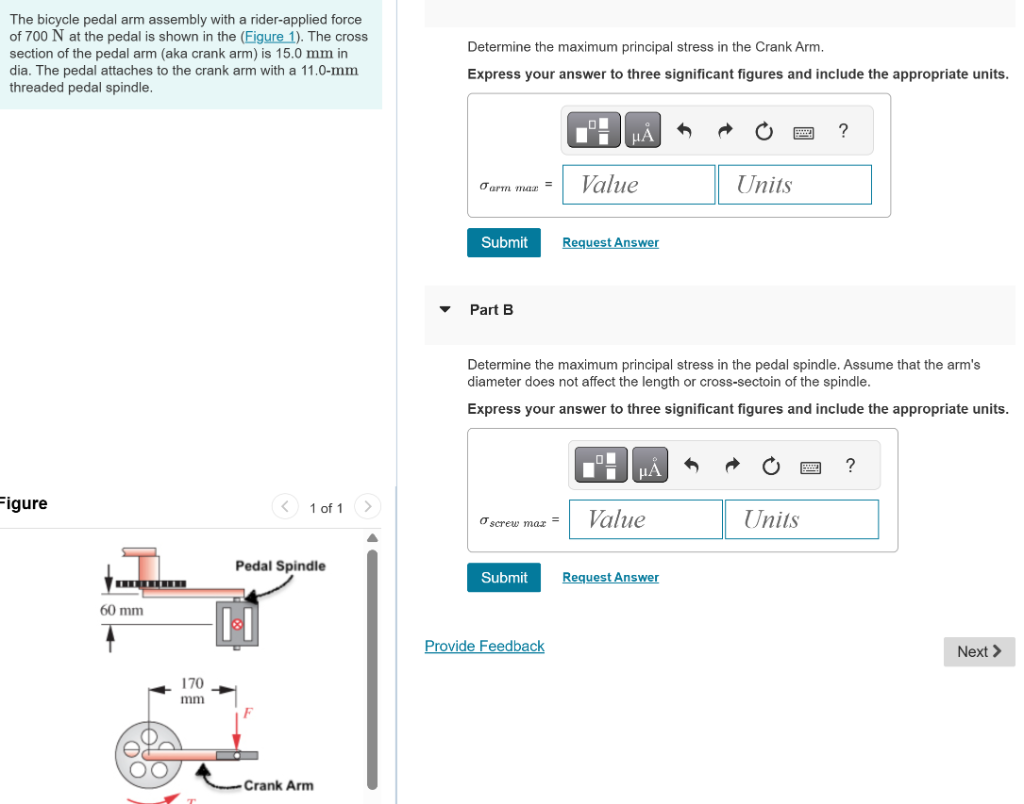
Act like a helpful tutor and exlain me :The bicycle pedal arm assembly with a rider-applied force of 700 N at the lis she the (Eigure 1). The Ee Determine the maximum principal stress in the Crank Arm, dia. The pedal attaches to the crank arm with a 11.0-mm Express your answer to three significant figures and include the appropriate units. threaded pedal spindle. h El -c=- Gammas = | Value Units JU v PartB Determine the maximum principal stress in the pedal spindle. Assume that the arm's diameter does not affect the length or cross-sectoin of the spindle. Express your answer to three significant figures and include the appropriate units. BR c=" igure 1of1 ji Gurcwmaz = | Value Units a Pedal Spindle 4 — 60 mm f Provide Feedback Nextd 170 mm F i O A _conkam -~ ae

Question:

Act like a helpful tutor and exlain me :Uploaded ImageThe bicycle pedal arm assembly with a rider-applied force of 700 N at the lis she the (Eigure 1). The Ee Determine the maximum principal stress in the Crank Arm, dia. The pedal attaches to the crank arm with a 11.0-mm Express your answer to three significant figures and include the appropriate units. threaded pedal spindle. h El -c=- Gammas = | Value Units JU v PartB Determine the maximum principal stress in the pedal spindle. Assume that the arm's diameter does not affect the length or cross-sectoin of the spindle. Express your answer to three significant figures and include the appropriate units. BR c=" igure 1of1 ji Gurcwmaz = | Value Units a Pedal Spindle 4 — 60 mm f Provide Feedback Nextd 170 mm F i O A _conkam -~ ae
This is AI generated Response.
Asked by: Alok Kumar
Created at: 2026-01-27 02:13:28

Final Answer:

Rendered Raw Text
Did you like this answer?
Absolutely! Let's break down the problem step by step: --- ## **Problem Recap** - **Force applied at pedal:** \( F = 700\, \text{N} \) - **Crank arm length:** \( L_{\text{crank}} = 170\, \text{mm} \) - **Crank arm diameter:** \( d_{\text{arm}} = 15.\, \text{mm} \) - **Pedal spindle diameter:** \( d_{\text{spindle}} = 11.\, \text{mm} \) - **Distance from pedal to crank arm:** \( L_{\text{pedal}} = 60\, \text{mm} \) --- # **Part A: Maximum Principal Stress in the Crank Arm** ## **Step 1: Type of Stress** The crank arm is subjected to a **bending moment** due to the force applied at the pedal. ### **Bending Moment:** \[ M = F \cdot L_{\text{crank}} \] \[ M = 700\, \text{N} \times .170\, \text{m} = 119\, \text{Nm} = 119,000\, \text{Nmm} \] ## **Step 2: Maximum Bending Stress** The maximum bending stress in a circular cross-section: \[ \sigma_{\text{max}} = \frac{M c}{I} \] Where: - \( c \) = outer radius = \( \frac{d}{2} \) - \( I \) = moment of inertia for a solid circle = \( \frac{\pi}{64} d^4 \) Plug in the numbers: **Find \( c \):** \[ c = \frac{15.}{2} = 7.5\, \text{mm} \] **Calculate \( I \):** \[ I = \frac{\pi}{64} d^4 = \frac{\pi}{64} (15.)^4 = \frac{\pi}{64} \times 50625 \approx 2485.6\, \text{mm}^4 \] **Plug values into the stress formula:** \[ \sigma_{\text{max}} = \frac{119,000 \times 7.5}{2485.6} \approx \frac{892,500}{2485.6} \approx 359\, \text{MPa} \] --- # **Part B: Maximum Principal Stress in the Pedal Spindle** ## **Step 1: Type of Stress** The spindle experiences a **bending moment** due to the force at a distance. ### **Bending Moment:** \[ M_{\text{spindle}} = F \cdot L_{\text{pedal}} \] \[ M_{\text{spindle}} = 700\, \text{N} \times .060\, \text{m} = 42\, \text{Nm} = 42,000\, \text{Nmm} \] ## **Step 2: Maximum Bending Stress** \[ c = \frac{11.}{2} = 5.5\, \text{mm} \] \[ I = \frac{\pi}{64} (11.)^4 = \frac{\pi}{64} \times 14641 \approx 719.2\, \text{mm}^4 \] \[ \sigma_{\text{max}} = \frac{42,000 \times 5.5}{719.2} \approx \frac{231,000}{719.2} \approx 321\, \text{MPa} \] --- # **Summary Table** | Part | Stress Formula | Value (MPa) | |---------------|----------------------------------------|-------------| | Crank Arm | \( \sigma = \frac{Mc}{I} \) | 359 | | Pedal Spindle | \( \sigma = \frac{Mc}{I} \) | 321 | --- ## **Key Concepts** - **Bending Moment:** Product of force and perpendicular distance. - **Bending Stress:** \( \sigma = \frac{Mc}{I} \) - **Moment of Inertia (solid circle):** \( \frac{\pi}{64} d^4 \) --- **Let me know if you want to see the calculations in more detail or have questions about bending stress!**

📢 Instructions:

  • Ask anything relatd to above question only.
  • For new Question goto :

Study Help, Fast Answers

VIPSolutions focuses on clear, step‑by‑step explanations so you can learn quickly. Whether you need an AI‑generated walkthrough or a short hint to get unstuck, each solution is organized for fast reading and easy review later.

Search similar questions, compare approaches, and bookmark the best answers for revision. Our goal is simple: quick, reliable study help that feels natural—not noisy.