 VIPSolutions
Act like a helpful tutor and exlain me :‘Synthesis Problem 1 (10 marks) = Propose a synthesis of 2.2.5-rmethy2-hexanol using 2-mefypropancl 5 your nly source of carbon. You may use any other reagents you need, including those hat contain carbon, but the carbon atom in your product must come fom 2- methyiprepanci,
Question:
Act like a helpful tutor and exlain me :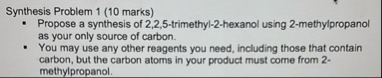 ‘Synthesis Problem 1 (10 marks)
= Propose a synthesis of 2.2.5-rmethy2-hexanol using 2-mefypropancl
5 your nly source of carbon.
You may use any other reagents you need, including those hat contain
carbon, but the carbon atom in your product must come fom 2-
methyiprepanci,
This is AI generated Response.
Asked by: Alok Kumar
Created at: 2026-02-03 05:37:49
Asked by: Alok Kumar
Created at: 2026-02-03 05:37:49
Final Answer:
Rendered
Raw Text
Did you like this answer?
## Synthesis Problem Explanation
Let's break down the task and outline a **step-by-step synthesis** for **2,2,5-trimethyl-2-hexanol** using **2-methylpropanol** (also known as isobutanol, \( \ce{(CH3)2CHCH2OH} \)) as **the only carbon source**.
---
### **Step 1: Analyze the Target Molecule**
#### **Target: 2,2,5-trimethyl-2-hexanol**
- 6 carbons in the main chain (**hexanol**)
- Three methyl groups at positions 2, 2, and 5
- Hydroxyl group at position 2
**Structure:**
```
CH3
|
CH3-C(OH)-CH2-CH2-C(CH3)2-CH3
```
- All carbons must come from **2-methylpropanol.**
---
### **Step 2: Analyze the Starting Material**
#### **2-methylpropanol (isobutanol):**
- Structure: \( \ce{(CH3)2CHCH2OH} \)
- 4 carbons per molecule
---
### **Step 3: Strategy**
- **Disassemble** 2-methylpropanol into useful fragments.
- Use **C-C bond-forming reactions** (e.g., Grignard, alkylation).
- Use functional group transformations to set up for these reactions.
---
### **Step 4: Synthetic Plan (Outline)**
#### **1. Prepare Grignard Reagents**
Convert 2-methylpropanol to **2-methylpropyl bromide** (\( \ce{(CH3)2CHCH2Br} \)), then to **Grignard reagent** (\( \ce{(CH3)2CHCH2MgBr} \)).
#### **2. Build the Carbon Skeleton**
- Use **Grignard addition** to carbonyl compounds (e.g., ketones/aldehydes) to assemble the hexanol skeleton with correct methyl substitutions.
- You’ll need to **oxidize** some isobutanol to aldehyde/ketone intermediates for these steps.
#### **3. Assemble the Target Structure**
- Use **multiple equivalents** of the Grignard to build up the chain and introduce the necessary methyl groups.
---
### **Step 5: Step-by-Step Synthesis**
#### **Step 1: Convert Isobutanol to Isobutyl Bromide**
\[
\ce{(CH3)2CHCH2OH + PBr3 -> (CH3)2CHCH2Br}
\]
#### **Step 2: Make Grignard Reagent**
\[
\ce{(CH3)2CHCH2Br + Mg -> (CH3)2CHCH2MgBr}
\]
#### **Step 3: Prepare 2-methylpropanal**
Oxidize some isobutanol to **2-methylpropanal**:
\[
\ce{(CH3)2CHCH2OH + [O] -> (CH3)2CHCHO}
\]
#### **Step 4: Grignard Addition**
React the Grignard reagent with 2-methylpropanal:
\[
\ce{(CH3)2CHCH2MgBr + (CH3)2CHCHO -> (CH3)2CHCH(OH)CH2CH(CH3)2}
\]
This gives a **5-carbon chain** with two methyl branches (still not quite there).
#### **Step 5: Build to 6 Carbons**
- Oxidize the alcohol obtained above to a ketone.
- Add another equivalent of Grignard to this ketone to introduce the last methyl group.
#### **Step 6: Final Product**
After assembling and combining fragments, you will have:
\[
\ce{2,2,5-trimethyl-2-hexanol}
\]
---
## **Summary Table**
| Step | Transformation | Purpose |
|------|----------------|---------|
| 1 | Isobutanol → Isobutyl bromide | Make alkyl halide |
| 2 | Isobutyl bromide → Grignard | Prepare nucleophile |
| 3 | Isobutanol → 2-methylpropanal | Make electrophile |
| 4 | Grignard + aldehyde | Chain extension |
| 5 | Oxidation to ketone | Prepare for more chain extension |
| 6 | Grignard + ketone | Final skeleton assembly |
| 7 | Workup | Isolate alcohol |
---
## **Key Takeaways**
- **All carbon atoms must originate from isobutanol.**
- Use **Grignard reactions** to build C–C bonds and assemble the desired substitution pattern.
- Use **oxidation** and **reduction** as needed to convert between alcohols, aldehydes, and ketones.
---
**Would you like to see the full reaction scheme with structures?**
📢 Instructions:
- Ask anything relatd to above question only.
- For new Question goto :