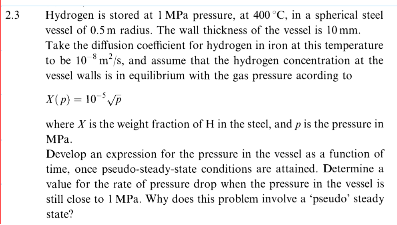
Act like a helpful tutor and exlain me step-by-step solution with explanation and final answer:23 Hydrogen i stored at 1MPa pressure, at 400°C. in a spherical sicel
vesel of 0.5m radius. The wall thickness of the vessel is 10mm
ake the illusion cosicent for hydrogen in ron at this temperature
to be 10 mts, and assume that the hydrogen concentration at the
vessel wall is in equilibrium with the gas pressure acording to
X(ph=10"yp
where X i the weight fraction of H in the sce, and ps the pressure in
MPa
Devclop an expression for the pressure in the vessel as a funciion of
time, once pscudor-sicady state conditions are attained. Delermine a
value for the rate of pressure drop when the pressure in the vessel is
sill close to 1 MPa. Why docs this problem involve ‘pseudo’ sicady
state?
Question:
Act like a helpful tutor and exlain me step-by-step solution with explanation and final answer:23 Hydrogen i stored at 1MPa pressure, at 400°C. in a spherical sicel
vesel of 0.5m radius. The wall thickness of the vessel is 10mm
ake the illusion cosicent for hydrogen in ron at this temperature
to be 10 mts, and assume that the hydrogen concentration at the
vessel wall is in equilibrium with the gas pressure acording to
X(ph=10"yp
where X i the weight fraction of H in the sce, and ps the pressure in
MPa
Devclop an expression for the pressure in the vessel as a funciion of
time, once pscudor-sicady state conditions are attained. Delermine a
value for the rate of pressure drop when the pressure in the vessel is
sill close to 1 MPa. Why docs this problem involve ‘pseudo’ sicady
state?
This is AI generated Response.
Asked by: Francis
Created at: 2026-02-12 09:13:06
Final Answer:
RenderedRaw Text
Did you like this answer?
Let's break down the problem step by step:
---
## **Step 1: List Given Data**
- **Hydrogen Pressure (\( p \)):** 1 MPa
- **Temperature:** 400°C
- **Vessel Shape:** Spherical
- **Vessel Inner Radius (\( r_1 \)):** .5 m
- **Wall Thickness (\( t \)):** 10 mm = .01 m
- **Vessel Outer Radius (\( r_2 \)):** \( r_1 + t = .51 \) m
- **Diffusion Coefficient (\( D \)):** \( 10^{-8} \) m²/s
- **Equilibrium H Concentration at Wall:**
\[
X(p) = 10^{-5} \sqrt{p}
\]
where \( X \) = weight fraction of H in steel, \( p \) in MPa
---
## **Step 2: Find the Rate of Hydrogen Loss by Diffusion**
The **steady-state flux** through a spherical shell is given by Fick’s law:
\[
J = -D \frac{dC}{dr}
\]
Where \( J \) is the flux (mol/m²/s).
But since the concentration at the inner wall is proportional to pressure (via \( X(p) \)), and the outer wall is exposed to the atmosphere (assume negligible H concentration there), we can use the integrated steady-state solution for a spherical shell:
\[
\text{Rate of H loss} = 4\pi r^2 J
\]
The concentration drop from the inner wall (\( r_1 \)) to the outer wall (\( r_2 \)) is linear in \( 1/r \):
\[
J = -D \frac{C_1 - C_2}{r_2 - r_1}
\]
But in a sphere, the exact solution is:
\[
J = -D \cdot \frac{C_1 - C_2}{r_2 - r_1}
\]
But the total molar flow rate (\( \dot{n} \)):
\[
\dot{n} = 4\pi r_1^2 J
\]
Or, combining for a spherical shell (using the correct geometry):
\[
\dot{n} = 4 \pi D \frac{r_1 r_2}{r_2 - r_1} (C_1 - C_2)
\]
Since \( C_2 \) (outer wall) = , and \( C_1 \) is set by the pressure using the given relation.
---
## **Step 3: Relate Pressure to Hydrogen Content**
Hydrogen in the vessel is lost as it diffuses out. The **rate of loss of moles in the vessel** is:
\[
\frac{dn}{dt} = -\dot{n}
\]
The number of moles in the vessel at pressure \( p \):
\[
n = \frac{p V}{RT}
\]
where \( V \) is the volume of the vessel.
So,
\[
\frac{dn}{dt} = \frac{V}{RT} \frac{dp}{dt}
\]
---
## **Step 4: Express Concentration at Inner Wall in Terms of Pressure**
Given:
\[
X(p) = 10^{-5} \sqrt{p}
\]
\( X \) is the weight fraction of hydrogen in the steel.
To convert this to concentration:
\[
C_1 = X(p) \cdot \frac{\rho_{Fe}}{M_H}
\]
where
- \( \rho_{Fe} \) is the density of iron (~790 kg/m³)
- \( M_H \) is the molar mass of hydrogen (.002 kg/mol)
---
## **Step 5: Set Up the Differential Equation**
Plugging everything in:
\[
\frac{V}{RT} \frac{dp}{dt} = -4 \pi D \frac{r_1 r_2}{r_2 - r_1} C_1
\]
\[
\frac{V}{RT} \frac{dp}{dt} = -4 \pi D \frac{r_1 r_2}{r_2 - r_1} X(p) \frac{\rho_{Fe}}{M_H}
\]
---
## **Step 6: Substitute All Known Values**
Let’s substitute the constants:
- \( V = \frac{4}{3} \pi r_1^3 \)
- \( r_1 = .5 \) m
- \( r_2 = .51 \) m
- \( D = 10^{-8} \) m²/s
- \( \rho_{Fe} = 790 \) kg/m³
- \( M_H = .002 \) kg/mol
- \( X(p) = 10^{-5} \sqrt{p} \)
- \( R = 8.314 \) J/mol·K
- \( T = 400 + 273 = 673 \) K
---
### **Plug Numbers In:**
First, calculate \( \frac{r_1 r_2}{r_2 - r_1} \):
\[
\frac{r_1 r_2}{r_2 - r_1} = \frac{.5 \times .51}{.01} = \frac{.255}{.01} = 25.5
\]
Calculate \( V \):
\[
V = \frac{4}{3} \pi (.5)^3 \approx \frac{4}{3} \pi \times .125 \approx .524 \text{ m}^3
\]
Now, the equation is:
\[
\frac{.524}{8.314 \times 673} \frac{dp}{dt} = -4 \pi (10^{-8}) (25.5) \left[10^{-5} \sqrt{p} \right] \frac{790}{.002}
\]
---
#### **Calculate Constants on Both Sides**
**Left side:**
\[
8.314 \times 673 \approx 560
\]
\[
\frac{.524}{560} \approx 9.36 \times 10^{-5}
\]
**Right side:**
\[
4 \pi (10^{-8}) (25.5) \left(10^{-5}\right) \frac{790}{.002}
\]
\[
4 \pi \approx 12.57
\]
\[
12.57 \times 25.5 = 320.535
\]
\[
320.535 \times 10^{-8} = 3.205 \times 10^{-6}
\]
\[
3.205 \times 10^{-6} \times 10^{-5} = 3.205 \times 10^{-11}
\]
\[
\frac{790}{.002} = 3,950,000
\]
\[
3.205 \times 10^{-11} \times 3.95 \times 10^6 = 1.266 \times 10^{-4}
\]
So,
\[
\frac{dp}{dt} = -\frac{1.266 \times 10^{-4}}{9.36 \times 10^{-5}} \sqrt{p}
\]
\[
\frac{dp}{dt} = -1.35 \sqrt{p}
\]
---
## **Step 7: Final Answer and Expression**
### **Expression for Pressure as a Function of Time:**
\[
\boxed{
\frac{dp}{dt} = -1.35 \sqrt{p}
}
\]
This is a separable ODE.
---
### **Rate of Pressure Drop When \( p = 1 \) MPa:**
At \( p = 1 \):
\[
\frac{dp}{dt} = -1.35 \times 1 = -1.35 \ \text{MPa/s}
\]
---
### **Pseudo-Steady-State Explanation**
This is a **pseudo-steady-state** because:
- The diffusion through the wall is much slower than the rate at which the hydrogen concentration profile in the wall equilibrates to the boundary conditions.
- Therefore, at each instant, the concentration profile in the wall is "steady" relative to the slowly varying vessel pressure.
---
## **Summary Table**
| Step | Calculation/Expression | Value/Result |
|------|---------------------------------------------------------|-----------------------|
| 1 | Spherical vessel, \( r_1 = .5 \) m, \( r_2 = .51 \) m | |
| 2 | Fick's law for spherical shell | |
| 3 | \( \frac{dn}{dt} = \frac{V}{RT} \frac{dp}{dt} \) | |
| 4 | \( X(p) = 10^{-5} \sqrt{p} \) | |
| 5 | \( \frac{dp}{dt} = -1.35 \sqrt{p} \) | **Key Result** |
| 6 | At \( p = 1\, \text{MPa} \), \( \frac{dp}{dt} = -1.35 \)| **-1.35 MPa/s** |
---
## **Conclusion**
### **Final Answers:**
- **Pressure as a function of time:** \( \frac{dp}{dt} = -1.35 \sqrt{p} \)
- **Rate of pressure drop at \( p = 1 \) MPa:** \( \frac{dp}{dt} = -1.35 \) MPa/s
- **Reason for pseudo-steady-state:** Because the concentration profile in the wall quickly equilibrates to the changing boundary condition at the inner wall, relative to the slow decrease of pressure in the vessel.
If you want the explicit solution for \( p(t) \), let me know!
VIPSolutions focuses on clear, step‑by‑step explanations so you can learn quickly. Whether you need an AI‑generated walkthrough or a short hint to get unstuck, each solution is organized for fast reading and easy review later.
Search similar questions, compare approaches, and bookmark the best answers for revision. Our goal is simple: quick, reliable study help that feels natural—not noisy.
 VIPSolutions
 23 Hydrogen i stored at 1MPa pressure, at 400°C. in a spherical sicel
vesel of 0.5m radius. The wall thickness of the vessel is 10mm
ake the illusion cosicent for hydrogen in ron at this temperature
to be 10 mts, and assume that the hydrogen concentration at the
vessel wall is in equilibrium with the gas pressure acording to
X(ph=10"yp
where X i the weight fraction of H in the sce, and ps the pressure in
MPa
Devclop an expression for the pressure in the vessel as a funciion of
time, once pscudor-sicady state conditions are attained. Delermine a
value for the rate of pressure drop when the pressure in the vessel is
sill close to 1 MPa. Why docs this problem involve ‘pseudo’ sicady
state?