 VIPSolutions
Act like a helpful tutor and exlain me step-by-step solution with explanation and final answer:Vv $0. Foe "521, 8 ° 21,c P, xp Consider a single-stage continuous evaporator process designed to concentrate a dilute aqueous salt solution. A feed stream (F) containing a solute with mass fraction xr enters the evaporator at a constant rate. The unit is heated by condensing steam (S) in heat exchanger. Inside the evaporator, withdrawn as as xp > xr. 1. Derive the algebraic expressions for the unknown mass flow rates of the vapor and product streams based on the principles of mass conservation for the steady- state evaporator system. « Establish the fundamental overall mass balance equation for the evaporator unit, accounting for all streams entering and leaving the system boundaries. 1.1.1 Write the general conservation of mass equation, Rate of Accumulation = Rate of Inflow - Rate of Outflow + Rate of Generation - Rate of Consumption. 1.1.2 Simplify the general equation for the conditions of steady-state operation with no chemical reaction, resulting in Rate of Inflow = Rate of Outflow. « Establish the component mass balance equation specifically for the non-volatile solute (salt), relating its flow in the feed to its flow in the product, 1.2.1 Write the conservation equation for the solute, expressing the solute flow rate in each stream as the product of the total stream flow rate and zp. 1.2.2 Apply the assumption that the vapor stream V consists of pure solvent and contains negligible solute, simplifying the solute balance equation. 2. Compute the symbolic solutions for the vapor flow rate V and the product flow rate P in terms of the known feed rate £ and the specified mass fractions z and zp. « Develop the final expression for the product flow rate P by manipulating the simplified solute balance equation derived from the component analysis. 2.1.1 Rearrange the simplified solute mass balance equation to isolate the product flow rate P on one side of the equation. 2.1.2 Express P explicitly as a function of the feed flow rate F, the feed solute fraction x, and the product solute fraction zp. © Develop the final expression for the vapor flow rate V by utilizing the overall mass balance equation and the newly derived expression for P. 22.1 Substitute the expression for the product flow rate P obtained in the previous step into the simplified overall mass balance equation. 2.2.2 Solve the resulting equation to obtain an explicit expression for the vapor flow rate V in terms of F, zr, and zp.
Question:
Act like a helpful tutor and exlain me step-by-step solution with explanation and final answer: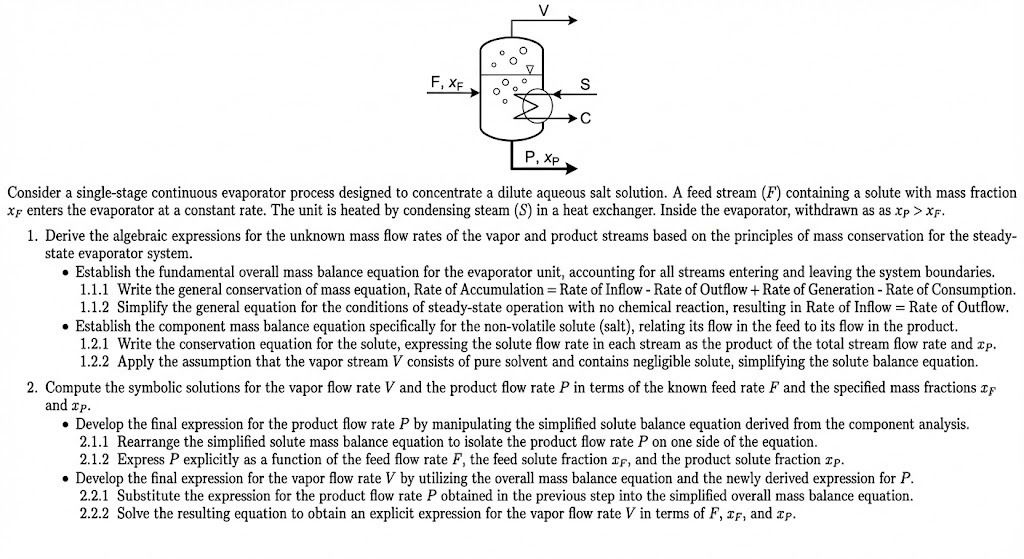 Vv
$0.
Foe "521, 8
°
21,c
P, xp
Consider a single-stage continuous evaporator process designed to concentrate a dilute aqueous salt solution. A feed stream (F) containing a solute with mass fraction
xr enters the evaporator at a constant rate. The unit is heated by condensing steam (S) in heat exchanger. Inside the evaporator, withdrawn as as xp > xr.
1. Derive the algebraic expressions for the unknown mass flow rates of the vapor and product streams based on the principles of mass conservation for the steady-
state evaporator system.
« Establish the fundamental overall mass balance equation for the evaporator unit, accounting for all streams entering and leaving the system boundaries.
1.1.1 Write the general conservation of mass equation, Rate of Accumulation = Rate of Inflow - Rate of Outflow + Rate of Generation - Rate of Consumption.
1.1.2 Simplify the general equation for the conditions of steady-state operation with no chemical reaction, resulting in Rate of Inflow = Rate of Outflow.
« Establish the component mass balance equation specifically for the non-volatile solute (salt), relating its flow in the feed to its flow in the product,
1.2.1 Write the conservation equation for the solute, expressing the solute flow rate in each stream as the product of the total stream flow rate and zp.
1.2.2 Apply the assumption that the vapor stream V consists of pure solvent and contains negligible solute, simplifying the solute balance equation.
2. Compute the symbolic solutions for the vapor flow rate V and the product flow rate P in terms of the known feed rate £ and the specified mass fractions z
and zp.
« Develop the final expression for the product flow rate P by manipulating the simplified solute balance equation derived from the component analysis.
2.1.1 Rearrange the simplified solute mass balance equation to isolate the product flow rate P on one side of the equation.
2.1.2 Express P explicitly as a function of the feed flow rate F, the feed solute fraction x, and the product solute fraction zp.
© Develop the final expression for the vapor flow rate V by utilizing the overall mass balance equation and the newly derived expression for P.
22.1 Substitute the expression for the product flow rate P obtained in the previous step into the simplified overall mass balance equation.
2.2.2 Solve the resulting equation to obtain an explicit expression for the vapor flow rate V in terms of F, zr, and zp.
Asked by: Francis
Created at: 2026-02-11 19:42:49
Final Answer:
Question:
give me detailed answer along with final answer ( student raasinattu evvu simple ga)
Asked by: Francis
Created at: 2026-02-11 19:46:22
Final Answer:
📢 Instructions:
- Ask anything relatd to above question only.
- For new Question goto :