 VIPSolutions
Act like a helpful tutor and exlain me step-by-step solution with explanation and final answer:ot Fp oosaod bow iid Vogel's model ca be combined wich Sea del 0 deve ily phase srs ove he coe pees ge Th Exec Je PR th were col Geeloped oly gone mr ok ch comple FR. Mich ws ded compl os rere ees) ) "7 Ky keh 10 octet pre ge 8 pe) ect cod Feonch I pt ye 2 Ans set rr he ed Tear I. sm 1 Cr pr
Question:
Act like a helpful tutor and exlain me step-by-step solution with explanation and final answer: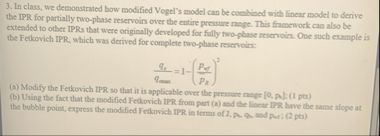 ot Fp oosaod bow iid Vogel's model ca be combined wich Sea del 0 deve
ily phase srs ove he coe pees ge Th Exec
Je PR th were col Geeloped oly gone mr ok ch comple
FR. Mich ws ded compl os rere
ees)
) "7
Ky keh 10 octet pre ge 8 pe)
ect cod Feonch I pt ye 2 Ans set
rr he ed Tear I. sm 1 Cr pr
This is AI generated Response.
Asked by: Francis
Created at: 2026-02-09 08:23:39
Asked by: Francis
Created at: 2026-02-09 08:23:39
Final Answer:
Rendered
Raw Text
Did you like this answer?
Certainly! Let's break down the problem **step-by-step**:
---
## **Given**
The Fetkovich IPR for a fully two-phase reservoir:
\[
\frac{q}{q_{\text{max}}} = 1 - \left(\frac{p_{wf}}{p_r}\right)^2
\]
Where:
- \( q \): well rate
- \( q_{\text{max}} \): maximum well rate (at \( p_{wf} = \))
- \( p_{wf} \): bottomhole flowing pressure
- \( p_r \): reservoir pressure
---
## **(a) Modify the Fetkovich IPR for the entire pressure range \([p_b, p_r]\)**
### **Background**
- **For \( p_{wf} \geq p_b \)** (single-phase, above bubble point): Flow is linear:
\[
q = q_{max,lin} \left( \frac{p_r - p_{wf}}{p_r - p_b} \right)
\]
- **For \( p_{wf} < p_b \)** (two-phase, below bubble point): Use Fetkovich equation, but shift it to start from \( p_b \).
### **Step 1: Linear portion (above bubble point)**
\[
q = q_{b} \left( \frac{p_r - p_{wf}}{p_r - p_b} \right) \quad \text{for } p_{wf} \geq p_b
\]
Where \( q_b \) is the well rate at \( p_{wf} = p_b \).
---
### **Step 2: Modified Fetkovich (below bubble point)**
We want the equation to start at \( p_b \) (not \( \)), so:
\[
\frac{q}{q_{max}} = 1 - \left( \frac{p_{wf}}{p_r} \right)^2
\]
But for \( p_{wf} < p_b \), we need to **normalize** the pressure drop:
Let’s shift the origin to \( p_b \), so the equation becomes:
\[
\frac{q - q_b}{q_{max} - q_b} = 1 - \left( \frac{p_{wf} - }{p_b - } \right)^2
\]
But \( p_b \) is not zero. Let’s generalize:
Let \( q = q_b \) at \( p_{wf} = p_b \) and \( q = q_{max} \) at \( p_{wf} = \):
So,
\[
\frac{q - q_b}{q_{max} - q_b} = 1 - \left( \frac{p_{wf}}{p_b} \right)^2
\]
Or,
\[
q = q_b + (q_{max} - q_b) \left[ 1 - \left( \frac{p_{wf}}{p_b} \right)^2 \right]
\]
for \( \leq p_{wf} < p_b \)
---
## **(b) Match slopes at the bubble point**
At \( p_{wf} = p_b \), the **slope** of the two equations must match.
### **Step 1: Compute slope of linear IPR at \( p_{wf} = p_b \):**
\[
q = q_b \left( \frac{p_r - p_{wf}}{p_r - p_b} \right)
\]
\[
\left. \frac{dq}{dp_{wf}} \right|_{p_{wf}=p_b} = -\frac{q_b}{p_r - p_b}
\]
---
### **Step 2: Compute slope of modified Fetkovich at \( p_{wf} = p_b \):**
\[
q = q_b + (q_{max} - q_b) \left[ 1 - \left( \frac{p_{wf}}{p_b} \right)^2 \right]
\]
\[
\frac{dq}{dp_{wf}} = (q_{max} - q_b) \left[ -2 \frac{p_{wf}}{p_b^2} \right]
\]
At \( p_{wf} = p_b \):
\[
\left. \frac{dq}{dp_{wf}} \right|_{p_{wf}=p_b} = (q_{max} - q_b) \left[ -2 \frac{p_b}{p_b^2} \right] = -\frac{2(q_{max} - q_b)}{p_b}
\]
---
### **Step 3: Set slopes equal and solve for \( q_{max} \):**
\[
-\frac{q_b}{p_r - p_b} = -\frac{2(q_{max} - q_b)}{p_b}
\]
\[
\frac{q_b}{p_r - p_b} = \frac{2(q_{max} - q_b)}{p_b}
\]
\[
q_b p_b = 2(q_{max} - q_b)(p_r - p_b)
\]
\[
q_b p_b = 2 q_{max} (p_r - p_b) - 2 q_b (p_r - p_b)
\]
\[
q_b p_b + 2 q_b (p_r - p_b) = 2 q_{max} (p_r - p_b)
\]
\[
q_b [p_b + 2(p_r - p_b)] = 2 q_{max} (p_r - p_b)
\]
\[
q_b [2 p_r - p_b] = 2 q_{max} (p_r - p_b)
\]
\[
q_{max} = \frac{q_b [2 p_r - p_b]}{2 (p_r - p_b)}
\]
---
## **Final Answers**
### **(a) The modified Fetkovich IPR is:**
- **For \( p_b \leq p_{wf} \leq p_r \):**
\[
q = q_b \left( \frac{p_r - p_{wf}}{p_r - p_b} \right)
\]
- **For \( \leq p_{wf} < p_b \):**
\[
q = q_b + (q_{max} - q_b) \left[ 1 - \left( \frac{p_{wf}}{p_b} \right)^2 \right]
\]
---
### **(b) The expression for \( q_{max} \) is:**
\[
\boxed{
q_{max} = \frac{q_b [2 p_r - p_b]}{2 (p_r - p_b)}
}
\]
Where \( q_b \) is the well rate at \( p_{wf} = p_b \).
---
### **Summary Table**
| Pressure Range | Equation |
|----------------------------|--------------------------------------------------------------------------------------------|
| \( p_b \leq p_{wf} \leq p_r \) | \( q = q_b \left( \frac{p_r - p_{wf}}{p_r - p_b} \right) \) |
| \( \leq p_{wf} < p_b \) | \( q = q_b + (q_{max} - q_b) \left[ 1 - \left( \frac{p_{wf}}{p_b} \right)^2 \right] \) |
| \( q_{max} \) | \( q_{max} = \frac{q_b [2 p_r - p_b]}{2 (p_r - p_b)} \) |
---
If you need a worked numerical example or further clarification, let me know!
📢 Instructions:
- Ask anything relatd to above question only.
- For new Question goto :