 VIPSolutions
Act like a helpful tutor and exlain me step-by-step solution with explanation and final answer:13.41 a. What product(s) (excluding stereoisomers) are formed when Y is heated with Cl? b. What product(s) (excluding stereoisomers) are formed when Y is heated with Bry? c. What steps are needed to convert Y to the alkene Z? Y z [cE]
Question:
Act like a helpful tutor and exlain me step-by-step solution with explanation and final answer: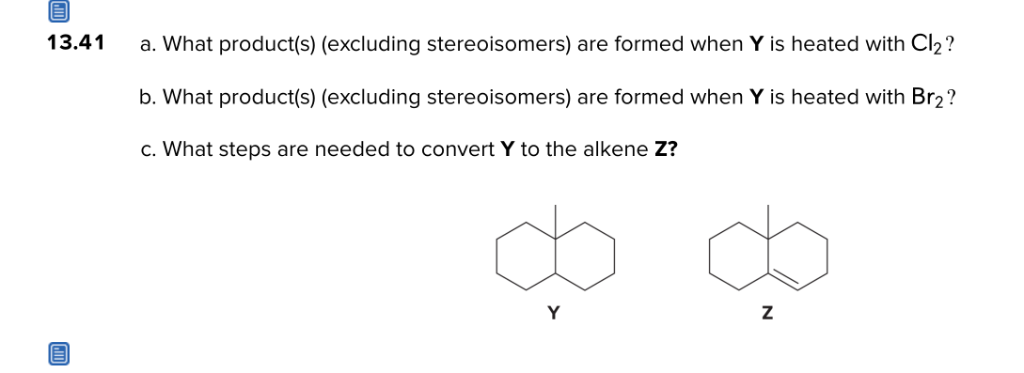 13.41 a. What product(s) (excluding stereoisomers) are formed when Y is heated with Cl?
b. What product(s) (excluding stereoisomers) are formed when Y is heated with Bry?
c. What steps are needed to convert Y to the alkene Z?
Y z
[cE]
This is AI generated Response.
Asked by: Francis
Created at: 2026-02-09 08:18:31
Asked by: Francis
Created at: 2026-02-09 08:18:31
Final Answer:
Rendered
Raw Text
Did you like this answer?
Let's break down and solve each part step by step:
---
## **13.41a: Product(s) when Y is heated with Cl₂**
### **Step 1: Recognize the Reaction Type**
- When a cyclic alkane (like compound **Y**) is heated with Cl₂ (chlorine gas), a **free radical halogenation** occurs.
- Chlorine will substitute a hydrogen atom, forming an **alkyl chloride**.
### **Step 2: Consider Structure of Y**
- **Y** is **decalin** (bicyclo[4.4.]decane, two fused cyclohexane rings).
- All hydrogens are secondary, except the two bridgehead positions, which are tertiary.
### **Step 3: Regioselectivity**
- Chlorine is less selective than bromine, so all hydrogens can be substituted, but tertiary hydrogens are more reactive.
- In Y, the bridgehead hydrogens are the only tertiary ones, so chlorination will mostly occur at these positions.
### **Step 4: Draw the Product**
- Replace a bridgehead hydrogen with Cl at either bridgehead (excluding stereochemistry):
#### **Product:**
- **1-chlorodecalin** (chlorine at either bridgehead position).
---
## **13.41b: Product(s) when Y is heated with Br₂**
### **Step 1: Recognize the Reaction Type**
- Same as above: **free radical bromination**.
### **Step 2: Regioselectivity**
- Bromine is highly selective for the most substituted (tertiary) position.
- In compound Y, the only tertiary positions are the two bridgehead carbons.
### **Step 3: Draw the Product**
- Replace a bridgehead hydrogen with Br:
#### **Product:**
- **1-bromodecalin** (bromine at either bridgehead position).
---
## **13.41c: Steps to Convert Y to Alkene Z**
### **Step 1: Analyze Structures**
- **Y** is decalin (no double bonds).
- **Z** is decalin with a double bond between the bridgehead carbon and the adjacent carbon (an exocyclic alkene at the bridgehead).
### **Step 2: Plan the Synthesis**
- To convert an alkane (Y) to an alkene (Z), you need:
1. Halogenation at the desired position (the bridgehead).
2. Elimination to form the double bond.
### **Step 3: Write the Steps**
1. **Bromination at the bridgehead position** (use Br₂ and heat/light):
- Forms **1-bromodecalin**.
2. **Dehydrohalogenation (Elimination, E2) using a strong base** (e.g., KOH/ethanol or NaOEt/EtOH):
- Eliminates H and Br to form the double bond, yielding the exocyclic alkene **Z**.
---
## **Final Answers**
### **a.** The product is **1-chlorodecalin** (chlorine at the bridgehead carbon).
### **b.** The product is **1-bromodecalin** (bromine at the bridgehead carbon).
### **c.** Steps to convert Y to Z:
1. Brominate Y at the bridgehead carbon with Br₂ (heat or light) → 1-bromodecalin.
2. Treat with strong base (e.g., KOH/ethanol) to eliminate HBr and form the exocyclic alkene **Z**.
---
**If you want, I can draw the structures for each product!**
📢 Instructions:
- Ask anything relatd to above question only.
- For new Question goto :