 VIPSolutions
Act like a helpful tutor and exlain me :Starting with benzene, synthesize cis-1-phenyl-1-propene. Show all synthetic intermediates and reagents. You do not need to show mechanisms. The synthesis should provide only the cis-isomer.
Question:
Act like a helpful tutor and exlain me :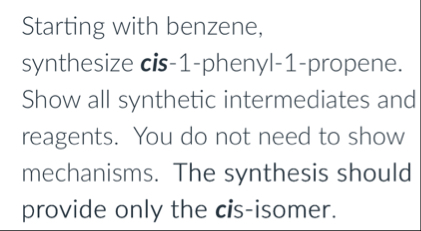 Starting with benzene,
synthesize cis-1-phenyl-1-propene.
Show all synthetic intermediates and
reagents. You do not need to show
mechanisms. The synthesis should
provide only the cis-isomer.
This is AI generated Response.
Asked by: Alok Kumar
Created at: 2026-03-02 03:56:50
Asked by: Alok Kumar
Created at: 2026-03-02 03:56:50
Final Answer:
Rendered
Raw Text
Did you like this answer?
# Synthesis of **cis-1-phenyl-1-propene from Benzene
Let's break down the problem and go step-by-step from benzene to **cis-1-phenyl-1-propene**.
---
## **Target Molecule**
- **cis-1-Phenyl-1-propene:**
This is a three-carbon chain with a double bond at the 1-position (adjacent to the phenyl group), and both substituents across the double bond are on the same side (cis, or Z).
Structure:

*(Ph = phenyl)*
---
## **Stepwise Synthesis**
### **Step 1: Friedel–Crafts Alkylation (or Acylation + Reduction)**
**Benzene → 1-Phenylpropan-1-one (Propiophenone)**
- **Reagents:**
- Propionyl chloride (CH₃CH₂COCl), AlCl₃
- **Product:**
- Propiophenone (C₆H₅COCH₂CH₃)
### **Step 2: Reduction to Alcohol**
**Propiophenone → 1-Phenyl-1-propanol**
- **Reagents:**
- NaBH₄ or LiAlH₄ (reduces ketone to secondary alcohol)
- **Product:**
- 1-Phenyl-1-propanol (C₆H₅CH(OH)CH₂CH₃)
### **Step 3: Dehydration to Alkene (cis-selective)**
**1-Phenyl-1-propanol → cis-1-Phenyl-1-propene**
- Standard acid-catalyzed dehydration (H₂SO₄) typically gives the more stable **trans**-alkene.
- To get **cis (Z)-alkene**, use a **stereoselective method**:
- **Convert the alcohol to a good leaving group (e.g., tosylate)**
- **Use a strong, non-nucleophilic base (e.g., KOtBu) at low temperature for E2 elimination**
- Or, use **Wittig reaction** (see below for alternative).
#### **Alternative: Wittig Reaction (More Selective)**
- **Propiophenone → cis-Alkene via Wittig**
- React the ketone with a Wittig reagent (Ph₃P=CHCH₃) under conditions favoring cis (Z) isomer formation (use unstabilized ylide, low temperature).
---
## **Summary of Steps and Reagents**
| Step | Intermediate/Product | Reagent(s) |
|------|--------------------------------|---------------------------|
| 1 | Propiophenone | CH₃CH₂COCl, AlCl₃ |
| 2 | 1-Phenyl-1-propanol | NaBH₄ or LiAlH₄ |
| 3 | cis-1-Phenyl-1-propene | 1. Ph₃P=CHCH₃ (Wittig), |
| | (cis only) | 2. Low temp, ether solvent|
---
## **Key Notes**
- **Friedel–Crafts acylation** avoids polyalkylation and gives a ketone.
- **Wittig reaction** with unstabilized ylides is typically cis-selective.
- Acid-catalyzed dehydration usually gives a mix or favors trans, so Wittig is preferred for cis selectivity.
---
## **Final Synthesis Outline**
1. **Benzene**
↓ *(CH₃CH₂COCl, AlCl₃)*
2. **Propiophenone**
↓ *(Ph₃P=CHCH₃, ether, low temp)*
3. **cis-1-Phenyl-1-propene**
---
### **Let me know if you want to see the structures or need further explanation on any step!**
Question:
Question in Electrical Engineering Topic: Synchronous Speed of Induction Motor Question: A 1 6 - pole induction motor is connected to a 5 0 Hz supply. Calculate its synchronous speed.
This is AI generated Response.
Asked by: Alok Kumar
Created at: 2026-03-02 04:01:34
Asked by: Alok Kumar
Created at: 2026-03-02 04:01:34
Final Answer:
Rendered
Raw Text
Did you like this answer?
# Synchronous Speed of Induction Motor
To calculate the synchronous speed of an induction motor, we can use the following formula:
\[
N_s = \frac{120 \times f}{P}
\]
Where:
- \(N_s\) = Synchronous speed (in RPM)
- \(f\) = Supply frequency (in Hz)
- \(P\) = Number of poles
## Given Data
- Number of poles \(P = 6\)
- Supply frequency \(f = 50 \, \text{Hz}\)
## Calculation
1. Substitute the values into the formula:
\[
N_s = \frac{120 \times 50}{6}
\]
2. Calculate:
\[
N_s = \frac{6000}{6} = 1000 \, \text{RPM}
\]
## Conclusion
- The synchronous speed of the 6-pole induction motor connected to a 50 Hz supply is **1000 RPM**.
📢 Instructions:
- Ask anything relatd to above question only.
- For new Question goto :