 VIPSolutions
Act like a helpful tutor and exlain me :SIR | In a vertical wetted-wall tower, the liquid (viscosity, p and density, p) flows down the inside as a thin film § m thick in laminar flow in the vertical z direction under gravity. Assume density and viscosity of the liquid to be constant. Obtain the velocity distribution, V,, as a function of x, the distance from the wall toward the liquid-gas interface; that is, x=0 is the wall surface, and x= 6 is the liquid-gas interface. The fluid is at a large distance from the entrance. Also obtain the expression of (i) average velocity and (ii) the force exerted by the fluid in the z direction on the surface perpendicular to the x direction. (10)
Question:
Act like a helpful tutor and exlain me :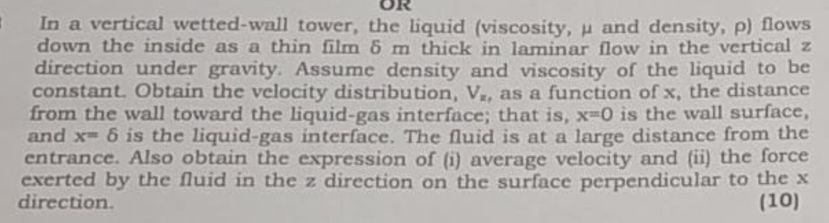 SIR
| In a vertical wetted-wall tower, the liquid (viscosity, p and density, p) flows
down the inside as a thin film § m thick in laminar flow in the vertical z
direction under gravity. Assume density and viscosity of the liquid to be
constant. Obtain the velocity distribution, V,, as a function of x, the distance
from the wall toward the liquid-gas interface; that is, x=0 is the wall surface,
and x= 6 is the liquid-gas interface. The fluid is at a large distance from the
entrance. Also obtain the expression of (i) average velocity and (ii) the force
exerted by the fluid in the z direction on the surface perpendicular to the x
direction. (10)
This is AI generated Response.
Asked by: Francis
Created at: 2025-12-30 05:50:55
Asked by: Francis
Created at: 2025-12-30 05:50:55
Final Answer:
Rendered
Raw Text
Did you like this answer?
Let's break down the problem and solve it step by step.
---
# **Problematement**
**Given:**
- A vertical wetted-wall tower with a thin liquid film (thickness = δ) flowing down the wall in the _z_-direction under gravity.
- The film thickness, δ = 5 m (though this is unusually thick for a film, but we'll use it as given).
- Viscosity = μ, Density = ρ (both constant)
- \( x = \): wall surface; \( x = \delta \): liquid-gas interface
- Find:
1. **Velocity distribution** \( V_z(x) \)
2. **Average velocity**
3. **Force exerted by fluid in the _z_ direction** on the surface perpendicular to the _x_ direction
---
# **1. Velocity Distribution \( V_z(x) \)**
**Assumptions:**
- Steady, incompressible, laminar flow
- Flow in the \( z \)-direction only
- Gravity acts downward (in \( z \)-direction)
- No pressure gradient in \( z \)-direction (open to atmosphere at interface)
**Governing Equation (Navier-Stokes for this scenario):**
\[
\mu \frac{d^2 V_z}{dx^2} = \rho g
\]
Where:
- \( V_z \): Velocity in the \( z \)-direction
- \( x \): Distance from wall
**Boundary Conditions:**
1. **No-slip at wall:** \( V_z() = \)
2. **Zero shear at interface:** \( \left. \frac{dV_z}{dx} \right|_{x=\delta} = \)
---
## **Solving the Differential Equation**
Integrate once:
\[
\mu \frac{dV_z}{dx} = \rho g x + C_1
\]
Integrate again:
\[
\mu V_z = \frac{\rho g}{2} x^2 + C_1 x + C_2
\]
\[
V_z(x) = \frac{\rho g}{2\mu} x^2 + \frac{C_1}{\mu} x + \frac{C_2}{\mu}
\]
Apply boundary conditions:
1. **At \( x= \): \( V_z() = \)**
\[
= + + \frac{C_2}{\mu} \implies C_2 =
\]
2. **At \( x = \delta \): \( \left. \frac{dV_z}{dx} \right|_{x=\delta} = \)**
\[
\frac{dV_z}{dx} = \frac{\rho g}{\mu} x + \frac{C_1}{\mu}
\]
Set \( x = \delta \):
\[
= \frac{\rho g}{\mu} \delta + \frac{C_1}{\mu} \implies C_1 = -\rho g \delta
\]
So,
\[
V_z(x) = \frac{\rho g}{2\mu} x^2 - \frac{\rho g \delta}{\mu} x
\]
Or, more neatly:
\[
\boxed{
V_z(x) = \frac{\rho g}{2\mu} \left[ x^2 - 2\delta x \right]
}
\]
or
\[
\boxed{
V_z(x) = \frac{\rho g}{2\mu} \left[ x^2 - 2\delta x \right]
}
\]
---
# **2. Average Velocity**
The average velocity across the film thickness (\( \le x \le \delta \)) is:
\[
V_{avg} = \frac{1}{\delta} \int_^\delta V_z(x) dx
\]
Plug in the expression for \( V_z(x) \):
\[
V_{avg} = \frac{1}{\delta} \int_^\delta \frac{\rho g}{2\mu} (x^2 - 2\delta x) dx
\]
\[
= \frac{\rho g}{2\mu \delta} \int_^\delta (x^2 - 2\delta x) dx
\]
Integrate:
\[
\int_^\delta x^2 dx = \frac{\delta^3}{3}
\]
\[
\int_^\delta 2\delta x dx = 2\delta \cdot \frac{x^2}{2} \Big|_^\delta = \delta^3
\]
So,
\[
V_{avg} = \frac{\rho g}{2\mu \delta} \left( \frac{\delta^3}{3} - \delta^3 \right)
= \frac{\rho g}{2\mu \delta} \left( -\frac{2}{3}\delta^3 \right)
= -\frac{\rho g \delta^2}{3\mu}
\]
But the negative sign here simply reflects the direction (downwards). So, the magnitude is:
\[
\boxed{
V_{avg} = \frac{\rho g \delta^2}{3\mu}
}
\]
---
# **3. Force Exerted by the Fluid in the \(z\)-direction**
This is the **shear force** exerted by the fluid on the wall (\( x = \)) in the \(z\)-direction.
Shear stress at the wall:
\[
\tau_w = \mu \left. \frac{dV_z}{dx} \right|_{x=}
\]
From earlier:
\[
\frac{dV_z}{dx} = \frac{\rho g}{\mu} x - \frac{\rho g \delta}{\mu}
\]
At \( x = \):
\[
\left. \frac{dV_z}{dx} \right|_{x=} = -\frac{\rho g \delta}{\mu}
\]
So,
\[
\tau_w = \mu \left( -\frac{\rho g \delta}{\mu} \right) = -\rho g \delta
\]
The negative sign indicates the direction (opposite to flow). The force per unit area is:
\[
\boxed{
\tau_w = \rho g \delta
}
\]
(magnitude, in the \( z \)-direction)
If you want **total force** on an area \( A \):
\[
F = \tau_w \cdot A = (\rho g \delta) \cdot A
\]
---
## **Summary Table**
| Quantity | Expression |
|----------|------------|
| **Velocity profile** \( V_z(x) \) | \( \frac{\rho g}{2\mu}(x^2 - 2\delta x) \) |
| **Average velocity** \( V_{avg} \) | \( \frac{\rho g \delta^2}{3\mu} \) |
| **Wall shear stress** \( \tau_w \) | \( \rho g \delta \) |
---
If you need a step-by-step example with numbers or further explanation, just ask!
📢 Instructions:
- Ask anything relatd to above question only.
- For new Question goto :