 VIPSolutions
Act like a helpful tutor and exlain me :SESE. I R Ee iq oD C D ¢ ¢ X | [i ——
Question:
Act like a helpful tutor and exlain me :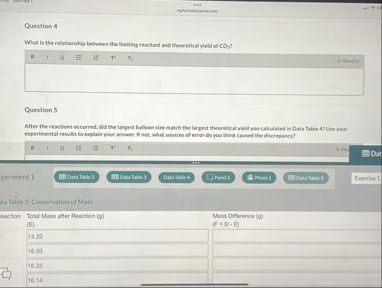 SESE.
I R
Ee
iq oD C D ¢ ¢ X | [i
——
This is AI generated Response.
Asked by: Alok Kumar
Created at: 2026-02-02 06:18:57
Asked by: Alok Kumar
Created at: 2026-02-02 06:18:57
Final Answer:
Rendered
Raw Text
Did you like this answer?
# Explanation for Questions 4 & 5
---
### **Question 4: Limiting Reactant and Theoretical Yield of CO₂**
**Question:**
*What is the relationship between the limiting reactant and theoretical yield of CO₂?*
**Answer:**
The **limiting reactant** is the reactant that is completely consumed first during a chemical reaction. It limits (determines) the maximum amount of product that can be formed, because once it is used up, the reaction stops. The **theoretical yield** of CO₂ is the maximum amount of CO₂ that can be produced, calculated based on the amount of the limiting reactant present at the start. In summary:
- The **theoretical yield of CO₂** depends directly on the amount of the **limiting reactant**.
- **Only the limiting reactant** determines the maximum amount of CO₂ that can be formed, regardless of how much excess of the other reactants is present.
---
### **Question 5: Comparing Experimental and Theoretical Results**
**Question:**
*After the reactions occurred, did the largest balloon size match the largest theoretical yield you calculated in Data Table 4? Use your experimental results to explain your answer. If not, what sources of error do you think caused the discrepancy?*
**How to Answer:**
1. **Compare Results:**
- Look at your experimental result (largest balloon size or mass of CO₂ produced).
- Compare it with the theoretical yield you calculated for CO₂.
2. **If They Match:**
- State that your experimental result matches the theoretical yield.
- This suggests the reaction went as expected and there were minimal losses or errors.
3. **If They Don’t Match:**
- State the difference (e.g., your balloon was smaller than expected).
- Possible sources of error include:
- **Gas leakage:** CO₂ may have escaped before being measured or collected.
- **Incomplete reaction:** The reactants may not have fully reacted.
- **Measurement errors:** Incorrect measurement of reactants or products.
- **Temperature/pressure variation:** Experimental conditions may differ from those assumed in theoretical calculations.
---
## **Summary Table**
| Step | What to Do |
|---------------------|--------------------------------------------------------|
| Identify limiting reactant | Determine which reactant runs out first. |
| Calculate theoretical yield | Use the limiting reactant to find max CO₂ produced.|
| Compare to experiment | See if experimental results match theoretical yield.|
| Explain discrepancies | List possible sources of error if there's a mismatch.|
---
Let me know if you need help with the specific calculations!
📢 Instructions:
- Ask anything relatd to above question only.
- For new Question goto :