VIPSolutions logo ✨ VIPSolutions

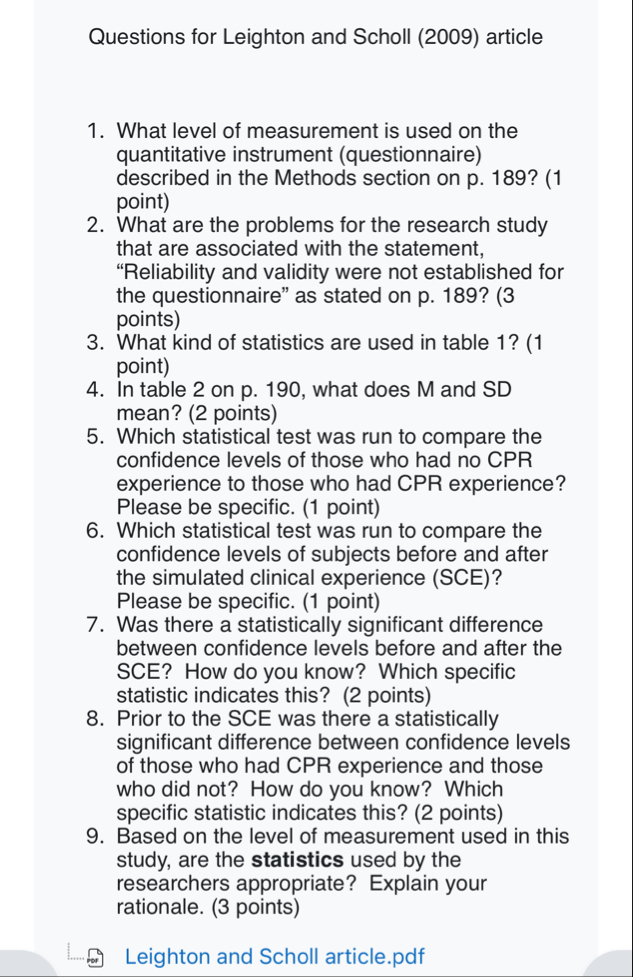
Act like a helpful tutor and exlain me :Questions for Leighton and Scholl (2009) article 1. What level of measurement is used on the quantitative instrument (questionnaire) described in the Methods section on p. 189? (1 point) 2. What are the problems for the research study that are associated with the statement, “Reliability and validity were not established for the questionnaire” as stated on p. 1897? (3 points) 3. What kind of statistics are used in table 1? (1 point) 4. In table 2 on p. 190, what does M and SD mean? (2 points) 5. Which statistical test was run to compare the confidence levels of those who had no CPR experience to those who had CPR experience? Please be specific. (1 point) 6. Which statistical test was run to compare the confidence levels of subjects before and after the simulated clinical experience (SCE)? Please be specific. (1 point) 7. Was there a statistically significant difference between confidence levels before and after the SCE? How do you know? Which specific statistic indicates this? (2 points) 8. Prior to the SCE was there a statistically significant difference between confidence levels of those who had CPR experience and those who did not? How do you know? Which specific statistic indicates this? (2 points) 9. Based on the level of measurement used in this study, are the statistics used by the researchers appropriate? Explain your rationale. (3 points) &) Leighton and Scholl article.pdf

Question:

Act like a helpful tutor and exlain me :Uploaded ImageQuestions for Leighton and Scholl (2009) article 1. What level of measurement is used on the quantitative instrument (questionnaire) described in the Methods section on p. 189? (1 point) 2. What are the problems for the research study that are associated with the statement, “Reliability and validity were not established for the questionnaire” as stated on p. 1897? (3 points) 3. What kind of statistics are used in table 1? (1 point) 4. In table 2 on p. 190, what does M and SD mean? (2 points) 5. Which statistical test was run to compare the confidence levels of those who had no CPR experience to those who had CPR experience? Please be specific. (1 point) 6. Which statistical test was run to compare the confidence levels of subjects before and after the simulated clinical experience (SCE)? Please be specific. (1 point) 7. Was there a statistically significant difference between confidence levels before and after the SCE? How do you know? Which specific statistic indicates this? (2 points) 8. Prior to the SCE was there a statistically significant difference between confidence levels of those who had CPR experience and those who did not? How do you know? Which specific statistic indicates this? (2 points) 9. Based on the level of measurement used in this study, are the statistics used by the researchers appropriate? Explain your rationale. (3 points) &) Leighton and Scholl article.pdf
This is AI generated Response.
Asked by: Alok Kumar
Created at: 2026-01-27 05:50:18

Final Answer:

Rendered Raw Text
Did you like this answer?
Certainly! Below are explanations and guidance for each question related to the Leighton and Scholl (2009) article. Since I don't have access to the article's specific content, I'll explain what each question is asking and how you should think about answering it. --- # Guide to Answering the Questions ## 1. **Level of Measurement (p. 189)** - **What to look for:** The four levels of measurement are: nominal, ordinal, interval, and ratio. - **How to answer:** Find out how the questionnaire's responses are structured. Are they categories (nominal), ranks (ordinal), or numbers with equal intervals (interval/ratio)? *Example:* If the questionnaire asks participants to rate confidence on a scale from 1 to 5, this is often considered **ordinal** (or interval, if you assume equal intervals). --- ## 2. **Problems with Lack of Reliability and Validity** - **What to look for:** Reliability means the instrument consistently measures what it's supposed to. Validity means it actually measures what it claims to. - **How to answer:** List problems such as: - Results may not be trustworthy. - Hard to compare with other studies. - Conclusions may be flawed. - Data may reflect measurement error rather than true differences. --- ## 3. **Statistics in Table 1** - **What to look for:** Are these descriptive statistics (mean, SD, frequencies) or inferential statistics (t-tests, ANOVA, etc.)? - **How to answer:** Identify the type (e.g., means, standard deviations, frequencies). --- ## 4. **Meaning of M and SD in Table 2** - **What to look for:** M = Mean (average value); SD = Standard Deviation (spread of data around the mean). - **How to answer:** Define both terms and their significance in summarizing data. --- ## 5. **Statistical Test: Comparing Confidence with/without CPR Experience** - **What to look for:** Which test compares means between two groups? (e.g., independent samples t-test) - **How to answer:** Name the test used and describe what groups were compared. --- ## 6. **Statistical Test: Comparing Before and After SCE** - **What to look for:** Which test compares means within the same group at two times? (e.g., paired samples t-test) - **How to answer:** Name the test used and describe what was compared. --- ## 7. **Statistical Significance Before/After SCE** - **What to look for:** Check if the p-value is less than .05 (or stated significance level). - **How to answer:** State if there was a significant difference, and point to the p-value or test statistic shown. --- ## 8. **Statistical Significance Prior to SCE (CPR vs. No CPR Experience)** - **What to look for:** Same as above, but for baseline comparison. - **How to answer:** Indicate if there was a significant difference, citing the relevant statistic. --- ## 9. **Appropriateness of Statistics Used** - **What to look for:** Did the researchers use the right statistical tests for the type of data (level of measurement)? - **How to answer:** Explain if the tests match the data. For example, you shouldn't use parametric tests with nominal data. --- ## **Summary Table** | Q# | Main Focus | What to Find/Explain | Example/Hint | |----|--------------------------|-----------------------------------------------|----------------------------------------------| | 1 | Level of Measurement | Nominal, ordinal, interval, or ratio? | Ordinal if Likert scale | | 2 | Reliability & Validity | Problems due to lack thereof | Results may not be valid | | 3 | Table 1 Stats | Type of statistics used | Means, SDs, frequencies, etc. | | 4 | M and SD | Define Mean (M), Standard Deviation (SD) | M = average; SD = variability | | 5 | Test for CPR Experience | Which test for two independent groups? | Independent t-test | | 6 | Test for SCE Comparison | Which test for pre/post in same group? | Paired t-test | | 7 | Statistical Difference | Was there a significant change? | Look for p-value < .05 | | 8 | Pre-SCE Difference | Significant difference pre-SCE? | Again, p-value and test statistic | | 9 | Appropriateness | Do tests fit data level? | Justify your answer with rationale | --- **Tip:** For best results, have the article open and refer to the page numbers and tables mentioned in each question. Let me know if you want specific sample answers or further explanation on any point!

📢 Instructions:

  • Ask anything relatd to above question only.
  • For new Question goto :

Study Help, Fast Answers

VIPSolutions focuses on clear, step‑by‑step explanations so you can learn quickly. Whether you need an AI‑generated walkthrough or a short hint to get unstuck, each solution is organized for fast reading and easy review later.

Search similar questions, compare approaches, and bookmark the best answers for revision. Our goal is simple: quick, reliable study help that feels natural—not noisy.