 VIPSolutions
Act like a helpful tutor and exlain me :Question 3 191 3.1 If the average flow stress is 78% of the final flow stress after deformation, determine the value of the strain hardening for the required flow stress. 4) 3.2 Determine the strain rate of a material to be deformed, given that the instantaneous height of the workpiece being deformed is 130 mm and the deformation speed is 15m/s. 3) 3.3 Interpret the formula for the effect of strain rate on flow stress at an elevated temperature in a material. 2)
Question:
Act like a helpful tutor and exlain me :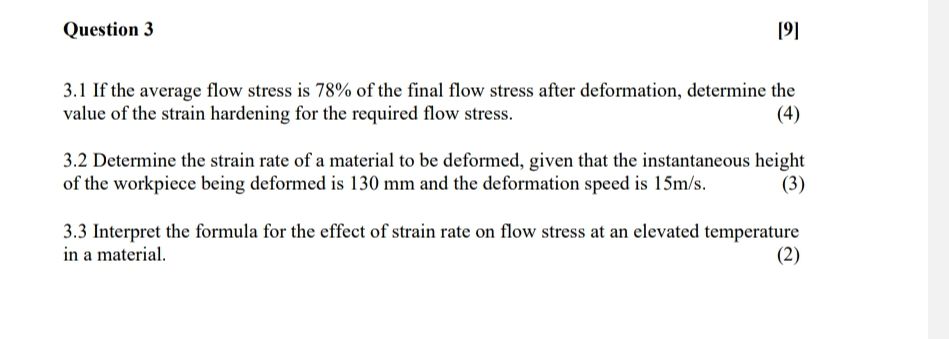 Question 3 191
3.1 If the average flow stress is 78% of the final flow stress after deformation, determine the
value of the strain hardening for the required flow stress. 4)
3.2 Determine the strain rate of a material to be deformed, given that the instantaneous height
of the workpiece being deformed is 130 mm and the deformation speed is 15m/s. 3)
3.3 Interpret the formula for the effect of strain rate on flow stress at an elevated temperature
in a material. 2)
This is AI generated Response.
Asked by: manish kumar
Created at: 2025-09-09 16:27:01
Asked by: manish kumar
Created at: 2025-09-09 16:27:01
Final Answer:
Rendered
Raw Text
Did you like this answer?
# Question 3: Explanation and Solutions
Let's address each part step by step:
---
## **3.1 Strain Hardening for Required Flow Stress**
### **Given:**
- Average flow stress = 78% of final flow stress
### **Required:**
- Value of strain hardening for the required flow stress
### **Explanation:**
The average flow stress (\(\bar{\sigma}\)) during deformation is given by:
\[
\bar{\sigma} = \frac{\sigma_0 + \sigma_f}{2}
\]
where:
- \(\sigma_0\) = initial flow stress
- \(\sigma_f\) = final flow stress
But here, the average flow stress is said to be 78% of the final flow stress:
\[
\bar{\sigma} = 0.78 \sigma_f
\]
Set the two equations equal:
\[
0.78 \sigma_f = \frac{\sigma_0 + \sigma_f}{2}
\]
Multiply both sides by 2:
\[
1.56 \sigma_f = \sigma_0 + \sigma_f
\]
Solve for \(\sigma_0\):
\[
\sigma_0 = 1.56 \sigma_f - \sigma_f = 0.56 \sigma_f
\]
**Strain hardening** is the increase in flow stress due to deformation:
\[
\text{Strain hardening} = \sigma_f - \sigma_0 = \sigma_f - 0.56 \sigma_f = 0.44 \sigma_f
\]
### **Final Answer:**
> **The strain hardening for the required flow stress is \(0.44\) (or 44%) of the final flow stress.**
---
## **3.2 Determining the Strain Rate**
### **Given:**
- Instantaneous height of workpiece, \(h = 130 \text{ mm} = 0.13 \text{ m}\)
- Deformation speed, \(v = 15 \text{ m/s}\)
### **Formula:**
\[
\text{Strain rate},\ \dot{\varepsilon} = \frac{v}{h}
\]
### **Calculation:**
\[
\dot{\varepsilon} = \frac{15}{0.13} \approx 115.38\ \text{s}^{-1}
\]
### **Final Answer:**
> **The strain rate is approximately \(115.38\ \text{s}^{-1}\).**
---
## **3.3 Effect of Strain Rate on Flow Stress at Elevated Temperature**
### **Formula:**
At elevated temperatures, the flow stress (\(\sigma\)) is often related to strain rate (\(\dot{\varepsilon}\)) by:
\[
\sigma = K \cdot \dot{\varepsilon}^m
\]
Where:
- \(K\) = strength coefficient (material constant)
- \(m\) = strain rate sensitivity exponent (usually between 0 and 1)
### **Interpretation:**
- **If \(m > 0\):** As strain rate increases, flow stress increases.
- At **elevated temperatures**, materials often show higher strain rate sensitivity (\(m\) increases), meaning the flow stress becomes more dependent on the rate at which the material is deformed.
- This behavior is important in hot working processes.
### **Final Answer:**
> **At elevated temperatures, as the strain rate increases, the flow stress also increases according to the power law \(\sigma = K \cdot \dot{\varepsilon}^m\), where \(m\) indicates the sensitivity of the material to strain rate.**
---
If you need further clarification or example problems, let me know!
📢 Instructions:
- Ask anything relatd to above question only.
- For new Question goto :