VIPSolutions logo ✨ VIPSolutions

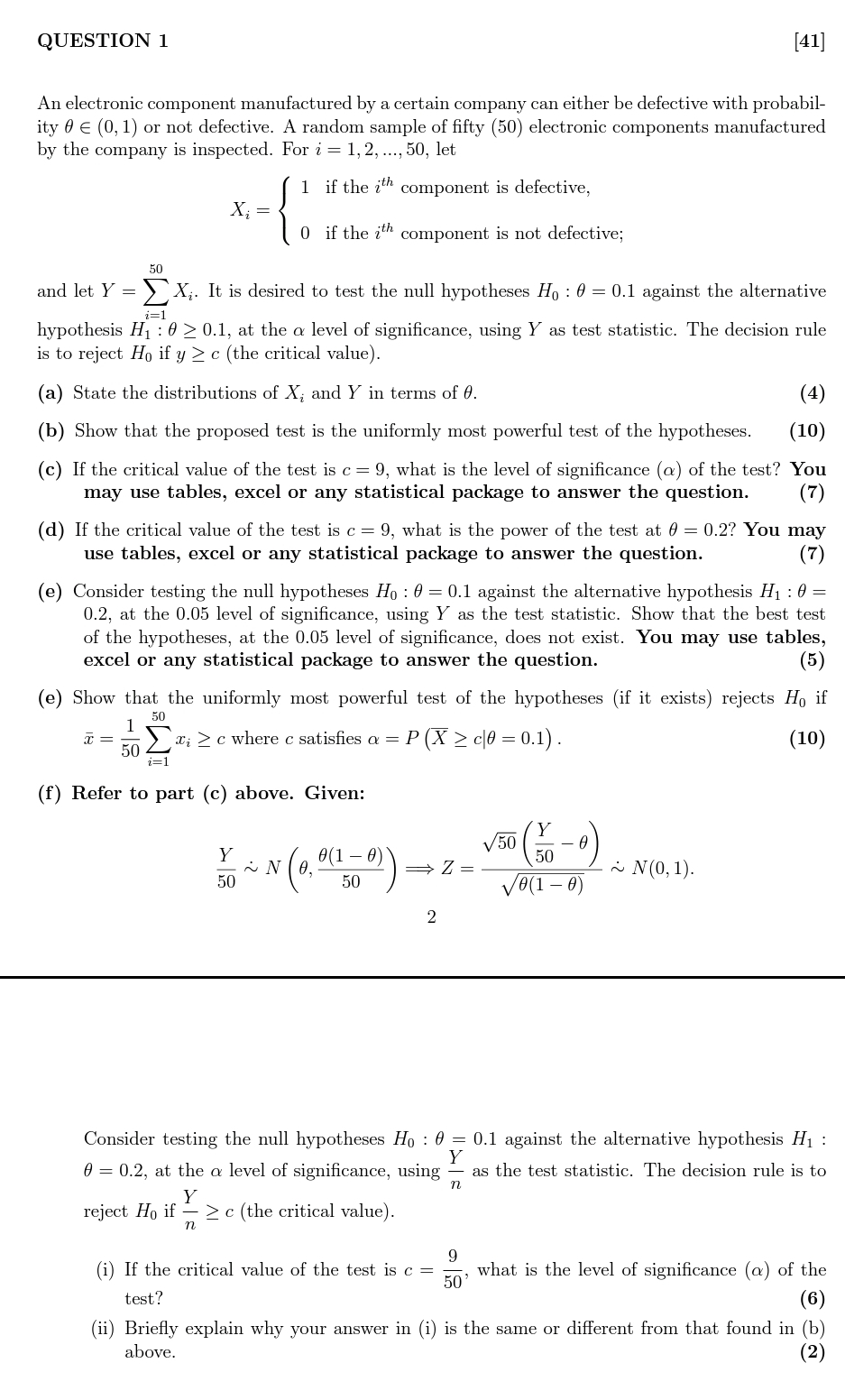
Act like a helpful tutor and exlain me :QUESTION 1 [41] An electronic component manufactured by a certain company can either be defective with probabil ity 6 € (0,1) or not defective. A random sample of fifty (50) electronic components manufactured by the company is inspected. For i = 1,2,...,50, let 1 if the i" component is defective, X; = 0 if the i" component is not defective; 50 and let ¥ = > X;. It is desired to test the null hypotheses Hy : § = 0.1 against the alternative i=1 hypothesis Hy : 6 > 0.1, at the « level of significance, using Y" as test statistic. The decision rule is to reject Hy if y > c (the critical value). (a) State the distributions of X; and Y in terms of 6. (4) (b) Show that the proposed test is the uniformly most powerful test of the hypotheses. (10) (c) If the critical value of the test is ¢ = 9, what is the level of significance (a) of the test? You may use tables, excel or any statistical package to answer the question. (7) (d) If the critical value of the test is ¢ = 9, what is the power of the test at 6 = 0.2? You may use tables, excel or any statistical package to answer the question. (7) e) Consider testing the null hypotheses Hy : § = 0.1 against the alternative hypothesis H : 6 = g ) gi ) 0.2, at the 0.05 level of significance, using Y" as the test statistic. Show that the best test of the hypotheses, at the 0.05 level of significance, does not exist. You may use tables, excel or any statistical package to answer the question. (5) (e) Show that the uniformly most powerful test of the hypotheses (if it exists) rejects Hy if 50 1 . ~ i= PIL > ¢ where ¢ satisfies a = P(X > ¢|f = 0.1). (10) (f) Refer to part (c) above. Given: Y 50-46 Y (001-0) va (3; ) oar AN (6, = Z=—"7 < N(0,1). 50 50 JL — 0) 2 Consider testing the null hypotheses Hy : 6 = 0.1 against the alternative hypothesis Hj : Y 0 = 0.2, at the « level of significance, using — as the test statistic. The decision rule is to n Y reject Hy if — > c (the critical value). n (i) If the critical value of the test is c = 50° what is the level of significance (a) of the test? (6) (ii) Briefly explain why your answer in (i) is the same or different from that found in (b) above. 2)

Question:

Act like a helpful tutor and exlain me :Uploaded ImageQUESTION 1 [41] An electronic component manufactured by a certain company can either be defective with probabil ity 6 € (0,1) or not defective. A random sample of fifty (50) electronic components manufactured by the company is inspected. For i = 1,2,...,50, let 1 if the i" component is defective, X; = 0 if the i" component is not defective; 50 and let ¥ = > X;. It is desired to test the null hypotheses Hy : § = 0.1 against the alternative i=1 hypothesis Hy : 6 > 0.1, at the « level of significance, using Y" as test statistic. The decision rule is to reject Hy if y > c (the critical value). (a) State the distributions of X; and Y in terms of 6. (4) (b) Show that the proposed test is the uniformly most powerful test of the hypotheses. (10) (c) If the critical value of the test is ¢ = 9, what is the level of significance (a) of the test? You may use tables, excel or any statistical package to answer the question. (7) (d) If the critical value of the test is ¢ = 9, what is the power of the test at 6 = 0.2? You may use tables, excel or any statistical package to answer the question. (7) e) Consider testing the null hypotheses Hy : § = 0.1 against the alternative hypothesis H : 6 = g ) gi ) 0.2, at the 0.05 level of significance, using Y" as the test statistic. Show that the best test of the hypotheses, at the 0.05 level of significance, does not exist. You may use tables, excel or any statistical package to answer the question. (5) (e) Show that the uniformly most powerful test of the hypotheses (if it exists) rejects Hy if 50 1 . ~ i= PIL > ¢ where ¢ satisfies a = P(X > ¢|f = 0.1). (10) (f) Refer to part (c) above. Given: Y 50-46 Y (001-0) va (3; ) oar AN (6, = Z=—"7 < N(0,1). 50 50 JL — 0) 2 Consider testing the null hypotheses Hy : 6 = 0.1 against the alternative hypothesis Hj : Y 0 = 0.2, at the « level of significance, using — as the test statistic. The decision rule is to n Y reject Hy if — > c (the critical value). n (i) If the critical value of the test is c = 50° what is the level of significance (a) of the test? (6) (ii) Briefly explain why your answer in (i) is the same or different from that found in (b) above. 2)
This is AI generated Response.
Asked by: Umesh
Created at: 2025-07-28 00:47:00

Final Answer:

Rendered Raw Text
Did you like this answer?
Let's go through each part step by step as a tutor would explain: --- ### **(a) State the distributions of \( X_i \) and \( Y \) in terms of \( \theta \).** - **\( X_i \)**: Each \( X_i \) is an indicator variable: - \( X_i = 1 \) if the \(i\)th component is defective (probability \( \theta \)) - \( X_i = 0 \) if not defective (probability \( 1 - \theta \)) - So, \( X_i \sim \text{Bernoulli}(\theta) \) - **\( Y = \sum_{i=1}^{50} X_i \)**: Sum of 50 independent Bernoulli(\(\theta\)) random variables. - \( Y \sim \text{Binomial}(n=50, p=\theta) \) --- ### **(b) Show that the proposed test is the uniformly most powerful test (UMP).** - The test is to reject \( H_0: \theta = 0.1 \) if \( Y \geq c \). - By the **Neyman-Pearson Lemma**, for simple hypotheses (\( H_0: \theta = 0.1 \) vs \( H_1: \theta = 0.2 \)), the UMP test uses the likelihood ratio: - The likelihood ratio is monotonic in \( Y \), so the test that rejects for large \( Y \) is UMP. - Therefore, this test is the UMP test for these hypotheses. --- ### **(c) If the critical value of the test is \( c = 9 \), what is the level of significance (\( \alpha \)) of the test?** - **Level of significance (\( \alpha \))**: Probability of rejecting \( H_0 \) when \( H_0 \) is true. - \( \alpha = P(Y \geq 9 \mid \theta = 0.1) \) - \( Y \sim \text{Binomial}(50, 0.1) \) - Use binomial tables, Excel, or calculator: - \( \alpha = P(Y \geq 9) = 1 - P(Y \leq 8) \) - Use `=BINOM.DIST(8, 50, 0.1, TRUE)` in Excel to get \( P(Y \leq 8) \) --- ### **(d) If the critical value is \( c = 9 \), what is the power at \( \theta = 0.2 \)?** - **Power**: Probability of correctly rejecting \( H_0 \) when \( \theta = 0.2 \). - \( \text{Power} = P(Y \geq 9 \mid \theta = 0.2) \) - \( Y \sim \text{Binomial}(50, 0.2) \) - Use `=BINOM.DIST(8, 50, 0.2, TRUE)` in Excel, so power is \( 1 - P(Y \leq 8) \) --- ### **(e) Existence of best test at 0.05 significance** - Consider testing \( H_0: \theta=0.1 \) vs \( H_1: \theta=0.2 \) at \( \alpha = 0.05 \): - Find \( c \) such that \( P(Y \geq c \mid \theta=0.1) \leq 0.05 \). - For binomial, sometimes there is **no integer \( c \)** that gives exactly \( \alpha = 0.05 \) due to discreteness; the closest value may be above or below 0.05. - This means a test with **exact** size 0.05 may not exist. --- ### **(e) [Second part] UMP Test Rejects Based on \( \bar{x} \)** - The UMP test, if it exists, rejects \( H_0 \) if \( \bar{x} \geq c \), where \( c \) is chosen so that: - \( P(\bar{X} \geq c \mid \theta=0.1) = \alpha \) - This is equivalent to the previous test, but phrased in terms of the sample mean. --- ### **(f) Refer to part (c) above:** Given: \[ \frac{Y}{50} \sim N\left(\theta, \frac{\theta(1-\theta)}{50}\right) \] \[ Z = \frac{\sqrt{50}\left(\frac{Y}{50} - \theta\right)}{\sqrt{\theta(1-\theta)}} \sim N(0, 1) \] Testing \( H_0: \theta=0.1 \) vs \( H_1: \theta=0.2 \) at level \( \alpha \), reject if \( \frac{Y}{n} \geq c \) (here n = 50, and \( c = \frac{9}{50} \)). --- #### **(i) What is the level of significance (\( \alpha \)) of the test?** - \( \alpha = P\left(\frac{Y}{50} \geq \frac{9}{50} \mid \theta=0.1\right) \) - This is the same as \( P(Y \geq 9 \mid \theta=0.1) \), **same as in part (c)**. --- #### **(ii) Why is your answer the same or different?** - It is **the same** because testing based on \( Y \) or \( \frac{Y}{n} \) is equivalent; the critical value just gets rescaled. Both are monotonic transformations and lead to the same probability calculation. --- ## **Summary Table** | Part | Key Point | |------|-----------| | (a) | \( X_i \sim \text{Bernoulli}(\theta) \), \( Y \sim \text{Binomial}(50, \theta) \) | | (b) | Neyman-Pearson Lemma: test is UMP | | (c) | \( \alpha = P(Y \geq 9 \mid \theta=0.1) \), use binomial table/Excel | | (d) | Power = \( P(Y \geq 9 \mid \theta=0.2) \), use binomial table/Excel | | (e) | Exact 0.05 test may not exist due to discreteness | | (e) | UMP test: reject if \( \bar{X} \geq c \) | | (f)(i) | \( \alpha = P(Y \geq 9 \mid \theta=0.1) \) | | (f)(ii) | Same as in (c) since tests are equivalent | --- **If you want to see how to use Excel or a calculator to get the exact values for \( \alpha \) or power, let me know!**

📢 Instructions:

  • Ask anything relatd to above question only.
  • For new Question goto :

Study Help, Fast Answers

VIPSolutions focuses on clear, step‑by‑step explanations so you can learn quickly. Whether you need an AI‑generated walkthrough or a short hint to get unstuck, each solution is organized for fast reading and easy review later.

Search similar questions, compare approaches, and bookmark the best answers for revision. Our goal is simple: quick, reliable study help that feels natural—not noisy.