 VIPSolutions
Act like a helpful tutor and exlain me :Question: (0.3) Each time a fisherman casts his line, a fish is caught with probability p, independently of all other casts. The fisherman continues fishing until a fish is caught, at which point he quits and goes home. Let C;denote the event that the fisherman catches a fish on the i-th cast. 1. Draw the probability tree for this experiment. 2. Find P(C,), P(C,), and the general expression for P(C,,)as functions of p.
Question:
Act like a helpful tutor and exlain me :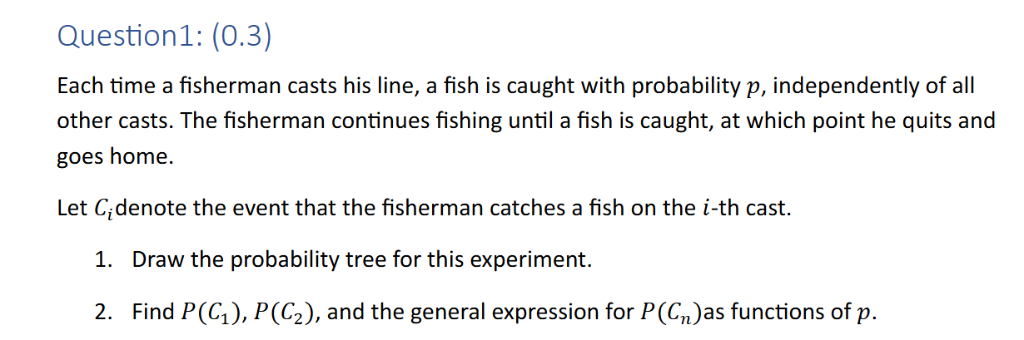 Question: (0.3)
Each time a fisherman casts his line, a fish is caught with probability p, independently of all
other casts. The fisherman continues fishing until a fish is caught, at which point he quits and
goes home.
Let C;denote the event that the fisherman catches a fish on the i-th cast.
1. Draw the probability tree for this experiment.
2. Find P(C,), P(C,), and the general expression for P(C,,)as functions of p.
This is AI generated Response.
Asked by: Alok Kumar
Created at: 2026-01-29 04:54:00
Asked by: Alok Kumar
Created at: 2026-01-29 04:54:00
Final Answer:
Rendered
Raw Text
Did you like this answer?
Let's break this down step by step:
---
# 1. Probability Tree for the Experiment
### Description
- On each cast, the fisherman can either **catch a fish** (with probability \( p \)) and stop, or **not catch a fish** (with probability \( 1-p \)) and continue to the next cast.
- He repeats this until he catches a fish.
### Tree Structure (First Few Steps)
- **Start**
- **Catch on 1st Cast**: Probability = \( p \) → **Stop**
- **No Catch on 1st Cast**: Probability = \( 1-p \) → Try again
- **Catch on 2nd Cast**: Probability = \( p \) → **Stop**
- **No Catch on 2nd Cast**: Probability = \( 1-p \) → Try again
- **Catch on 3rd Cast**: Probability = \( p \) → **Stop**
- ... and so on
Here's a visualization (truncated to the first three casts):
```
Start
|
|-- Catch on 1st try (prob = p) --> End
|
|-- No Catch (prob = 1-p)
|
|-- Catch on 2nd try (prob = p) --> End
|
|-- No Catch (prob = 1-p)
|
|-- Catch on 3rd try (prob = p) --> End
|-- ... (continues similarly)
```
---
# 2. Probabilities for Each Case
Let \( C_i \) be the event that the fisherman catches a fish for the first time on the **i-th** cast.
## Find \( P(C_1) \), \( P(C_2) \), and the General Expression \( P(C_n) \)
### Probability on the First Cast (\( C_1 \))
- **Catches fish immediately:**
\[
P(C_1) = p
\]
---
### Probability on the Second Cast (\( C_2 \))
- **Misses first cast** (\( 1-p \)), then **catches on second** (\( p \)):
\[
P(C_2) = (1-p) \cdot p
\]
---
### Probability on the n-th Cast (\( C_n \))
- **Misses first \( n-1 \) casts** (\( (1-p)^{n-1} \)), then **catches on the n-th cast** (\( p \)):
\[
P(C_n) = (1-p)^{n-1} \cdot p
\]
---
## **Summary Table**
| Cast (i) | Probability \( P(C_i) \) |
|-----------|--------------------------------|
| 1 | \( p \) |
| 2 | \( (1-p)p \) |
| n | \( (1-p)^{n-1} p \) |
---
## **Key Point**
This is the **geometric distribution**:
- The probability of the first success on the \( n \)-th trial.
---
If you need more details or want to see the tree drawn more visually, let me know!
📢 Instructions:
- Ask anything relatd to above question only.
- For new Question goto :