 VIPSolutions
Act like a helpful tutor and exlain me :Q5. Sketch the (1 21 0) plane in the figure below. [10] Jil —>h LK
Question:
Act like a helpful tutor and exlain me :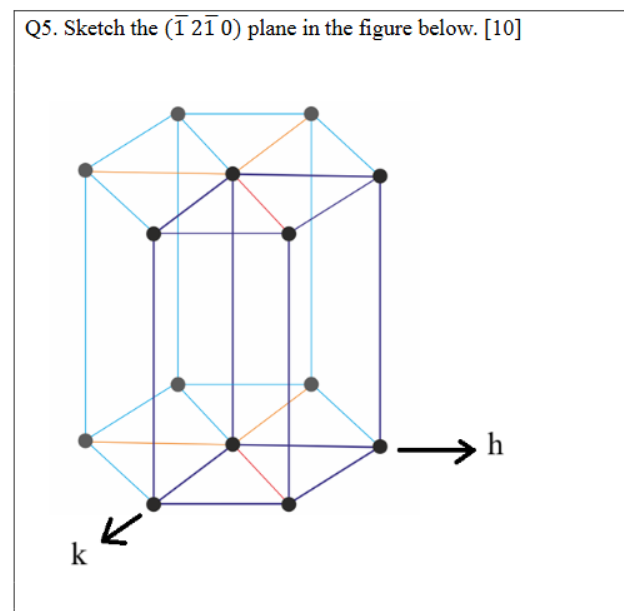 Q5. Sketch the (1 21 0) plane in the figure below. [10]
Jil —>h
LK
This is AI generated Response.
Asked by: Alok Kumar
Created at: 2026-01-27 04:12:40
Asked by: Alok Kumar
Created at: 2026-01-27 04:12:40
Final Answer:
Rendered
Raw Text
Did you like this answer?
# Explanation of the (1̅ 2 1̅ ) Plane in a Hexagonal Lattice
Let's break down **how to sketch and understand the (1̅ 2 1̅ ) plane** in the hexagonal close-packed (HCP) crystal structure shown in your image.
## 1. **Understanding Miller-Bravais Indices (h k i l)**
- **h, k, i, l** are the Miller-Bravais indices for hexagonal crystals.
- For the plane (1̅ 2 1̅ ):
- **h = -1**
- **k = 2**
- **i = -1**
- **l = **
The last index (**l**) refers to the direction along the *c-axis* (vertical axis in the drawing). Since **l = **, the plane is **parallel to the c-axis** (it doesn’t cut the height of the prism).
## 2. **Plotting the Plane**
### Step 1: **Identify Axes**
- **h** and **k** are shown in the image.
- The **i** direction is calculated by: \( i = -(h + k) \).
- In hexagonal geometry, the three axes (a₁, a₂, a₃) are at 120° to each other in the base plane.
### Step 2: **Find Intercepts**
- **Intercepts** are found by taking the reciprocal of the indices (ignoring signs for now):
- Along **a₁ (h)**: intercept at \(-1\)
- Along **a₂ (k)**: intercept at \(1/2\)
- Along **a₃ (i)**: intercept at \(-1\)
- Along **c (l)**: intercept at ∞ (since l=), so **no intercept on the vertical axis**.
### Step 3: **Draw the Plane**
- On the **base hexagon** (bottom face):
1. **From the origin**:
- Move **-1** unit along **h (a₁)** (this is one unit in the negative h direction).
- Move **2** units along **k (a₂)** (this is two units in the positive k direction).
- Move **-1** unit along **i (a₃)**.
2. **Connect these points** on the hexagonal base.
- The plane will **cut through the corners** in a diagonal fashion on the bottom hexagon, and since l=, this plane will be **vertical** (parallel to the c-axis).
## 3. **Visual Summary**
- **The (1̅ 2 1̅ ) plane** is a vertical plane that:
- Passes through the corners as described above.
- Stays parallel to the c-axis (vertical axis).
- You would shade the region connecting those intercepts in the base hexagon and extend vertically upwards.
---
### **In Your Diagram**
1. **Start at one corner** of the base hexagon.
2. **Count -1 step along h (to the left, if h is rightward)**.
3. **Count +2 steps along k (up/left, depending on your orientation)**.
4. **Count -1 step along i (down/right, at 120° to h and k)**.
5. **Connect these points**—that’s the trace of the (1̅ 2 1̅ ) plane on the base. Draw a vertical plane passing through this trace up the height of the prism.
---
## **Summary Table**
| Index | Direction | Intercept |
|-------|-----------|-----------|
| h | a₁ | -1 |
| k | a₂ | 2 |
| i | a₃ | -1 |
| l | c | ∞ |
---
## **Tip**
- In exams, **highlight or shade** the plane you traced for clarity.
If you'd like, I can sketch this for you if you upload a blank version of the lattice! Let me know if you want a step-by-step drawing.
📢 Instructions:
- Ask anything relatd to above question only.
- For new Question goto :