 VIPSolutions
Act like a helpful tutor and exlain me :Q4. Continuous Probability (PDF based) A continuous random variable X has pdf flz)=ka®, 0
Question:
Act like a helpful tutor and exlain me :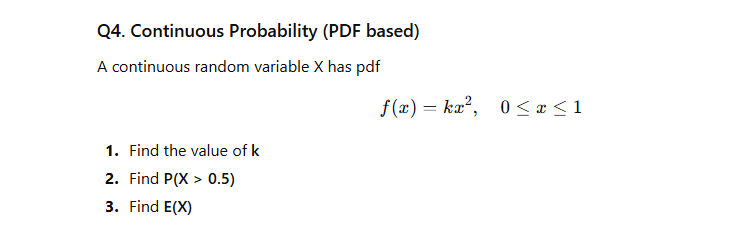 Q4. Continuous Probability (PDF based)
A continuous random variable X has pdf
flz)=ka®, 0
This is AI generated Response.
Asked by: Alok Kumar
Created at: 2026-02-03 12:30:35
Asked by: Alok Kumar
Created at: 2026-02-03 12:30:35
Final Answer:
Rendered
Raw Text
Did you like this answer?
Let's break down the solution step by step.
---
## Given PDF
\[
f(x) = kx^2, \quad \leq x \leq 1
\]
---
## 1. Find the Value of \( k \)
A probability density function (PDF) must integrate to 1 over its domain:
\[
\int_{}^{1} f(x) \, dx = 1
\]
\[
\int_{}^{1} kx^2 \, dx = 1
\]
Let's solve this integral:
\[
k \int_{}^{1} x^2 \, dx = 1
\]
\[
k \left[ \frac{x^3}{3} \right]_^1 = 1
\]
\[
k \left( \frac{1^3}{3} - \frac{^3}{3} \right) = 1
\]
\[
k \left( \frac{1}{3} \right) = 1
\]
\[
k = 3
\]
---
## 2. Find \( P(X > .5) \)
\[
P(X > .5) = \int_{.5}^{1} f(x) \, dx
\]
\[
= \int_{.5}^{1} 3x^2 \, dx
\]
\[
= 3 \left[ \frac{x^3}{3} \right]_{.5}^{1}
\]
\[
= \left[ x^3 \right]_{.5}^{1}
\]
\[
= (1^3) - (.5^3)
\]
\[
= 1 - .125 = .875
\]
---
## 3. Find \( E(X) \) (Expected Value)
\[
E(X) = \int_{}^{1} x f(x) \, dx
\]
\[
= \int_{}^{1} x (3x^2) \, dx
\]
\[
= \int_{}^{1} 3x^3 \, dx
\]
\[
= 3 \left[ \frac{x^4}{4} \right]_^1
\]
\[
= 3 \left( \frac{1}{4} - \right)
\]
\[
= \frac{3}{4}
\]
---
## **Summary Table**
| Part | Solution |
|--------------|---------------------------------------------|
| 1. \( k \) | \( 3 \) |
| 2. \( P(X>.5) \) | \( .875 \) |
| 3. \( E(X) \) | \( .75 \) |
Let me know if you want to see step-by-step calculations or explanations!
Question:
in details with theory alos
This is AI generated Response.
Asked by: Alok Kumar
Created at: 2026-02-03 12:34:35
Asked by: Alok Kumar
Created at: 2026-02-03 12:34:35
Final Answer:
Rendered
Raw Text
Did you like this answer?
# Continuous Probability and PDF
In this tutorial, we will explore a continuous random variable with a probability density function (PDF). We will find the normalization constant \( k \), calculate the probability \( P(X > 0.5) \), and determine the expected value \( E(X) \).
## Given PDF
The PDF of the continuous random variable \( X \) is given as:
\[
f(x) = kx^2, \quad 0 < x < 1
\]
### Properties of a PDF
A valid PDF must satisfy two conditions:
1. **Non-negativity**: \( f(x) \geq 0 \) for all \( x \) in the domain.
2. **Normalization**: The integral over the entire space must equal 1:
\[
\int_{-\infty}^{\infty} f(x) \, dx = 1
\]
### Step 1: Find the Value of \( k \)
To find \( k \), we will integrate the PDF over its domain:
\[
\int_{0}^{1} f(x) \, dx = 1
\]
\[
\int_{0}^{1} kx^2 \, dx = 1
\]
Calculating the integral:
\[
k \int_{0}^{1} x^2 \, dx = k \left[ \frac{x^3}{3} \right]_{0}^{1} = k \left( \frac{1^3}{3} - 0 \right) = k \left( \frac{1}{3} \right)
\]
Setting this equal to 1:
\[
k \left( \frac{1}{3} \right) = 1 \implies k = 3
\]
---
### Step 2: Find \( P(X > 0.5) \)
To find the probability that \( X \) is greater than 0.5:
\[
P(X > 0.5) = \int_{0.5}^{1} f(x) \, dx = \int_{0.5}^{1} 3x^2 \, dx
\]
Calculating the integral:
\[
= 3 \left[ \frac{x^3}{3} \right]_{0.5}^{1} = \left[ x^3 \right]_{0.5}^{1}
\]
\[
= (1^3) - (0.5^3) = 1 - 0.125 = 0.875
\]
---
### Step 3: Find \( E(X) \) (Expected Value)
The expected value \( E(X) \) is calculated as follows:
\[
E(X) = \int_{0}^{1} x f(x) \, dx = \int_{0}^{1} x (3x^2) \, dx = \int_{0}^{1} 3x^3 \, dx
\]
Calculating the integral:
\[
= 3 \left[ \frac{x^4}{4} \right]_{0}^{1} = 3 \left( \frac{1^4}{4} - 0 \right) = 3 \left( \frac{1}{4} \right) = \frac{3}{4}
\]
---
## Summary
| Part | Solution |
|--------------|---------------------------------------------|
| 1. \( k \) | \( 3 \) |
| 2. \( P(X > 0.5) \) | \( 0.875 \) |
| 3. \( E(X) \) | \( 0.75 \) |
### Conclusion
We have successfully found the normalization constant \( k \), the probability \( P(X > 0.5) \), and the expected value \( E(X) \) for the given PDF. If you have any further questions or need additional explanations, feel free to ask!
Question:
VIPSearch Google Advanced AI Help An Ex ia temperature - transmitter loop ( barrier blue IS cable sensor ) being documented. a ) What is the Items that must appear in the Descriptive System Documents DSD ( mention at least four items ) ( 2 marks / Item ) b ) Explain why the cable - parameter calculation is mandatory ( 4 mat
This is AI generated Response.
Asked by: Alok Kumar
Created at: 2026-02-03 15:28:22
Asked by: Alok Kumar
Created at: 2026-02-03 15:28:22
Final Answer:
Rendered
Raw Text
Did you like this answer?
# Documentation for Descriptive System Documents (DSD)
When documenting a temperature transmitter loop with a barrier blue IS cable sensor, several key items must be included in the Descriptive System Documents (DSD).
## A. Required Items in DSD
1. **System Overview**:
- A brief description of the overall system, including its purpose and functionality.
2. **Component Specifications**:
- Detailed specifications for each component, such as the temperature transmitter, barrier, and sensor, including model numbers and technical parameters.
3. **Wiring Diagrams**:
- Clear diagrams illustrating how components are connected, including cable types, lengths, and termination points.
4. **Calibration Procedures**:
- Instructions on how to calibrate the system, including any tools required and steps to follow for accurate measurements.
---
## B. Importance of Cable Parameter Calculation
### Reasons for Mandatory Cable Parameter Calculation:
1. **Safety Compliance**:
- Ensures that the cable and components meet safety standards for Intrinsic Safety (IS) applications, preventing potential hazards such as electrical sparks.
2. **Signal Integrity**:
- Proper calculation helps to maintain signal quality over distance, ensuring accurate temperature readings and system performance.
3. **System Reliability**:
- Identifying the correct cable specifications reduces the risk of failures due to incorrect voltage drop or heat generation, which can compromise system reliability.
4. **Regulatory Requirements**:
- Compliance with industry regulations often mandates that all electrical installations undergo thorough parameter calculations to ensure safety and functionality.
---
Feel free to ask if you need more detailed information or clarification on any of these points!
Question:
Summary
This is AI generated Response.
Asked by: Alok Kumar
Created at: 2026-02-03 15:32:10
Asked by: Alok Kumar
Created at: 2026-02-03 15:32:10
Final Answer:
Rendered
Raw Text
Did you like this answer?
# Summary of Key Concepts
This document covers two topics: the calculation of probabilities and expected value for a continuous random variable with a given PDF, and the essential items for Descriptive System Documents (DSD) in temperature transmitter loop documentation.
## Continuous Probability with PDF
### Given PDF
The probability density function is defined as:
\[
f(x) = kx^2, \quad 0 < x < 1
\]
### Key Calculations
1. **Value of \( k \)**:
- Found using normalization of the PDF:
\[
k = 3
\]
2. **Probability \( P(X > 0.5) \)**:
- Calculated as:
\[
P(X > 0.5) = 0.875
\]
3. **Expected Value \( E(X) \)**:
- Calculated as:
\[
E(X) = 0.75
\]
### Summary Table
| Part | Solution |
|-----------------|--------------|
| 1. \( k \) | \( 3 \) |
| 2. \( P(X > 0.5) \) | \( 0.875 \) |
| 3. \( E(X) \) | \( 0.75 \) |
---
## Descriptive System Documents (DSD) for Temperature Transmitter Loop
### Required Items in DSD
1. **System Overview**: Description of the system's purpose and functionality.
2. **Component Specifications**: Detailed specs for each component, including model numbers.
3. **Wiring Diagrams**: Diagrams showing connections, cable types, and lengths.
4. **Calibration Procedures**: Instructions for calibrating the system accurately.
### Importance of Cable Parameter Calculation
1. **Safety Compliance**: Prevents hazards in Intrinsic Safety applications.
2. **Signal Integrity**: Maintains quality for accurate temperature readings.
3. **System Reliability**: Reduces risk of failures due to incorrect specifications.
4. **Regulatory Requirements**: Ensures compliance with industry standards.
---
If you have further questions or need more details, feel free to ask!
📢 Instructions:
- Ask anything relatd to above question only.
- For new Question goto :